Maulik Sailor (00:10)
folks who are joining us on LinkedIn, the drill this happens like fairly regularly, and we wanna just make sure that we are not we we don't have any problem with LinkedIn in particular. So, anyways, to everyone who is joining us today.
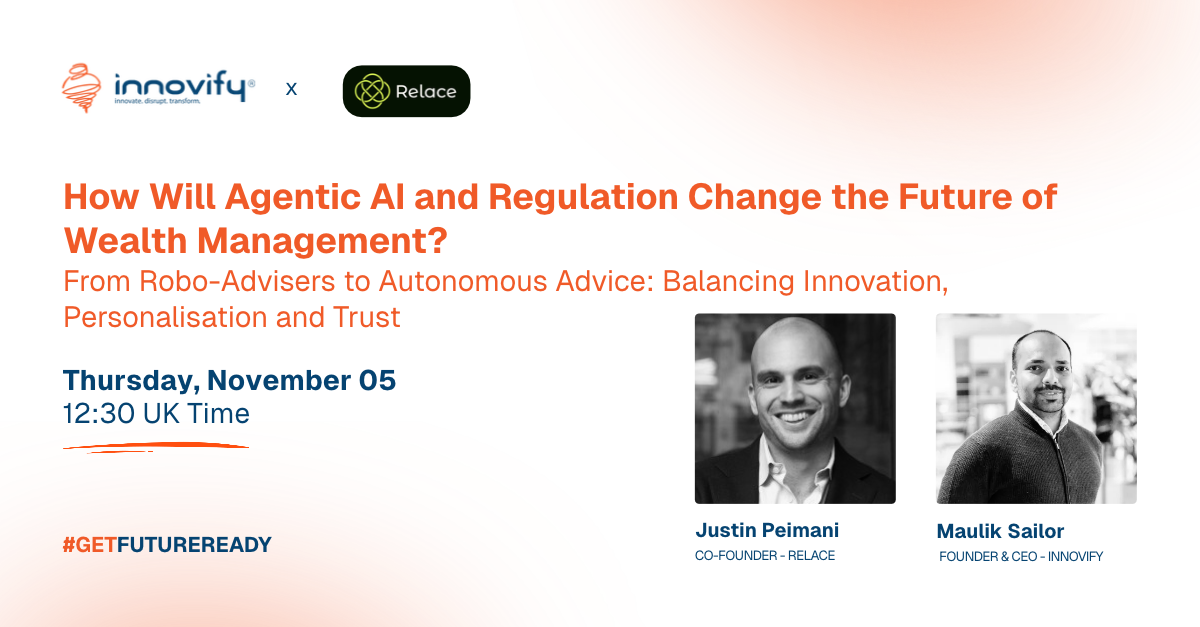
for the brand new episode of Get Future Ready with Innovify we talk about the latest at the intersection of FinTech, AI, and e commerce. We have been running this series around regulations and compliance. We had three prior episodes with co founders of of Relace which is a a UK based startup, offering compliance solutions to their enterprise customer.
We had Justin before as as one of our speaker. We also had his co founder, Lyubomira, as speaker at two of the episode. but before we dwell into more into the topic today, let me just welcome Justin first to our podcast. Justin, welcome again. thanks, great for you for us to have you here today. How you been?
Justin Peimani (01:08)
Great, great. It's great to be with you guys again. We always enjoy these conversations, so I'm looking forward to this one.
Maulik Sailor (01:14)
Yeah, great. And just to remind the audience, I think you between our last episode and now there is a big announcement that you got to make.
Justin Peimani (01:22)
Yes, so thanks for bringing it up. So between the last one and this one, so we announced our fundraise. So we raised a pre-seed round of 1.6 million. The number of wonderful VCs in there boost capital ascension Coro as well as angels from Morgan Stanley, JP Morgan, Barclays, and OpenAI as well. So we're a wonderful group of investors that are supporting us in everything that we do. So I'm very, very happy.
Maulik Sailor (01:46)
That's that's the wonderful news. particularly having great angels on your cap table, goes a long mile.
Justin Peimani (01:51)
Yeah.
Maulik Sailor (01:52)
and so really congratulations for that.
Justin Peimani (01:55)
Thank you.
Maulik Sailor (01:56)
and just just for us to recap, and for the audience who may be joining us first time today, can you just give a quick intro about your background as well as about your company?
Justin Peimani (02:06)
Yeah, yeah, absolutely. So I'm a lawyer by training. I qualified in New York, and I've spent the last 10 years of my career building software companies and mostly focused in and around financial services. So I've worked with banks, I've worked with hedge funds, I've worked with asset managers, wealth managers, which we'll talk about today, as well as fintech. So I've seen quite a variety. And when Lubomir and I came together to start
relace it really came from what we saw across a number of our different customers. And that was really that regulation is pervasive, it's everywhere, and it's only growing. And the challenge that firms have is how to manage it. Because there's a shortage of talent, a lot of the systems that they have are pen and paper or spreadsheets and are very siloed. So it's very challenging for organizations to move at the pace that they want to move.
So that's the reason for Relace. And what we have is a series of products, starting with our consumer duty solution, but we have others as well, that help firms to really make sense of the rules that apply to them, apply them within the context of their business, and then ultimately enable the teams to move faster. Because it's not just about compliance, it's about product, it's about sales, it's about marketing. Everyone has different needs. And so we build solutions to help everyone move faster and at the pace that they want to grow at.
Maulik Sailor (03:25)
Yeah, that's pretty good, Justin. I wanna do a small sidestrap because a question I had, which I never asked you actually, you or Lubomira, right? you both basically went through Antler. but the question I have is did you guys meet before Antler or at Antler Cohort?
Justin Peimani (03:39)
So it's a good question and you've done your research on that one. So we were both advisors to Antler portfolio companies. So we both have relationships with Adam and the team there. So we actually met before that. So we met at an event in London that was focused on executives and senior operators in and around tech and fintech. And we just started talking. We started talking about
where we saw software going, where we saw opportunities in the market, where we saw challenges. And then very quickly we realized that we had a lot of the same interest. And so over about a year to year and a half, we just kept having those conversations. And then it became very clear that when we want to start a company, there's only one person that we wanted to call to do that. And so working with her every day, and you've met her, she's a force of nature,
incredible, incredible technical mind, incredible mind for product. And so I learned a lot from her every day.
Maulik Sailor (04:31)
Yeah, that's pretty good. You know what? I have spoken to her many times, but I have never met her in person. Did you know that?
Justin Peimani (04:37)
We'll have to change that.
Maulik Sailor (04:38)
yeah, hopefully soon, right? but just talking of the co founding journey, of course I've been true and as well in the past. and I had my my share of good and bad co founders, so having one great co founder with you is I would say is
It's one of the biggest problems solved, being a founder, right?
Justin Peimani (04:56)
Yeah, sure.
Maulik Sailor (04:57)
and I think just reflecting back on on my experience, yes you can have, sometimes not so not so great co founder, sometimes you get amazing co-founder, but then, life happens, things happen beyond your control and so forth. And
Justin Peimani (05:07)
Yeah.
Maulik Sailor (05:10)
so I've been through some of that. and I always feel that, having a great co-founder with you and both of you hustling the early stages.
is one of the best I would say working relationship that you can have. And I think best to probably, you want to make your early stage startup time to be more enjoyable, more fun to work with with your co
Justin Peimani (05:29)
Hmm.
Maulik Sailor (05:30)
founders. I think for you both to be able to work together and make this happen is I think is amazing, right? I'm actually doing a talk with Seed Legals in a couple of weeks' time.
Justin Peimani (05:38)
Mm-hmm. Yeah. Yeah.
Maulik Sailor (05:39)
about co-founder journeys, right?
and one of the biggest reasons for startup failure is actually co-founders. Right.
Justin Peimani (05:47)
Absolutely.
Maulik Sailor (05:48)
so congratulations for that for both being a great founding team but as well as for your fundraising. Right. Cool.
Justin Peimani (05:55)
Thank you. Thank you.
Maulik Sailor (05:56)
now let's summarize what we're going to talk today. Right. So we had a few sessions now
to talk different aspects of compliance, innovating beyond compliance,
Justin Peimani (06:07)
Yep.
Maulik Sailor (06:08)
how do you really take consumer duty of care and few other topics that we have spoken earlier. But there is one area that we felt that we missed out earlier,
Justin Peimani (06:17)
Mm.
Maulik Sailor (06:17)
where, it's obvious you got to have tons of compliance within that. but what's changing, right? And I think that's what we want to talk about. And the segment we wanna pick up today is
wealth management right now wealth within the wide fintech sector you got plenty of stuff going on and wealth to my mind is a segment which is there but not really mainstream right and
Justin Peimani (06:43)
Mm, yeah. Yeah.
Maulik Sailor (06:45)
there is less you can do within that how much can you innovate in that space right so there's always
a a question about that. Okay, what new can you bring to it? And I think the reason why you can't bring a lot to it is probably very heavy regulations.
Justin Peimani (06:59)
Hmm, is it? Yeah. You got it?
Maulik Sailor (06:59)
Right.
so I wanna rewind a few years back, right, before we dwell into the topic. Now wealth management historically was very much relationship driven, right? So your wealth manager, right? you wouldn't really open up your books if you don't really see him in person or trusted him
Justin Peimani (07:19)
Yeah.
Maulik Sailor (07:20)
with your life effectively, right?
Justin Peimani (07:22)
Yeah, good.
Maulik Sailor (07:23)
and
Then it changed, to online platforms and so forth. But again, online platforms were always secondary to this whole in-person relationship.
Justin Peimani (07:31)
Yeah. Yeah.
Maulik Sailor (07:35)
And then came the world of RoboAdvisory. Right? There was a time, I think about ten, fifteen years ago, where
Justin Peimani (07:42)
Mm-hmm.
Maulik Sailor (07:43)
Robo Advisory is gonna take over the whole wealth management space.
Justin Peimani (07:45)
Yeah.
Maulik Sailor (07:46)
you have AI and algorithms basically.
helping you select your wealth management strategy, helping you like run everything and that's the future. So but that did not really happen. Yes, you got your rebo advisors, but they are still secondary to your main product, right? And I think the main product in wealth management, again as an outsider, I think the number one product there is trust.
Justin Peimani (08:09)
Mm-hmm.
Maulik Sailor (08:10)
And number two is performance.
Justin Peimani (08:12)
Mm-hmm.
Maulik Sailor (08:13)
Right?
And performance is related to risk, right? and then within all that, the consumer services, like your customer relationship and personal services that you can offer basically is what really make or break. You can build the best platform, but you don't really have that, that connection with your customer, you're not gonna really make it, right? so I wanna summarize all of that.
And ask you a question that, with your experience, right? If you were to take, some lessons learnt, good or bad from this whole last fifteen or twenty year of robot advisory,
Justin Peimani (08:46)
Yeah.
Maulik Sailor (08:46)
what what what would that be?
Justin Peimani (08:48)
Yeah,
it's a really good question. And so we actually held a roundtable recently with wealth managers just on this topic and to talk through. So I think there's a couple of things in there. think so the whole concept behind robo advisory is that if we bring wealth management onto a digital platform and onto your mobile phone, then all of a sudden that will open up access and more and more people will begin to invest.
and they'll engage and they'll manage their finances, they'll manage their wealth. And so the pool of potential clients in that industry would grow. And that hasn't really happened. When you look at the data over the last 20 years, there's hardly any change in terms of the number of people who are accessing public markets. In the US, it typically hovers around 60%. In the UK, it typically hovers around 20%. There's all kinds of reasons for that.
I would say with that generation of companies like a Robin Hood, like a Nutmeg, like an E-Trade also, if you want to go down that path, what they all got right was there was a different experience that certain demographics wanted to have. If you're Robin Hood, that's going towards a younger demographic that wants to learn more about finance, that wants to manage their money, and they just don't want to go into a bank to do that. They want to do that on their own. So the tooling was there for them to do that. So I think
That was one kind of success point of it. And you see what's happened to some of those companies. JPMorgan has acquired assets in this space. Morgan Stanley has acquired assets in this space. And a lot of the banks have different technology platforms now. I think what didn't happen is, it's interesting to think about why, is it why aren't there more people investing in the public markets and managing their wealth more actively when you have all this tooling there?
And it comes back to a few of elements that you mentioned, right? It's number one, there's trust, there's performance, and there's another one that I would add in there, which is expertise, right? Because when you're talking about wealth, you're talking not only about the investments that you hold today, but what's going to happen to those investments when you're no longer here.
How are they going to be passed down to your children, depending on how much you have, what are the tax implications of that? How is that going to be passed along? And what are the services that you're going to need to make sure that your family is secure after that or that they're not hit with a very large inheritance bill? And that's typically some of the services that, particularly the Swiss private banks, have been very, very good at delivering. And that hasn't really come up with a lot of the robo advisors yet.
So when you look at the last 20 years or so, you can think about these new experiences, we can access, we can invest online on our phones better. So that's changed and that's a good thing. But you still don't see the access question. And I think that's when you think about the technologies that are coming out now and what AI can start to do is you can start to go down that path. How much expertise can I bring to someone on their phone directly without having to meet someone?
what kind of experience can I give someone that's maybe different, that would bring them in as a client, they wouldn't otherwise think about.
Maulik Sailor (11:51)
Cool, understood. and thinking out loud on on that front, right? Robot advisory was there, people started use more as an like ancillary to the main product.
Justin Peimani (12:03)
Hmm.
Maulik Sailor (12:04)
And also in some scenarios, the main product, right?
Justin Peimani (12:07)
Yep. Yep.
Maulik Sailor (12:09)
And then behind wealth management, you also have
your performance analytics, right? So collecting a lot of performance data, trying to optimize your portfolio and all of those things.
Justin Peimani (12:18)
Yeah.
Maulik Sailor (12:19)
And they also had predictive technologies, right? That okay, let's try to predict the market and outbeat the market. And a lot of people tried building that. that okay, we're gonna
Justin Peimani (12:29)
Yeah.
Maulik Sailor (12:30)
build a data model,
Justin Peimani (12:32)
Yeah.
Maulik Sailor (12:32)
build a time series and see what's gonna happen next, right? And sentiment analysis, blah blah blah, right?
So wealth management as a whole, and there's of course there's a there's an extra market trading and all the other technologies as well that as an expert, but I'm not gonna
Justin Peimani (12:46)
Sure.
Maulik Sailor (12:47)
touch that. But wealth management as a whole was probably one of the heavy adopter of all this underlying AI technology, like data modeling, data
Justin Peimani (12:58)
Hmm?
Maulik Sailor (12:59)
cleansing, machine learning, predictive models,
artificial intelligence to a level, thematic investment, whatever, it
Justin Peimani (13:07)
Mm-hmm.
Maulik Sailor (13:08)
was one of these early adopter of quite a handful of AI models and so forth, right? And it would be natural for us to think that okay, given with all the disruptions that's happening in the space, open AI, ChatGPT, LLMs, and suddenly everyone in the world is talking about AI, AI, AI into every single
Justin Peimani (13:29)
you
Maulik Sailor (13:29)
thing that we do.
What do you think? What has changed for wealth management in particular?
Justin Peimani (13:34)
Yeah.
Maulik Sailor (13:36)
have I mean, I have not really seen anything major come out. Right?
Justin Peimani (13:40)
Yeah.
Maulik Sailor (13:41)
So it's it feels a little bit ironic. What what's your view?
Justin Peimani (13:43)
Yeah, yeah, it's a good question. So I think there's two categories that we have to talk about here, right? So there's client facing AI technologies and solutions, and then there's non-client facing solutions. So what we tend to see is the client facing ones. So one example of this is Lloyds, right? Lloyds is having a big drive into the mass affluent segment. So these are clients that typically would not come to wealth managers. So they might have
a few hundred thousand saved up, liquid investable assets that they're looking for more expertise on. So there's a big push into that. So I think we see a lot of AI capabilities going there. It's like how you deliver personalization at scale. And that's a phrase that you hear a lot within wealth managers that are going after that demographic. The other side of it where you see a lot more change, and the wealth managers that we speak to really focus on this area, it's how do you think about
client onboarding? How do you think about enabling the relationship manager to meet with a customer and deliver on the expectations that that client has? How does compliance manage the volume?
of regulatory change that comes through that they have to then enable the organization on. How does finance deal with all the assets? So you can go through that spectrum and that's where lot of the investments are being made right now. And it's everything from using copilot to just, you you do a little bit more analysis within an Excel sheet to kind of full internal build systems that some of the private banks are using to perform suitability assessments. Because that's going to one area where
are looking at and saying, what, if you're providing tailored advice, we have to make sure that that advice is suitable because you are, someone is trusting you, right, with their, with what they've accumulated over their life. And if something goes wrong, they really do have to understand what the risks are and enter those risks fully with full knowledge of what they are. So you're seeing a lot of development there.
in the back office, in the middle office that doesn't necessarily make its way to us. But that's going to really where the bulk of the investment is gone. And the firms that we speak to, that's what they're most excited about. I think whenever there's a new wave of technology, we get really excited about the frontiers and what things can happen and open AI solving math problems. But we forget how much of work is still heavily manual.
right? And still documents. I was speaking to one relationship manager at a large Swiss private bank a few weeks ago and said, look, 50 % of my day is filling out forms. Whether I'm bringing on a new client or I'm looking to expand my relationship with an existing client, there's constant forms that we have to fill out. And so if some solutions can be built just to digitize that,
That's already an improvement in the service that that RM can then provide, which ultimately should lead to more business. So that's why they tend to focus
there.
Maulik Sailor (16:33)
Yeah. So you kind of sparked a question there. That
Justin Peimani (16:35)
Hmm.
Maulik Sailor (16:36)
isn't like, the promise of AI, particularly these LLMs, right? Is
Justin Peimani (16:40)
Yeah.
Maulik Sailor (16:41)
to remove all this clerical admin away from human and let AI do that, right? So you
Justin Peimani (16:45)
Yeah.
Maulik Sailor (16:46)
got transcribing apps, you got, these form filling apps, the repeatable process where you just need like brokers, they just need to call and ask the same question to every single customer they speak, can you get it AI to do that and all?
So in your engagement, when you talked with the investment or relationship manager,
Justin Peimani (17:02)
Yep.
Maulik Sailor (17:03)
are they are they doing anything about it? Are they proactively adopting AI to remove all that admin burden and have more time available to speak to their end clients?
Justin Peimani (17:14)
Well, they certainly want to. They certainly want to. And I think the rate at which a firm is going to adopt those will depend on, number one, the size, and then number two, the types of clients that they work with. If you work for a private bank and you service primarily ultra-high net worth clients, so clients that have 30, 50, 100 million investable assets, the way that you're going to think about that is going to be quite different.
because your focus is, okay, how do I make the experience as seamless as possible and how do I deliver the expertise in a way that that client can consume quickly because they tend to be people that don't have a lot of spare time. So every minute that I have with my client, that's valuable. And so I have to optimize that. any technology that's gonna help me deliver that experience, I'm gonna invest heavily behind it and a lot of private banks are doing that. When you start to look at firms that are
not catering to that demographic and going a little bit, down in the wealth scale, those firms, they're also making investments, but they're going to tend to focus a little bit more on the client facing side. Right. So they'll say, okay, how do I make it easier for my client to engage with me? Right. How do I provide the information to them? Because in many of those cases, the client has a couple hundred thousand investable assets, right. They may be thinking about investment for the first time. Right.
they may be entering the public markets for the first time and they'll need a bit of guidance in terms of, how do I think about this for the next 20 years so that my children don't have to worry about money in the same way that I did? So the kinds of questions and the kinds of service that you need are different. So the firms then adapt to that and they try and make investments differently. But obviously at that scale, what you're gonna roll out is gonna be very different than the kinds of tests that you can run if you're with one client at a time.
Maulik Sailor (19:00)
An alternative school of thought is
Justin Peimani (19:02)
Mm.
Maulik Sailor (19:02)
like really putting AI or AI agent in front of the end client. So do you see a
Justin Peimani (19:07)
Yep. Yeah.
Maulik Sailor (19:09)
world or a solution where there's no humans involved, right from customer relationship to presenting all the information to
Justin Peimani (19:14)
Yeah.
Maulik Sailor (19:17)
adopting or adapting to the the customer's, investment strategy or wealth management strategies
Justin Peimani (19:23)
Yeah.
Maulik Sailor (19:24)
and building the portfolio as well as reporting on those portfolios.
Justin Peimani (19:27)
Sure,
sure.
Maulik Sailor (19:28)
plus all
the regulations around that. Do you think this kind of companies can exist purely on AI or agentic workers without any human involvement?
Justin Peimani (19:37)
You mean wealth managers or people doing it themselves?
Maulik Sailor (19:40)
this this
whole let's say wealth management space. And what to help you out? let's let's narrow it down to everyday investor, people
Justin Peimani (19:45)
Yeah. Sure.
Maulik Sailor (19:47)
typical upper middle class people who are looking to grow their wealth.
Justin Peimani (19:51)
Yeah, yeah, look, look, I think there's a place for that, right? And I think we all know people who put their finances into chat GPT or Claude and say, OK, what can I do better? What are some investments that make sense for me? So people are doing that today. I think the gap that exists today, and I was just looking at the polling data earlier.
which is there's still a 50 percentage point difference in trust between a person and AI when it comes to financial advice. So that gap will close in the same way it closed with the internet and same way it closed with mobile. So people will trust AI more and more and more as they use it more and they rely on it more. But there's still that big gap. So there will be a demographic today that says, what, I don't want to deal with the human. And particularly people in technology.
who develop the systems, understand how they work, understand the biases that are intrinsic in them, understand where they go wrong and use it as a tool. So there's definitely a market for that. Is that going to be 80 % of the market? I think unlikely in the short term, but over time, it's only a matter of time until these experiences become more more digital and there are people.
Maulik Sailor (20:57)
Yeah, this is like, you know,
this self-checkout you see in supermarkets, right?
Justin Peimani (21:01)
Yeah.
Maulik Sailor (21:01)
In the beginning people like hated it. They maybe used it because or out of curiosity or whatever.
Justin Peimani (21:08)
Yeah.
Maulik Sailor (21:08)
Now you see completely the other way around, people hate it because now they're doing the work for the supermarket without really getting paid
Justin Peimani (21:14)
Exactly.
Maulik Sailor (21:16)
for it. but then they also like it because okay, I can just pick stuff I want without having any small talk and just, walk out
Justin Peimani (21:22)
Yeah.
Maulik Sailor (21:22)
of this store, right?
Justin Peimani (21:23)
Yeah.
Maulik Sailor (21:23)
So you
you see people on both ends of the spectrum.
Justin Peimani (21:26)
too.
Maulik Sailor (21:26)
And within wealth management, so what what do you think is a sweet spot?
Justin Peimani (21:32)
Hmm.
Maulik Sailor (21:33)
Maybe let's say near future, long term, who knows? But near future, let's say next twelve months.
Justin Peimani (21:36)
Yeah. Yeah.
Maulik Sailor (21:38)
what do you think the right balance looks like?
Justin Peimani (21:42)
I think so. So to me, the right balance is really about two things, right? It's about the administrative burden that the organization carries and the ability to deliver an experience to the end client. So those are going to be the two areas that I think are most ripe for disruption. And a lot of the wealth managers that we speak to of all different shapes and sizes will tell you just the processes are heavily manual.
So wherever we can bring in AI to add efficiency, and we're even talking about just filling out forms, right? Like documents together, right? Bringing together data across different systems to then feed in to a suitability assessment as an example, or offboarding clients.
These are all use cases where we're starting to see firms either develop those tools internally or go to vendors outside. In our world, we're very focused on the compliance and the regulatory elements. In wealth management in the UK, the...
The two key words right now are consumer duty. Because of a lot of what's happened over the summer with some high profile firms and of receiving some significant fines and the consequences of that. So every firm is really looking at what is the experience that they're delivering to their end client and how does that meet the outcomes that that client is looking for because the regulator is holding them accountable to that.
So that's been a very, very big area in wealth management. And then extending it into the client experience. If you're a firm that goes to market through advisors, it's how do you enable that advisor with the right information? Because an advisor that has, let's just say, a mobile app that tells them exactly who their client is, what their needs are, what they're looking for, what their priorities are in their life, they can provide much better advice and guidance. So they don't need to spend as much time with the client, and that time is high value.
So one advisor can go from having five or six clients or 10 clients to having 100 potentially, right? And that's the real opportunity. So if we're talking about the next 12 months, and if I were a wealth manager, those would be the two things that I would focus on is how do I better enable my RMs and my advisors to get more clients on their books and to do that quickly and deliver the same quality of experience? And then how can I reduce the burden on the organization behind that?
Maulik Sailor (23:53)
Yeah. Taking the scenario of fully agentic wealth management space, right? Let
Justin Peimani (23:57)
Yeah.
Maulik Sailor (23:58)
the whole end to end spectrum of wealth management done through AI agents, right?
Justin Peimani (24:02)
Yeah.
Maulik Sailor (24:03)
with no human involvement, right?
Justin Peimani (24:05)
Sure.
Yeah.
Maulik Sailor (24:12)
are the current regulations enable that kind of scenarios or or not? And if not, what needs to change?
Justin Peimani (24:19)
Yeah, so very good question there. And I think the FCA has made some recent announcements on this. The regulators are very clear that whether you have an agent acting on your behalf or not, you as a firm are ultimately accountable.
So that's the starting point for that conversation. So any firm that wants to deliver an experience entirely through an agent runs the risk of whatever that agent does. In the same way they run a risk of it, if a person says something that's problematic or doesn't conduct themselves in the right way.
So right now, that's the dynamic. I can tell you that it's something the regulator is looking at very, very closely, both within wealth management and outside, because it's clear to everyone that the technology is here. It can provide value. So there's going to be more more adoption. So how do we make sure that that's safe for the market? Because we are dealing with people's money, and we're dealing with people's livelihoods. So that has to be taken seriously.
The question is, is the regulatory framework, is it set up for this? There is a structure in place for it right now. And we know what the end structure will look like. We'll see a lot more come out. Probably won't be from the FCA. think they've made it very clear that they're not going to become an AI regulator directly. But some of the other regulators are taking a different approach.
Maulik Sailor (25:29)
Cool. just talking of this whole regulatory landscape.
Justin Peimani (25:34)
Hmm.
Maulik Sailor (25:34)
Do you believe UK as an ecosystem is
Justin Peimani (25:37)
Yeah.
Maulik Sailor (25:37)
poised to create this kind of innovation, this kind of wealth tech platform which is completely autonomous, right? Or do you
Justin Peimani (25:46)
Hmm.
Maulik Sailor (25:46)
think there is another another regulatory like region that can that is better posed to do that?
Justin Peimani (25:53)
Yeah, yeah, it's a good question. I'm a little biased here because I'm a London based founder. So I tend to think it's a good ecosystem. I think there's a couple pieces there. think what London does offer is a regulator that's very close to the market and is regularly engaged. So that's good. We have a really deep, deep pool of wealth managers here.
in London as well as family offices, which we haven't talked about so much. So the client base for a wealth tech solution is here, right? And the regulators here actively invest in innovation. So those ingredients are there. Now, if you step back from that and you look at like, where does wealth creation happen most? It's China and the US, right? So just in terms of volume of wealth, like those are the two markets where you'd expect to see just more companies come up.
Now, in those markets, you have to find the same dynamics. So in the US, it's heavily concentrated around New York. And there are companies that are coming up and developing systems, whether it's fully AI native wealth managers, and we're starting to see some of those, or it's companies that are building AI solutions for wealth managers to deliver an experience.
So whether it's back office, front office, middle office, you see those types of companies coming up. I think London should have a good number of those companies because we have everyone within zone one. We have the clients, we have the
Maulik Sailor (27:14)
Yeah.
Justin Peimani (27:14)
regulator, and we have many technologists. So if there's not one, then I'll be disappointed.
Maulik Sailor (27:20)
Okay. And I wanna ask the same question twice for two different sets of end users, right? so let's
say if you're a founder wanting to build a new wealth tech platform, know,
Justin Peimani (27:31)
Yeah.
Maulik Sailor (27:32)
and you being a founder as well as experience in well tech with regulations and everything
Justin Peimani (27:36)
Sure.
Maulik Sailor (27:37)
else, right? what would be your top tip to a founder who let's say wanna build a a new agent tic wealth management?
Justin Peimani (27:45)
Spend time in Mayfair. Spend time in Mayfair would be my number one tip, right? And it's partly a joke and it's partly not because you just have such an incredible density of family offices, of firms that are in a very, very small area, right? So very quickly, just by sitting in a restaurant, you can hear what different people are talking about. You can hear the challenges that compliance has, that risk has, that portfolio managers have.
So you can pick up on all those things. And then once you have a solution that works for one, it's a very, very dense network. So you can build a business fairly quickly. It might take you a little bit more time to get off the ground. But once you are, you should be able to grow quite quickly if you just stay very, close to it. So just stay in Mayfair would be my tip.
Maulik Sailor (28:32)
Okay.
And the same question, but from a different perspective.
Justin Peimani (28:35)
Yeah.
Maulik Sailor (28:35)
That let's say you are an established wealth manager with, a number of clients that you are already serving, you got
Justin Peimani (28:38)
Yeah.
Maulik Sailor (28:41)
enough healthy AUM under you. Let's say fifty million as a ballpark, right?
Justin Peimani (28:43)
Sure.
Maulik Sailor (28:46)
I would like to say more, but let's say fifty million, right, to cover
what? No, I I want to increase the ballpark. I would say, about about hundred million ballpark AUM under you, right?
Justin Peimani (28:54)
Okay.
Maulik Sailor (28:56)
you're showing a number of clients, maybe smaller, upper middle class families or whatever, right? You already have platforms available, you already have maybe a CRM available, a highly personalized C RM available and all that.
Justin Peimani (29:10)
Thank
Maulik Sailor (29:10)
Now again you hear all this, your investment in tech Okay, you got
the last stage of all technology available to you, but now you keep hearing about all this Agentic AI wanting to replace humans and all. What would you do?
Justin Peimani (29:26)
Yeah, I think the, always react a little bit when people talk about like AI replacing humans and the efficiency, because to me that's one part of it. But the part that's more interesting for me is the growth story, right? How am going to use AI in that context of managing a hundred million? It's how am going to find more clients, right? Or how am I going to create the right structure so that my clients place more of their wealth with me? Right.
And those, think, are the areas of biggest opportunities. That'd be the first place that I look. And so if I have relationship managers that are going out building relationships, I think with that kind of AUM, we're talking about doctors, we're talking about professionals. How can I better enable those people? How can I give them more information? How can I give them a better list of people to prospect?
How can I give them more detail on those people so we can provide more tailored advice that's suitable to them? And I think one of the big trends that we haven't really talked about in wealth management is the nature of wealth that's being created now is also different. If you
Maulik Sailor (30:27)
Mm-hmm.
Justin Peimani (30:27)
look at historically, you'd have families that inherited wealth and you'd have the new wealth generation that would come with different waves. Now we're in this AI boom, so there's a lot of wealth that's being created around that.
There's a lot more entrepreneurs, there's professional athletes, there's influencers, and all of these people have very different needs, right? Because if your wealth is primarily created through one asset, which is a company that you build, the risks that you have to think about are different. Your taxation is different than someone who has a high cashflow business that just, like an influencer, for example, that has brand marketing deals. So.
You have to think about what your proposition is and you have the ability now to tailor it. So to me that that'd be where I look. It's who's my client that I want to serve as. How specific can I get in the proposition that I offer to them and then do that as many times as many times as many times. Like that'd be the very first thing before I think about replacing people because the replacing people question doesn't grow my business. What it does do is it can make it more efficient, but I'm always going to say, okay, let's figure out how we grow first.
And then the efficiency, we can do it anytime. And that can be from reducing processes to saying one person can take on more work. And the other thing is as a business owner, and this is something that I don't think many people talk about, is if I can make my existing team more productive, that means I can bring on more people to do more work. So if I get the right people in, then I'll be hiring if I enable
Maulik Sailor (31:51)
Yeah.
Justin Peimani (31:51)
them properly.
Maulik Sailor (31:52)
And I wanna ask a similar risk question, but from a platform
Justin Peimani (31:55)
Yeah.
Maulik Sailor (31:55)
perspective. And I think like let's say AJ Bell UYouInvest is one of the widely used platforms here in the UK, right? And that whole platform experience is around build your own portfolio kind
Justin Peimani (32:07)
Right.
Maulik Sailor (32:08)
of approach, right? But I find, them to be a little bit outdated, know, compared
Justin Peimani (32:12)
.
Maulik Sailor (32:13)
to let's say NutMeg, where Nutmeg is more fine tuned, they build the portfolio, they provide managed services.
Justin Peimani (32:19)
Sure.
Maulik Sailor (32:19)
You know,
performance wise, you're probably gonna get slightly better performance on NutMeg because they're full time wealth managers and
investment managers who are continuously optimizing your portfolio and all that, right?
Justin Peimani (32:29)
Mm-hmm.
Maulik Sailor (32:30)
And so, it's ultimately wealth management with different product offering, right?
Justin Peimani (32:35)
Yep.
Maulik Sailor (32:35)
With completely different experience, right? But both of them has been hugely successful in the UK in serving their respective client base.
If you were let's say a t a CIO chief innovation officer at these companies,
Justin Peimani (32:49)
Yep.
Maulik Sailor (32:50)
right? And again, the same lens, you're seeing all these things happening, you th you think okay, fine, maybe we can make investment into customer relationship, you know, maybe
Justin Peimani (32:58)
Yep.
Maulik Sailor (32:58)
we can invest AI into, portfolio optimization or, mitigating risk or reporting services. Again, what would be your your typical advice to them?
Justin Peimani (33:09)
Yeah, think my typical advice, I tend to be quite boring when I give this kind of advice, which is like, out what's broken and then fix that and then find the next problem and do that. And so if I were a CIO of a wealth manager, like the first thing I'm gonna look at is, okay, what is driving growth? What are the constraints on driving growth? Is it, need to free up time for my RMs? Is it, I need my compliance team to become...
more efficient and be able to take on the higher workload and manage the volume that's coming through them? Is it, need onboarding to be more effective, I need offboarding to be more effective, I need suitability to be conducted in a more seamless way? I would look through those lists of questions and then that would be my menu. And I'd say, okay, what can I either build internally with our own systems or what can I go outside to find a really good vendor that's gonna plug that hole? And I'm gonna work through that list.
because ultimately a lot of what AI is enabling them to do is to do work a lot faster. And so where is that going to give me the highest return? And as a CIO, that's what I care about. It's I have a team, where am I going to allocate those resources and what it's going to give the business? And it has to be the highest ROI. So if I'm looking at that, that'd be the way that I think about it. I tend to shy away from the low hanging fruit kind of solutions.
So everyone knows there's a number of processes that we can optimize and you can get to those. But focus your internal team on the biggest
ones.
Maulik Sailor (34:37)
I'm just looking at the time. we've been talking good part of of the hour,
Justin Peimani (34:41)
Mm.
Maulik Sailor (34:42)
and maybe we need to start wrapping up. But before we wrap up, right? what's next for relays, right? you have razor seed funding.
Justin Peimani (34:48)
Yeah. Sure.
Maulik Sailor (34:50)
What's next for you? we are towards the end of the year. twenty
Justin Peimani (34:53)
Yeah.
Maulik Sailor (34:53)
twenty seven I believe will be a big bang for you. What
Justin Peimani (34:56)
Thank you.
Maulik Sailor (34:56)
is it?
Justin Peimani (34:57)
Thank you. know, we have a saying whenever someone asks us that question, it's build product, sell product. We're very old school in that way. But I think some of the things that we have coming up, which we're really excited about. we have a roundtable coming up in a couple of weeks that we're organizing an operational resilience. So a number of COOs, CCOs that are joining us.
from wealth, from asset management, from a number of different sectors. And we also have a big showcase event with the FCA. So we talked a little bit about the sandbox that we're in there. So we're showcasing our consumer duty solution at the end of the month. So November 25th is a big date for us, which will be a shared big event at the FCA. So that's kind of what the next couple of weeks for us look like.
Maulik Sailor (35:38)
Cool, and what does twenty twenty seven look like?
Justin Peimani (35:41)
Hopefully more product and more sales.
Maulik Sailor (35:43)
Yeah.
are you looking to expand to the US?
Justin Peimani (35:47)
Good question. Good question for us. Nothing that I can announce for you right now. I think there's plenty of work that we're doing right now that we're excited about with our clients here. But we do support multiple jurisdictions. We cover the UK. We cover the EU. done some work for the US and the Middle East as well. And we're going to continue to grow that based on customers. So if a customer tells us, want you to support us in the US, we'll be there for them.
Maulik Sailor (36:10)
That's pretty good. Anyways, I I think with this, I would like to end our our talk for today. thanks a lot, Justine, for joining us for this talk on on wealth management. Congratulations on your
Justin Peimani (36:22)
Thank you.
Maulik Sailor (36:23)
successful raise and all the best wishes for growth of your company.
Justin Peimani (36:26)
Thank
Maulik Sailor (36:27)
And to everyone who is listening in today, if you are looking for any wealth management or compliance related solutions,
Feel free to contact Justine, founder LinkedIn is called with Relace right? and the domain
Justin Peimani (36:38)
It is safe.
Maulik Sailor (36:39)
is relace dot co. feel free to reach out directly to Justine and stay tuned with our community. We will be bringing more episodes like this, generally talking about the impact of AI across the range of fintech segments, Until then, thanks a lot. See you soon. Thank you.
Justin Peimani (36:53)
Thank you. Thank you.