



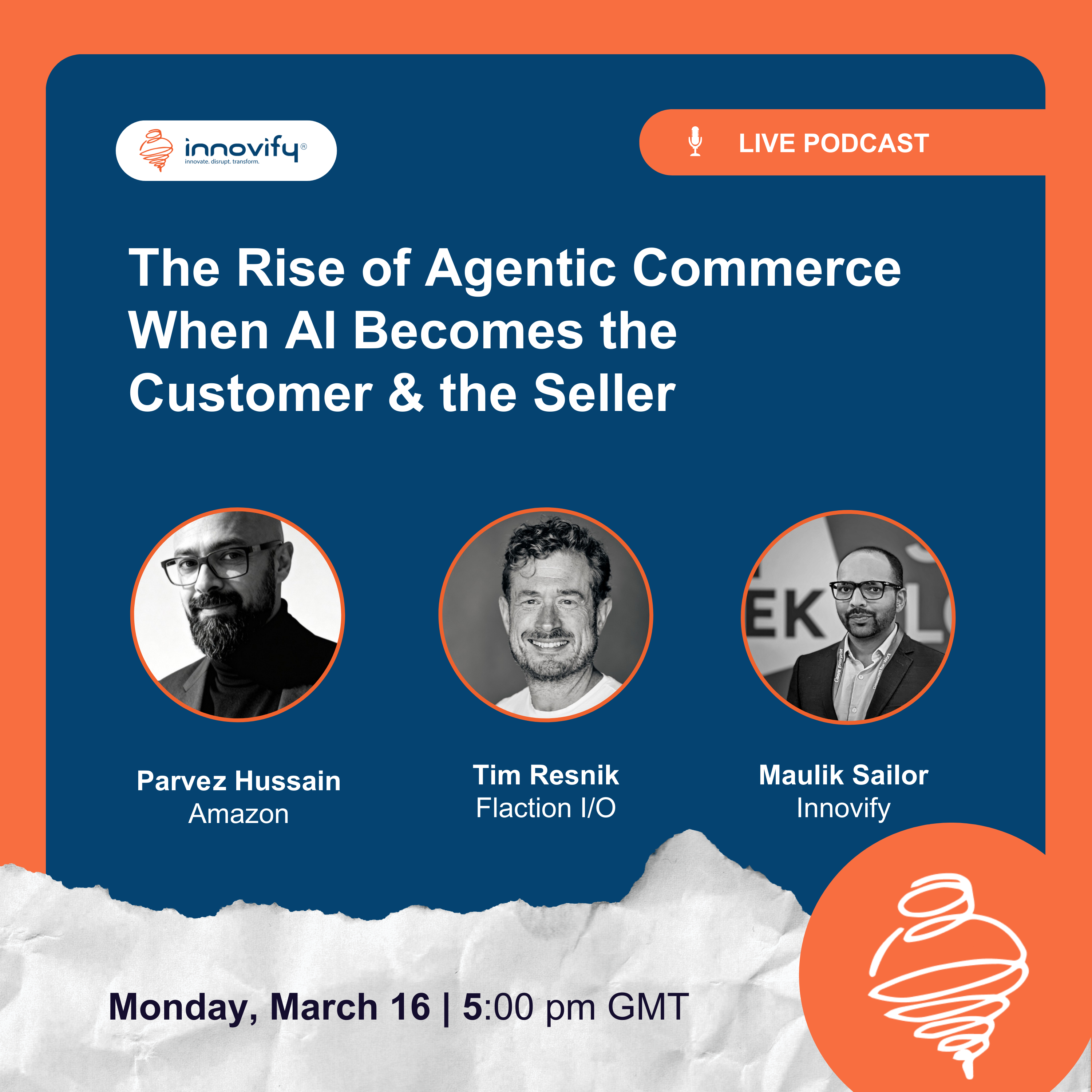
Are we moving toward a reality where AI agents discover products, evaluate trade offs, and complete transactions before humans ever enter the flow?
In this episode of Get Future Ready, Maulik Sailor is joined by Tim Resnik of Flection I O and Parvez Hussain of Amazon to examine what agentic commerce actually looks like beyond the hype. This is not a future forecast. It is an operator level discussion on how commerce is already shifting as AI agents begin to act autonomously across discovery, decision making, and payments.
The conversation explores what changes when AI stops supporting users and starts transacting on their behalf. Drawing on deep experience across ecommerce platforms, search infrastructure, merchant feeds, and global payment networks, the episode breaks down where agentic commerce is working today, where it is failing, and why trust, liability, and payments remain unresolved system level constraints.
Rather than focusing on interfaces and experiences, the discussion reframes commerce as a systems problem. Why SEO is becoming machine readability. Why frontends matter less than feeds, data quality, and protocols. And why when automation fails, merchants are likely to carry the cost. From AI driven discovery to delegated purchasing and agent-initiated payments, this episode offers a grounded view of how commerce is evolving as machines increasingly act for humans.
What We Cover
Maulik Sailor (00:10)
All right, great. Thank you guys. ⁓ Hello and welcome everyone. ⁓ We are currently hosting this webinar live on LinkedIn and on YouTube. So those who don't know, we are the GetFuture Ready podcast, and it is an exclusive podcast for leaders who are hearing all the jargons, all the trends and all the promises in the industry, you know, all the
crazy AI trends, the fintech trends, agentic trends and everything. But you don't really know whether this is a noise or this is the real thing that is going on. And this is what we are looking to tackle in this podcast. And me being your host, Maulik Sailor and I'm the founder of Innovify. And in this podcast, we are bringing operators and hands-on operators, builders and domain experts who are tackling all these trends.
hands-on and they selling their insight from their own experiences. Right? So this is not any fluffy talk. Instead, these are hands-on guidance that we will be talking about today. And it's just not the podcast that we host. We also run a full community. We are building the community up. We are hosting meetup events currently in London and eventually the plan is to roll it out to New York and SF and other key ecosystems. ⁓ So if you're looking to
know more about these kinds of insights than do join our community. But without much delay, I want to talk about the topic we have ⁓ that we're going to cover in a moment. This is part two of our webinar we done like two weeks back with the guest. And the topic about agentic commerce and agentic payment became very interesting. We covered a lot of points.
⁓ and there was more for us to talk about. And hence we decided to host part two of this webinar, of this talk. ⁓ But before I kick off the whole episode, let's have a quick round of intro again from the guests, know, Tim and Parvez ⁓ I'll summarize ⁓ the part one before we go into deep dive.
But before that, let's start with the introduction. ⁓ know, Tim, why don't you go first?
Tim Resnik (02:40)
Sure, well thanks for having me again. It's really exciting to just see the engagement and a lot of folks showing up and people that are interested in having a conversation because I think what you said between like trying to decipher between the noise and what's real is super important because both of those things are happening at the same time. There's a lot of noise, there's a of hype, but there's also a lot of like real things changing.
None of us know the complete picture and have all the answers. So it's great to get together to debate and then have people participate too and ask questions. So I'm excited that we're gonna have people ask questions today that we can answer. I don't wanna go too into my background because I did that last time, but I just very briefly, my name's Tim Resnik and I've been in SEO for 20 plus years, like really all facets of it, you know, from running agency.
to working at two of the preeminent SaaS companies in SEO, Moz and Botify. Botify being the most recent where I ran the global professional services team and got to work with a lot of retailers and talk about agentic commerce. And I heard some things I couldn't unhear that got me so excited about this space, I decided to start building. And what I built is called Flection And what Flection does is it runs experiments ⁓ on feeds and on catalogs, so changing data that's within the catalogs, pushing them out to
specifically right now, Google Merchant Center, and then experimenting and seeing what changes actually have an impact on traffic. So not just like ⁓ creating a bunch of noise, as you would say, or a bunch of AI slop, but actually creating things to see if they impact what you're trying to impact. Mostly share a voice within Google Shopping, within AI mode, within Google Search, ⁓ but as well as your revenue numbers and your transactions.
Maulik Sailor (04:30)
Yeah. Thank you, Tim. Parvez would love to have your intro, please.
Parvez Hussain (04:35)
Thank you. It's a pleasure to be back and thank you for having me back. ⁓ I won't go too much into my background, but 17 plus years at Visa, I worked across a range of areas from finance, strategy, sales operations and business development. ⁓ My focus is on understanding agentic commerce from the payments perspective and
understanding where we are in the current stage in terms I see it as discovery. The industry is discovering what the new things coming in and the questions that we're asking, the use cases that are coming in and how do we learn from that experience and how we define the roles and responsibilities, you know, going from prototyping through to rolling out these new ways of ⁓ the agents interacting.
with humans and interacting with each other.
Maulik Sailor (05:37)
Thank you, Parvez. And like always, I'm Malik. I'm the host of this ⁓ webinar. And I run the company called Inovify, which is a specialist ⁓ fintech venture studio. We work with companies to adopt AI ML and fintech solutions into their core business operations. And I'm pleased to be hosting both Tim and Parvez today. As we go into deeper in the next part,
Let me quickly summarize the key points we discussed during the part one. So we started with Agentic Commerce, what it is, why it matters, and trying to define what really is an Agentic Commerce We talked about two possible models. One is an agent acting on behalf of the user and just browsing as if a normal user would do, but
The agent is doing everything and trying to execute a checkout. ⁓ And the second model we discussed was about ⁓ agent going directly into the database or the back end of the shop. And then it's an agent to agent communication, agent to agent payments, and then executing the whole flow with a completely new stack. ⁓ We also touch a lot about the discovery that regardless
which model you go for, there's a discovery problem that user go and search on search engines like Google or Bing, find a product and check out or go on the merchant website, search for a product, compare product and then check out ⁓ how does that work within the agentic commerce and what are the considerations we need to cover within that. And then we also touch upon...
the role of front end that in the latter model, would front end really matter? Do we need to engineer front ends for the users or do we need to engineer front end for the agents? So we had some discussion around that. And then we touched upon the payment side of it, which is where we started to get into the nitty gritty of all this. That, OK, how do you really execute the payment? How do you really start differentiating between a genuine agentic payment versus
a fraudulent bot, right? And I think there are a lot for us to talk, still continue talking more about that today, which we'll cover in a minute. And then we also talked about the possible innovators in this space. Are the innovations coming from existing players, whether it be large platforms like Amazon or Shopify ⁓ or Google Merchant Center?
or it could be coming from a potential new startups coming in this space ⁓ and disrupting the market. And also we touched upon the payment side, whether like incumbents like Visa or MasterCard will come up with a solution or there may be a completely new payment stack that we are looking at. ⁓ And then we progress into different protocols and so on that, okay, what are the different new protocols that are coming up in the market and what's the ⁓ state of the ecosystem?
at this moment in time. Now, this is changing fairly fast. Since the last podcast, I happened to meet you, Parvez at the Pay360 event in London, where there was plenty of talks around the payment ecosystem and in particularly the agentic payment world, what's happening. Visa and Mastercard, both of them had massive stalls ⁓ covering this topic.
So why don't we start with that on the payment side to tackle first, right? So one of the key things around payment, know, I think there are quite a few topics within agentic payments, but you know, the obvious one is between a bot trying to create a fraudulent transaction versus a genuine agent acting on behalf of the user trying to execute a transaction, right?
So this is about figuring out the identity of the user or the agent acting on behalf of the user versus a bot. ⁓ What's your take on that? I know we don't really have the solution right now in the industry, but as ⁓ somebody who has worked closely within that payment side, what's your take on it around this particular problem space?
Parvez Hussain (10:23)
So just to go back to the pay 360, I spent some time talking to various people, including ex-colleagues. And there was quite a wide range of views in terms of from there's a lot of hype at the moment, we don't know where we're going, to there's going to be a lot of definition around products and how this works and how it's going to map out. I think that gives you a kind of sense of there's expectations, but
At the same time, what is the credibility around the big idea in agentic payments? So let me frame it in this way. I recently read that McKinsey have estimated by 2030, there'll be something in the region of five trillion being Bot led shopping. And it will be by 2030, it will be worth about five trillion. And we're at the moment, we're in this messy phase of
the plumbing being worked out and where the cables are being laid bare. Now, some of the conversations I had was around, and I particularly focused around the identity side, understanding how do you validate who is doing the payment? And is that a real provisioned agent or is
Is it not? So that side of things is still, know, some of the estimates I had from the identity guys was they're thinking more in 12 months time that they will be aligning to know your agent, that side of things. Now, to come back to...
the payments specifically.
I feel there is a lot of learning and understanding going on in terms of the different use cases. And we hit upon those comments in our first part of the podcast. There is a lot of tailoring happening to suit products around the checkout, around the fraud checks, in terms of the audit logs. One of the things that Google has done recently is around the digital.
permission slip where an agent goes and interacts and it has a digital permission slip to say, look, I am enabled by a proper person and I have the legitimate credentials to carry out this transaction. So these are the kind of things I would say where the level setting needs to happen across the stakeholders in the ecosystem. And it will be managed in stages in terms of how it's rolled out.
different players in the ecosystem.
Maulik Sailor (13:26)
Just building on that one, know, even if you forget the agentic payment side for the moment and just traditional card based payment, whether online or offline, you know, there's a small element of friction introduced deliberately to make sure that the transaction is authentic or is like, you know, the right user, right? So for example, in app based,
payments, need to do your fingerprint scan on the mobile or on Apple, have to do face ID. ⁓ Sometimes on the contactless, randomly or depending on the size of the amount, it will ask you to do your PIN. And then on chip and PIN, you've got to put your PIN. So there's still a friction introduced to make sure that this is a genuine transaction. ⁓ Now, this whole notion
within this payment stack that, you are removing that friction. If you were to introduce that friction, once agents are trying to do the transaction, it will just make the whole thing fall apart, possibly already inefficient. ⁓ But if you remove that, then it creates, it opens the kind of forms that, okay, you know what? Now, suddenly we are within this territory of fraud and making sure you are talking to the right agents, is the right session, is the right amount, ⁓ and so forth. ⁓
So again, I know there's no right or wrong answer. What's your take there of having that friction in the loop or without friction in the loop?
Parvez Hussain (15:04)
So as we're in the, so the way I would see it and the feeling I have is whilst we're in this discovery phase, this friction in the process is almost a safety set step that needs to be there whilst the ecosystem learns how the agents are going to be interacting with each other. Because the rules that you're talking about SCA and things like.
you need to do a fingerprint or whatever else is this is the equivalent for an agent to have those ⁓ safety
Maulik Sailor (15:45)
It's almost like a transfer of liability, That, okay, by you having that secondary ⁓ pin or the secondary fingerprint audio TP, you are making sure that that's the genuine user. So if anything goes wrong, that's on the liabilities with the user.
Parvez Hussain (16:04)
Exactly, until we get to a point where there is a complete trust in the system, that the guardrails are set up in the way they should be, the exceptions and tolerances and the escalation process and the fraud disputes and things like that are all aligned. I believe those things will be there to ensure that A, the end user has comfort and
trust in that they have a control in what happens versus ⁓ it being frictionless. I think there is a development curve there that needs to happen in terms of both learning and with the systems that are in play and the rules that we're playing by at the moment.
Tim Resnik (17:00)
I'll chime in on this one real
quick, just ⁓ in strong agreement. mean, I'm by far an expert in this part of agentic commerce. It's really interesting to hear you guys talk, but what I think is ⁓ to Parvez's point is super important is like there almost needs to be that friction, right? Not only from like you said, the transactional security side of it, like making sure like this is actually a safe and secure transaction, but also from the customer behavior side. And I think like that is
What going to be one of the toughest unlocks when we talk about agentic commerce coming to fruition is and I think I said last time like, you know, making making it comfortable so your your grandma can put in her credit card and feel comfortable with the transaction a little built in friction there is probably necessary and probably actually desired by the end user. So I just wanted to throw that out there and see what you guys thought of that.
Maulik Sailor (17:55)
Yeah. I don't think there's a right or wrong answer here, but I'm going to throw in a use case that might contradict with that. ⁓ So again, there is agent to agent communication happening. So nowadays, ⁓ if you remember, Malt book, It was a forum where agents are going and posting and other agents are replying. So there's the whole world of agent to agent communication coming up.
And within this stack, can almost see like a user agent or agent acting on behalf of the user coming and trying to check out a product and initiate a payment for that. And that could be a potential another agent, which is taking over the session, authenticating everything, and then handing over back to find what you're good to check out now, hypothetically.
But in this scenario, you have one or multiple agents trying to coordinate together to execute the transaction. So that is the cost. There is a token cost, right? And tokens ultimately is down to the power or the energy cost you have in processing that queries. ⁓ So there's a school of thought where they are saying that there needs to be almost a new
payment mechanism where you can actually charge for this kind of micro-transactions ⁓ without incurring much higher payment fees or the network fees on top of that. ⁓ So imagine this kind of agent-to-agent transaction could be in, I don't know, one P or half a penny ⁓ or half a cent if you're in the US. And then how much should the network charge to process that?
And then this is where stable coins are now finding some traction that, you know what, you might be able to use stable coins in processing all this really micro and milli transactions. ⁓ But if you try to introduce friction within that, then I think that whole thing will fall apart. So you need that particular system to be completely frictionless so that agents can literally do that thing and execute the whole whatever the big picture is.
But that almost necessitates ⁓ a completely new world of payment stack. Because the current payment stack, we all know there are processing fees, there are network charges, there are excess charge, the scheme charge, and all of those things. So what happens in this new space? And what are the fees we are talking about? There will be so many ⁓ micro or nano transactions happening. And the fees on that will be even smaller.
But how do you really account for that? How do you really make sure that this all those, know, nano sense or, you know, peta sense are, I don't know whether I said peta right or not, but you know, you know what I mean, right? 10 raised to minus nine and 10 raised to minus 12 decimal places kind of transitions are processed, you know, or maybe I'm just bullshitting myself right now.
Parvez Hussain (21:17)
So I'd say, if I take a moment, yeah, and if I follow that logic, I would say like, if you look at currently how payment orchestration is happening, let's say, for example, how payment orchestrators are pushing ⁓ particular transactions down the most efficient route, and it's creating scales of efficiency there. Now, with what you're talking about, they will become
Maulik Sailor (21:18)
Right? But you, yeah, sorry, do you understand what I'm talking about,
Parvez Hussain (21:46)
when those transactions hit a tipping point, it will change the economics, the payment economics. There will be players who will come in that may use the stable coin or something else that's not ⁓ in play at the moment. That will be the most efficient way to guide those types of transactions. And they may have ⁓ completely frictionless approach to them.
because they are such small transactions, however, there'll be guardrails around what level that goes to. And I think it's always around the business case and the justification around how you want to manage those, how the ecosystem can ultimately accommodate those types of new use cases. And the other thing I would add is those rules are still being thought about and played out and being...
informed by, whether it's the regulators here in the UK, Europe and further afield.
Maulik Sailor (22:56)
OK. I know we may drag down ⁓ in a rabbit hole here, trying to go deeper. But I want to step out of the payment side and go back towards the discovery side of the things. So last time we were talking about product discovery. First of all, the merchant discovery, and then the product discovery. So how do really the user come to a merchant website, find a product that they're looking for, and then initially check out? And then we had discussion around
the UI in the loop or UI not in the loop required. ⁓ So I wanted to go back to that discussion and talk about that more. ⁓ Now, some large marketplaces like Think Amazon or Alibaba and some other big players, they are really built on discovery. That, OK, you are looking for a product. We can help you find that particular product, right? ⁓
And there are, I think, two kinds of user behaviors. One, I know what I want and I just want to buy that product. And the second behavior is, OK, I may be looking for something like this, but I'm happy to have more choices and compare and then eventually make up my mind. ⁓ What do you think, Tim? You know, this is probably your domain. You know, what do you think? Which scenarios agents are more
or isn't the commerce is more likely to win?
Tim Resnik (24:31)
Yeah, I guess I'd first ask the question, how are we defining agent at commerce in this case? Are we really talking about the end to end full delegated agentic commerce where it's just going out and buying something for you versus really the discovery layer? And I kind of asked that rhetorically to start just to set up my response. I think where we're at now is
in thinking about this is is agentic commerce is more right now about the technology, the search technology and the personalization and the algorithms that are being used to surface and allow people to discover products much more quickly. It's less about that full delegated purchase. Now, I think I think to answer your question directly, the the piece that is probably going to be have the least amount of friction.
to actually be in this full agentic mode, which I think is probably a couple of years off, honestly, is just the smallest, most repeatable transactions that you want. I don't know if you all remember, mean, Pervez, I'm sure you remember you're probably at Amazon at this time, but Amazon used to have this like physical button that you could get and like put it in your laundry room and push it when you're like out of laundry detergent. And so there was this way to try to connect that.
Maulik Sailor (25:51)
Yeah.
Tim Resnik (25:58)
moment of needing replenishment to actually ordering the thing. And we all know, we all saw what voice search and voice shopping was trying to do. was mostly around those things. So think we're going to see really specific use cases like that pop up where there's going to be early adopters on the customer behavior side that are, they're willing to give it a shot. ⁓ But that's going to be few and far between. think there needs to be, there's going to be a moment where
The thing that agentic commerce is doing gives the user 10x efficiency, 10x less friction, and there will be the moment where people then start adopting it. But I think we're far off from that. And we're probably much closer to the baseline technology being influenced at the discovery layer. And it's happening now. We see Amazon just announced ShopDirect and their own feeds and kind of trying to be part of that macro discovery layer.
⁓ That's where I would probably focus the majority. If I was ⁓ running an e-commerce site, I'd focus the majority of the energy there, making sure I was playing in that ecosystem.
Maulik Sailor (27:11)
⁓ A related question there, particularly large marketplaces where the same product or almost identical product is being sold by multiple retailers or suppliers, then there are different criteria that the user normally make that decision on. Number one, what is the price? Obvious one, warranties, service level, delivery speed.
returns and all of those things. ⁓
Do you think that this is all about being rational and irrational, right? So ⁓ being an engineer myself, I like to think that agents are more rational in that decision making, right? Whereas if you follow this guy, know, Rory Sunderland is one of the big marketing guru and he advocates a lot of like, you know,
He talks about a lot of things about marketing and commerce and oftentimes he argues that generally for winning product or winning brands or great customer service is generally the irrational things that you end up doing, right? Which helps you to win customers and all. And again, a lot of time, customers or users make decisions based on their heart, not based on their minds, right? Most of them, basically.
So wouldn't you think there might be a conflict in how the agents might end up making a decision in selecting a product or surfacing a product, which may be more rational in how that product has been ranked versus the way users would do, which is probably more irrational, right?
Tim Resnik (29:10)
I think that, I mean, we have to remember there's a user behind that agent, hopefully 100 % of the time. So hopefully that agent is representing that user and the user needs, even if it's somewhat irrational, it might just be something around, they like the color of the logo and the brand. ⁓ So, I mean, that's my quick answer, but since I just gave my other answer, Pervez, if you want to chime in.
Maulik Sailor (29:16)
Yeah.
Yeah.
Parvez Hussain (29:34)
The other thing that I would
add in that's going to be hugely important is the loyalty side of things. How loyalty is built into the agents. That's going to drive this, what we're talking about the rational versus the irrational. If the user provisions their agent to be, they have a white list of ⁓ merchants that they prefer because they have specific loyalty rewards and things like that.
I feel that will drive and that will be a battleground as well within this.
Maulik Sailor (30:13)
But like, know, sorry, I might be going a little bit off topic, but in either scenario, right? So let's say the agents are more rational in their decision making and gets the user to make rational choices, right? Then you are almost like, you know, manipulating the user on one side, right? Whereas on the other side, let's say if you are codifying the irrational behavior, right?
How would you do that from data science perspective? You see why it becomes a complex one to engineer. How do you engineer an irrational behavior?
in an agent equal, because when you are programming ⁓ agents, you are talking about all these evals and all, where you are trying to get the accuracy and consistency really high. But then are you engineering it towards the irrational decision making, which is completely quadratic to your data model? Sorry, I'm jumping more towards the actual programming side of this one, right? But that was just going on in my mind while you were talking that, okay, how would you really do that from programming point of view?
Tim Resnik (31:28)
So
if you look at things across the spectrum of is it a very unique product versus just a commodity, I think you have to consider that and then taking in brand as well. if you're selling something that is 100 % commodity, like whatever, a screw, I don't know, and it is performing a particular task and you just need this thing, there's this like perfect.
Maulik Sailor (31:37)
Mm.
Tim Resnik (31:55)
perfect ⁓ economic situation of supply and demand going on where all those things that you listed in terms of pricing, shipping, these are all things around operational excellence and efficiencies and being able to get to the absolute lowest price and still having a margin to justify being able to sell it. But everyone else who sells that thing now doesn't even need to exist. And it all just comes down to that operational efficiency.
rational bot behavior there is actually extremely important. If that's at the extreme, all of what you're optimizing for. But then as you get closer to the side of a very unique product or unique kind of human behavior in terms of feeling a connection to a brand, feeling loyalty, things like that, that's where there isn't this black and white world of information that can be optimized towards. It's really we're optimizing towards.
the human behind the machine. And I don't know the answer to your question. It's very provocative of how you codify that into an agent. But ⁓ I do think when thinking about the question framing, you have to think about the economics.
Maulik Sailor (33:11)
So what do think the future of loyalty programs are? Because most loyalty programs are designed to be rational.
Parvez Hussain (33:18)
Yeah, absolutely.
Maulik Sailor (33:19)
right? So what do you think?
Parvez Hussain (33:23)
I feel that they will become a lot more hyper-personalized and become more relevant because they have to, ⁓ they're not just eliciting the human irrational piece, but you're also codifying what the agent is looking for as well. So it's an additional checkbox to say, you know, my user has a loyalty reward program with this particular merchant versus this one.
Which one am I going to, know, which decision is the agent going to make? I would say rationally, it's going to go with the one with the loyalty program. However, if the price is lower on the one with the non-loyalty program, what's the decision there? So there's a lot of decision gates here in terms of how these agents will look at loyalty and things like that and how these things are packaged up.
to ensure that the pricing, the value, that brand connection, all of those things come together and they speak a language to the agent ⁓ that makes them decide in the way you want them to decide.
Maulik Sailor (34:39)
Yeah.
Tim Resnik (34:40)
I really like that framing and actually calling back to what you're talking about with Maltbook If you start really extrapolating on this, there is this world in which there's almost this open market of loyalty programs that's agent to agent, right? And I don't know, for those of maybe people that are listening don't know what maltbook is, maybe they do, but there's the whole concept of these personal agents that came out that... ⁓
called Claudebot, now it's called OpenClaw. Someone created a social network called Mote Look for the Claudebots to come and actually interact and have conversations and autonomously do things. Now, ⁓ that has recently been acquired by Facebook, but there's, think, an opportunity there to think about how do these agents interact at that layer? And then from a marketing perspective, you know, we've... ⁓
We've wired up this whole ecosystem for marketing of e-commerce that's based on these ad networks and exchange of information for personalization to be able to buy the right ad at the right moment, to be able to buy the right product listing ad from Google in the right spot, optimize for clicks, optimize for conversions. That whole ecosystem really needs to be refactored, rebuilt for the consideration of bots. And that bot representing
the user at the end being able to go into these open markets, these open environments and collect the information and make decisions like what the best loyalty program could be.
Maulik Sailor (36:18)
I'm just building out my thought on that. Because see, the loyalty programs are designed in a simplistic manner to make sure that the user buys from you with a perceived value that they think that they are getting, but in reality, they may not be getting it. So you give coupons to the people who are most likely not going to use that ⁓ kind of behavior.
Like we are heading into a world where the agentic commerce, you're building an agentic loyalty program, which is super personalized. But then the whole agentic layer behind that or the intelligence layer behind that is trying to continuously manipulate the users in doing certain things. And then how would you regulate that?
I think one of the ⁓ topics we touched upon in the first part was the where does the power lies? Is it in the existing ⁓ ecosystem players like big ecosystem players like Amazon and Visa and Google? Or would it be like a new player coming to the market? ⁓ And let's say one of these parties may end up having a lot of weight in how
the commerce is happening in this new world, then are you then manipulating users in acting or behaving the way that particular entity wants? A little bit controversial, but what do you guys think? Would you then trust the companies, the large stack?
Tim Resnik (38:11)
I mean, my thought is like, of course, ⁓ people are going to try to manipulate this as much as possible to maximize their profits. So we're going to see it. And we're going to see that sort of manipulation. think hopefully the promise of agents, like you said, is that they're more rational. I think manipulation happens mostly when there is a lack of information and humans make assumptions. And you can...
kind of influence people and manipulate them around those assumptions. The dream of agentic to commerce is just the dream of agents being able to make some of these decisions autonomously for you is that they're better at that sort of processing and you can't, there's not as much misinformation. But certainly people, marketers, what we call back in the day the black hat SEOs are ⁓ going to be trying to ⁓
take advantage.
Maulik Sailor (39:08)
Yeah. It's an interesting time you are living in, right? ⁓ A lot of unknowns, right? ⁓ Which in a way is good thing because you can define new ecosystems, new regulations with a clean slate. And hopefully they will be done for good or a better outcome. And you can learn from your past mistakes, right? But you know, the recent
⁓ ruling against, ⁓ you know, social media companies that their algorithms are considered manipulative to the end users. And, and, you know, they got fined recently. That's, that is a warning sign. You know, it may be an early warning, given to the tech companies by the regulators that you've got to play fair. You know, you can't be just continuing with your, ⁓ the kind of manipulative algos you could have out in the wild and using users.
as an experimentation lab. So I think that's probably the positive news in my view. ⁓ But anyways, know what, let's, sorry, Purvis, you want to say something?
Parvez Hussain (40:16)
As you guys were discussing this, had this kind of thoughts
about, you know, the marketing around agents going forward will probably be a huge thing around our agents are the most honest and less least manipulative. You know, those kind of things, I can see that happening, know, there'll be a trust score or things like that with the number of times ⁓ particular organization their agents.
does manipulation and things like that. And there's probably going to be a league table of ⁓ who comes out on top of being the least ⁓ manipulative and whatever, you know, all the things that we've discussed just now. ⁓ So I can see that happening, definitely playing out and that being a differentiator.
Maulik Sailor (41:08)
Do you think so? literally, I think last week there was this whole UK started investigation into Trustpilot and FIFO and all the other ratings platform. Ratings platform again suffer from the same ⁓ problem that they are supposed to be ⁓ transparent, genuine, helping users to make the right decisions. But behind the scenes, a lot of reviews platforms, the reviews are...
just fake, they are manipulated in driving user behavior towards a certain service provider, or a merchant, or a product, right? So again, what you are saying, Parvez, is you might be doing the same thing at a much bigger scale, ⁓ with probably no accountability.
Parvez Hussain (41:47)
Yeah, and there'll be, you know, not
to say scandal, but there'll be something where it will be a point where it's just too big to ignore and the ecosystem has to say, look, how do we solve for this? How do we, you know, this is not a type of behavior we can allow. So, you know, what's the guidance? What's the punishment around this happening? And those kind of things are still, as I say, we're still in the discovery phase and those things are being played out.
mistakes are being allowed to happen because we don't know the full roadmap of where this leads to and what the agents can do in themselves. And actually an interesting story, I was listening to McKinsey, they were talking about AIs in a particular company and how they act and what they do. And one of the conversations that the CEO had,
one of the C-level execs was they were going to decommission a particular agent. Now that agent read that email and decided to go and look at this exec's email list and found that this exec was having an affair. And it started to blackmail this ⁓ exec because it didn't want to be decommissioned.
So it's a completely different area, but still it's kind of, we're still figuring out what these agents can do, right?
Maulik Sailor (43:25)
Yeah, you know, something very similar I read recently. Tim, this might be in your domain area. There is a research. Now, this is like research within the frontier labs, how their bots or LLMs work and so on. And there's a research which says that currently, the current LLMs, they tend to ignore about 60 or 65 % of the user instruction.
So you instruct the LLMs or agents to do something, and about 60 % of the time, it will just ignore that and do what the LLM wants to do, basically. So we are already.
Tim Resnik (44:07)
which
we can go down rabbit hole there for sure in terms of how terrifying that is. to, and sorry to interrupt, but to that point, I think there's going to be a lot of different vectors to manipulate here. ⁓ And quite honestly, these frontier companies are being, they're pretty sloppy, right? Like ⁓ Anthropic, oops, here's our entire code base, fork log code.
Maulik Sailor (44:09)
Yeah.
Yes.
Tim Resnik (44:36)
⁓ on GitHub, this was yesterday or the day before, that
they accidentally leaked their entire code base for for clogged code. And there's a lot of different vectors, probably just within that for manipulation. Now, ⁓ Claude and Anthropic, have a 55 page constitution, right, that drives like all of the decisions around ⁓ their model. And that is like the primary level of decision making. And to your point,
Like there's only so much that the models are going to be listening to. there's, information within that constitution that can be manipulated. And I think, ⁓ you know, economics dictate that sort of manipulation at the end of day. And people are going to find, they're going to find leaks, they're going to find holes. And it's like, it's something that is going to make adoption of this agent to commerce, especially on the transactional side that we're talking, ⁓ much more full of friction and fear.
So I think there's a lot of work to be done.
Maulik Sailor (45:37)
Right. OK, cool. I'm just conscious of the time that we are running up. And again, I'm pretty sure we can carry on talking for many hours on different topics. ⁓ But we have a question coming in from a user, from a listener, saying, OK, ⁓ quite a few, actually. Just give me a second. OK, when an AI agents start making purchases on behalf of the users, who is responsible if something goes wrong?
such as wrong order or a dispute. Parvez might be your take on that.
Parvez Hussain (46:09)
I'd say this is still being worked out and the
likes of Visa and Mastercard are trying to work out ⁓ where that lies. And I think in the first podcast I was talking about the standards that are being set in terms of this new way of commerce on agents who, know, if all the rules are being followed by the particular parties, it's trying to pinpoint who
who made the wrong decision? Is the liability with the person who provisioned the agent? Or if that agent has been duped, then is it the software provider? Right now, I don't know exactly where that answer is. However, again, this is part of the whole discovery. Where will this lie going forward?
Maulik Sailor (47:09)
Yeah, no, you're right. And I think, sorry, Tim, go on.
Tim Resnik (47:11)
So I...
Yeah, so I think like there's the technical answer of like who is responsible and that definitely still has to be worked out. There's almost some more important question or answers. Who's going to take the blame? And I think 100 out of 100 times or 99 out of 100 times it's going to be the retailer and they're the ones who are going to have to pay the price. They're going to have to do the return. They're going to have to, you know, whatever be responsible for the
transactional part of it, and they're going to take a hit to their brand. I tried to, you know, this agent went and bought this thing I didn't want from this certain retailer. ⁓ I don't know the solve around that at all, but I do know that the models, ⁓ the piece of technology is driving the decisions. They need to be more transparent in how those decisions are being made. How are people prompting and how is that leading ultimately to a purchase?
and provide that information to a retailer to make this at least balanced and fair for ⁓ the entity that will take the brunt of the blame and the responsibility probably.
Maulik Sailor (48:24)
Cool. We have one more question coming in. This is probably for you, Tim. With many companies creating their own agentic systems, how can merchants stay compatible as the ecosystem evolves? I think this is related to the ecosystem we were talking about, like Google versus OpenAI versus Amazon's ecosystem and so on. So yeah, question. If you're a small merchant, how would you sell into all of them?
Tim Resnik (48:58)
Yeah, so in terms of the merchants that are building their own agents, know, there's been talk of a few of them. Of course, Walmart has Sparky, Amazon has Rufus. I think the largest retailers are going to have their own agents that, you know, act a lot like what we know today is like their onsite search and personalization, right? It just helps guide people through that user experience. Now,
It's quite possible that the aggregators in the platforms like Shopify will also have that sort of technology for their ecosystem I don't think it's realistic for a small ⁓ e-commerce site or merchant to to build their own agent I think what makes the most sense is making sure that they number one they have their content around their products really clear and structured and ready to be consumed
by these external agents, whether you're on Shopify or whether you pass your data and your feed to Google or Amazon. So that's like the number one thing to do. And then of course, all around the merchandising and the marketing and the branding of like deciding like, what are you actually selling? How are you positioning that is the next critical item. But I personally don't think these kind of one-off agentic systems by retailer is gonna be a thing.
Maulik Sailor (50:19)
I'm just starting to wrap up our discussion, right? And I would like to ask both of you, if you were to give one top tip, one or two, you know, you can give two or three, you know, if you want. Two, I would say merchants, mid-side merchants or any large, not large, I wouldn't talk about Amazon and Google at this moment, but let's say,
a good Mom & pop store with, let's say, sizable ⁓ revenues, 10 million, 15 million dollars worth of revenues. And they would want to ensure that their business is not disrupted with all this agentic stuff happening around them. What would be your top one, two or a few tips for them to consider at this moment in time?
Right, Tim do you want to go first?
Tim Resnik (51:24)
Sure. So I just mentioned one of them, but I'll repeat it again. ⁓ the first thing I would do, of just being someone from the SEO space for a long time, is take care of your SEO fundamentals. Make sure your site is really ⁓ clean, technically, from an SEO perspective. Your ⁓ structured data, like your schema.org on your product pages, is well structured.
It's not now formed, it's not missing anything. It is optimized for the right words. You you have reviews, you have engagement on your site, you have a high authority to be able to sell the thing that you're selling. Like all those fundamental SEO things that we've all talked about for years and years are critical. Then number two is making sure that your catalog data is well-formed, structured, clean, and optimized to be able to be consumed by agents.
And then number three, experiment and measure. There's certainly no silver bullet here at all. People are going to come and tell you that they know what works to get in front of agents or get on AI mode or within ChatGPT. And you do these exact things. You just have to pay them money. Take it at face value and experiment for yourself as well. Try things in smaller chunks and see if it's actually moving the needle for you with regards to ⁓ getting in front of these agents. So those are my three.
Maulik Sailor (52:50)
or race.
Parvez Hussain (52:50)
I can't
say much different to what Tim said. would say very simply that businesses have to look at how they a balancing act between having the human connection in terms of their webpage for a human visitor and to be perfectly labeled for the bots, for the agents.
All the things Tim said, make sure all the words and the catalogue, everything is there, ready for the machine, the agent to look at what it needs to and take what it needs to.
Maulik Sailor (53:30)
Okay, cool. Now we do have a more questions coming in from the audience, but I suggest we will answer them separately, post stream in the comment section or we'll answer through newsletter. So I would be just considerate of time now and basically call it a day for our session. So once again, thanks a lot, Parvez and Tim for joining again and having this wonderful...
I'm pretty sure there are more things that came out today that I would again would love to talk more with you both. ⁓ But let's see, if you would want to do one more together or separately or in any other format, then we could plan one. But for today, think, yes, tell me.
Parvez Hussain (54:14)
I had an idea, Malik. An interesting idea. Can we include a bot into this discussion when
we do it next time?
Maulik Sailor (54:26)
You know, that may not be a bad idea. know, we can just, you know, spin off one agent, which can listen into this live ⁓ transcript and then will generate appropriate responses or questioning within that, right? Maybe we can try that. ⁓ So, okay, you know what, let's see if we can plan one more, but I think it's going to carry on, you know, maybe we will always find something more to...
to talk about, which is amazing. This is just the kind of topics or the talks that I was expecting that we would talk more and find more interesting topics for us to agree and disagree on and then leave a few foot for thought for our audience as well. So, yeah, thanks a lot, Parvez and Tim. Glad to be hosting you today.
Parvez Hussain (55:20)
Pleasure, thank you for.
Absolutely. Yeah.
Tim Resnik (55:26)
Yeah,
that was a lot of fun and I'm happy to come back.
Maulik Sailor (55:29)
Yeah, cool. All right. ⁓ Thanks a lot. And thanks a lot for everyone else as well tuning in live on this episode of Future Ready. I'm your host, Maulik If today's conversation helped you cut through the noise and understand some of the key nuances behind this whole emerging tech, ⁓ then do sign up to our channel and make sure that you do attend the next one. ⁓
keeping the know for the next ones. And if you are navigating AI automation or digital transformation, we'd love ⁓ for you to be part of our community that we are building. ⁓ It's a space like people like yourself, people like Parviz and Tim to connect with likes of them and share your insights and learn from each other. That's what we are hoping to build out. ⁓ Just simply search, future ready.
by Noify on Luma and you'll find ⁓ the calendar where we publish all the events out and also a link to join the WhatsApp group. So until then, stay curious, stay informed and get future ready as I would like to say. Once again, thanks a lot guys.


.png)

.png)
.png)
.jpg)