


.png)
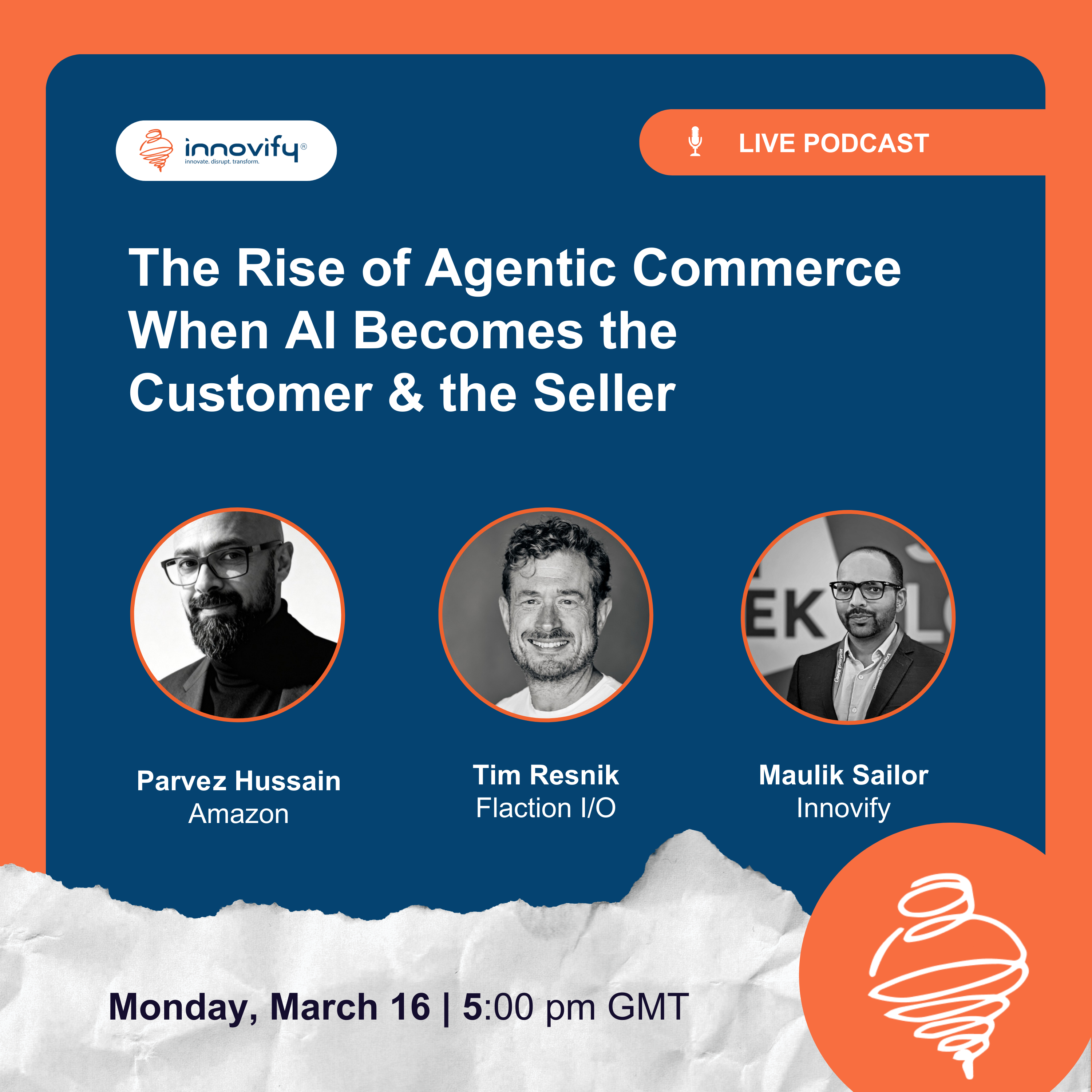
In this episode, Maulik Sailor is joined by Tim Resnik (Flection I/O) and Parvez Hussain (Amazon) to explore the rise of agentic commerce and what it means for the future of buying, selling, and payments. Together, they unpack how AI agents are beginning to reshape search, product discovery, decision-making, and checkout—often faster than regulation and infrastructure can keep up.
Drawing on deep experience across ecommerce, search, payments, and platform ecosystems, the conversation examines where agentic commerce is already working, where it breaks down, and why payments, liability, and trust remain the biggest blockers to full automation. From AI-driven discovery to delegated purchasing and agent-initiated payments, this episode offers a grounded look at how commerce is evolving as machines increasingly act on behalf of humans.
Maulik Sailor (00:12)
Okay cool, we are live actually.
Right, thank you guys. How are you all doing? You're waiting for our audience to join. I'll give it a few minutes and then ⁓ we'll start ⁓ within a minute or two. Okay, but let's wait for our audience to join.
I'm just checking on LinkedIn if our stream is live.
It is actually pretty good.
Okay, cool. I think we'll kick off.
Hello and welcome everyone to the brand new episode of Future Ready with Innoify. And today we have amazing topic to talk about, which is currently hot in the industry. I'm not alone. I've got two amazing guests joining me today, which I'll be glad to introduce in a minute. But those are the folks who are joining in now or later. ⁓ We are live streaming on LinkedIn and YouTube and post event will be publishing.
and edited version out on Spotify and YouTube as a podcast. So stay tuned in and we'll be good to kick off our session for today. So today we're going to talk about agentic commerce. As we know right now, the entire industry across the board is being disrupted by the rise of AI and the AI agents. AI agents generally tend to automate a lot of that we execute on a day-to-day basis.
But the difference now between the previous wave of automation is the power of LLM. We've got plenty of models in the market now with a very good human level reasoning and decision-making skills, which is changing the way we interact with other online tools and products. And one of the biggest impact we are seeing at this moment is around the way we buy and sell things online in a traditional way.
Parvez Hussain (02:35)
you
Maulik Sailor (02:56)
⁓ If you go back like 20, 25 years back, ⁓ people used to buy and sell things offline using cash as a primary mechanism to exchange value. And then came the whole world of online commerce and then things started moving online, as in you needed a website, you needed a mobile app, and then you needed to come out with a new way of making payments, ⁓ verifying transactions, avoiding frauds so on. So there was a huge wave of disruption that happened.
Parvez Hussain (03:01)
But.
Maulik Sailor (03:24)
about 25 years ago, 30 years ago. And we are probably living in a very similar time where with the rise of AI agents, the world of commerce is changing. The way we transact is changing. The way we transact human to human, to person, from one system to another, from human to two systems and so on. Across the board, everything is changing. And with a potential impact that we probably don't know or don't fully understand.
But what if not, I've got two amazing guests who will be able to share a lot of the insights from their own hands-on experience within this particular space. ⁓ Those who don't know me, I'm Maulik. I'm founder of Innovify We are a digital studio. We specialize in developing AI-led products, ⁓ particularly within FinTech and e-commerce domain. And today we have Tim and Parvez joining me in this talk.
Seems like Parvez just lost his stream. We'll wait for him to join online hopefully soon. But whilst we're waiting for Parvez, Tim, it be great to know about you. I'm pleased for you. Parvez is back. So I'm pleased for you both to be here with me today. Why don't we start with a quick introduction? Tim, let's start with you first. It would be great to know about your background and what your current focus is.
Tim Resnik (04:50)
Yeah, first, thank you very much for having me. I think it's great to be talking about these topics. It's very new industry and lots is changing. mean, literally every day something new is coming out and there's a new platform or new protocol ⁓ that's coming on the market and there's still a lot to be figured out. So it's really great to be here talking with both of you about it. So thank you. ⁓ My background historically, I've spent the last 20 years in marketing technology and product and in e-commerce.
Parvez Hussain (04:53)
Okay.
Tim Resnik (05:20)
mainly in the realm of driving upper funnel traffic via SEO and paid search as well. And for the last seven years, I've been heavily focused on e-commerce. I started that journey at the time, it was the largest retailer in the world and that's Walmart. And I worked for the Walmart tech side of the house and ran MarTech on search performance.
That really working at that scale was very fascinating. were using early models of what we're seeing today with, with transformers. It was, it was called BERT back then. And we would do, we'd process hundreds of millions of products to better understand the relationships for those products so that we could optimize them for search. So there was a lot of, a lot of interesting work there. Spent some time at Wayfair heading the mobile tech team as the product lead and
Most recently, I've been advising a lot of Fortune 500 companies across the board on agent commerce. So a lot of the companies I've been meeting with have been, you know, very, very concerned with what's going on and being potentially being disintermediated by these agents. And I know we're going to talk about the user experience a little bit coming up and who owns what, and that's going to be fascinating. And today I've now, what I'm doing is.
building my own startup, it's called Flection. Me and a co-founder have built some software that enables us to optimize kind of the push of data to these platforms. So optimizing the feeds so that people can make sure their products are visible on the platforms. They can govern what their brand and how their brand is being represented on these platforms. And most importantly, I think right now is be able to measure like what
what the changes and what they're doing in these feeds is actually impacting on these AI surfaces. Because without that, as I said before, this industry is so new, it's really difficult to build a plan and build a strategy when you don't have any visibility in what's going on. So that's me in a nutshell. And again, glad to be here. Thanks for having me.
Parvez Hussain (07:17)
and
Maulik Sailor (07:31)
Yeah, thanks a lot, Tim. know, Parvez would be great for you to introduce yourself and someone as your background for our audience.
Parvez Hussain (07:40)
Absolutely, thank you. Firstly, ⁓ a pleasure to be here and thank you for the invite. And as Tim mentioned, there's so much going on in this space that trying to decipher where the boundaries are and who does what, clear lines of responsibility is still being mapped as we're walking through this. So it's great to talk about this and just understand the different perspectives.
where the challenges lie. In terms of my background, I spent 17 years at Visa in a part of the industry where you hard lessons fast. Good intentions don't matter if the rules don't hold up in the real world. And more recently, I've been at Amazon where volume in terms of decisions and things like that, it's a very
multiplies very fast on small mistakes. within agentic commerce, this changes who makes the decisions, where software decides as opposed to a human being in the loop. that breaking of the old assumptions around what the intent is, where the frictions lie and who the liability lies with. These are the key anchors in terms of how
this may work or may not work, but that's where my interests lie. And the things I worked on is around building partnerships with tier one banks, financial institutions, understanding their roadmap with the things that they want to do with their clients in terms of their card holders, payment credential holders, and what the industry is doing. they're trying to absorb
the changing sands under their feet and trying to understand, going back to what Tim was saying, they feel like they may be disintermediated from the information that they have on their client base. And who will own that and who will drive the decisions in terms of where they would need to go to? Are they going to be in charge of that or is somebody else going to be in charge of that? So yes, that's me in a nutshell.
Maulik Sailor (10:04)
It's great for us to have both of you today because in a way, your background is more around top of the funnel, search and discovery. How do you get into the e-commerce transaction? And Parvez ways, your background is more particularly on the Visa and more about checkout and payment, the tail end of the transaction process. How do you really make sure that the payment goes through and the order and charge back and everything else is handled? So in a way, we can cover
Tim Resnik (10:12)
Mm-hmm.
Parvez Hussain (10:32)
Yes.
Maulik Sailor (10:34)
the full funnel of ⁓ the transition of the e-commerce journey. But before we go into details, some of the folks may not know much about what is an agentic in commerce. How would you define that? And ⁓ I would like both of you to chip in. But in my mind, there are two definitions. First is, you
your traditional e-commerce the way you are currently doing things, know, checking out on a website or a mobile app, but you have an agent declared on top, which is mimicking the user behavior and doing it on behalf of the user. That's one definition. And the second definition I have is actually an agent bypassing this all, just going straight into the databases, right? And the cloud databases, wherever in the world they are, finding exactly what I want.
what price point I want it, when do I want it and where to get it delivered. And basically making all that smart decisions and giving me the best product at the best price at the right time. What do you guys think? Where does your definition lies?
Parvez Hussain (11:50)
Tim, do you want to go first?
Tim Resnik (11:52)
Yeah, okay, sure. So I pretty much am aligned with that definition. do have some hot takes with regards to the timing of it all. ⁓ I think we're currently in a state where there's not going to be a lot of delegation or full delegation to agents. I mean, if you just think about it and...
Parvez you've been in the industry very long with credit cards. Think how long it took for like our grandmas to like put their credit card online. Right. I mean, maybe over COVID, maybe they still haven't. Now we're asking, are we going to entrust an agent to go out and purchase something on our behalf that we haven't really even vetted? I don't think so. I mean, I think maybe it will start with replenishment and commodities and small things like that.
But the way I'm looking at agentic at commerce today is really as an extension of search and discovery where we're all trained to search for products within the e-commerce ecosystem in a way that's like just really messy and historically has been a complete mess. I like to refer to it as like a bowl of spaghetti, right? Where it's a circuitous path to get from your intent and the thing that you want to the thing.
that you actually are going to buy and make that transaction. And, you know, you, you see an ad, you click on an ad, you go to that site, you find a price, maybe you go to another site to compare. You come back later. I mean, it's, it's a whole thing, right? You go and look at reviews, you read it, et cetera. I think that spaghetti bowl of a mess, an agent is going to help make that a lot more streamlined and help get person from point A to point B a lot quicker. And.
Parvez Hussain (13:37)
Hmm.
Tim Resnik (13:43)
I think it's going to be more of an assisted process
where the agent is assisting the consumer rather than a fully delegated process at this time. Now the future, who knows? We might all be wearing our glasses that see that we're missing eggs in our fridge and all of eggs show up or our shoes have a hole in them and all of sudden a new pair of shoes show up. I think we're a ways off from that.
Maulik Sailor (14:11)
Parvez what do you think?
Parvez Hussain (14:13)
Yeah, I mean, agree with most of what Tim said there. And I do a short summary and the simplest way to think about it for me is agentic commerce is the decision. So let's say you have a concierge that chooses a set of things for you.
brings it to you and says, here's a choice of three things. Now there's a separate piece where you pay, which is the ⁓ agent-initiated payments, which is a settlement where you choose the item and you say, OK, I'm going to go and pay for that. So one way to think about it is one is the concierge that brings you the choices. And the other side of it is the cashier that actually closes, swipes the card or closes the transaction to say,
That's yours now. Here's your receipt. Thank you. So it's the buyer becomes the optimized search engine with a set of parameters in the background, know, which merchants, what's your size of item that you want to buy, whatever it is.
that kind of customized and that agent knows exactly what you like and where you like to shop. Now the other end is that payment piece where you trust the agent to make the payment based on the choices that you've given it. So that's how I see the two elements of agentic commerce.
Maulik Sailor (15:50)
Okay.
Okay, cool. let's start. There's a lot for us to talk about this, right? But why don't we start with the top of the funnel, which is like, you know, getting into the transaction, right? Right now, you know, the product discovery started at level. First is on the internet, you're looking to find a product, you go onto Google, search for something, and you get the link to the product or to the retailer, and then you go onto their website, and then you...
do search, filter, compare, whatever, right? That's what you do. Now we already know that a lot of users' behavior is changing from search to questioning or prompting. Instead of going to Google to search, they go to chat GPT or even Gemini and say, hey, you know what? I'm looking for this. What do you recommend? Or find me this pair. This is my problem. Can you find a solution? Or this is what I'm looking for. What do you recommend? And basically, the LLM
or chat GPT ⁓ searches out and present you with the top two or three ⁓ recommendations. Now, they may not be ideal, but the thing is that's making people lazy. Now, they think that, okay, fine, if chat GPT recommended me this product, then it's great. They may be the best ones for me. So starting with you tim what do you think? Let's say if I have a new merchant trying to set up
and a new e-commerce store or a platform, ⁓ what should I do? What do you think where the industry is heading? And as a new retailer or a merchant, what should I take care of?
Tim Resnik (17:37)
It's a great question. ⁓ I'd like to first start with my point of view with regards to what's shifting and where people are actually searching. You had mentioned keywords to prompts. Totally agree with that. think we are, people are being accustomed and trained to, to use conversation to discover, which is great. I mean, that's always, that's always kind of been a gap with
with search and having to think in keywords. That's not how people think. People think in questions and now we're at that point. I disagree with, at least part of your statement is I don't think ChatGPT and Gemini and these surfaces are the main surfaces people are using today. I think it's Google and I think Google will continue to win. ⁓ And I think they have the largest
⁓ number of SKUs in the largest shopping graph in the world. And it's going to take, it's going to take chat, gpt a very, very long time to catch up. Not to mention there's also a small company called Amazon that is really, ⁓ pushing to get into this game as well. But I, and with talking to a lot of larger retailers, ⁓ folks tend to lean towards thinking of agentic and AI discovery as chat, GPT
And Google's been surprisingly the underdog here, uh, which is really funny to think about, but I, I think that is, um, it's not the and it won't be the case now to answer your question, what to do if you're a retailer again, just, just getting back to the mechanisms of how search and discovery works. So how search and discovery works today and mostly has worked is that
Parvez Hussain (19:06)
No.
Tim Resnik (19:28)
Google will go out and pull information from the web, understand what you're selling. They will then index that information and people will search upon that information. And, you know, historically our sites or everyone's e-commerce sites have been made for humans, right? To consume. They've been good. They've been nice to look at the words on those sites have been for humans, lots of JavaScript to be able to process. So you can make pretty things on the website.
But now what's happening is that these platforms are starting to consume information that you push to them. And you push those, that information to them through feeds, right? Like traditionally feeds that have been used for things like ads, right? Where it's a structured information around, around the product and meta information around the products and attributes, et cetera. And then the ad systems decide how they're going to rank those things.
Parvez Hussain (20:06)
Okay.
Tim Resnik (20:23)
But today what's going on is the AI platforms are now starting to use these feeds and this information for the conversations to be able to understand the core of products that are out there. So as a retailer, I really think the number one thing to do, of course, you have to focus on the user experience. Like people are still coming to your site and you got to focus on the content there, but you also have to really start focusing on your catalog and how that catalog is structured, the taxonomy of that catalog.
Parvez Hussain (20:30)
Okay.
Tim Resnik (20:52)
the information around your products, the content around your products that you'll be pushing out to these platforms.
Maulik Sailor (21:01)
Cool. ⁓ Parvez anything for you to add?
Parvez Hussain (21:04)
Okay.
So the lens, I agree with what Tim is saying. And I think the key thing for me is going to be the provisioning and onboarding of an agent. It's going to become a sort of a really huge battleground and a valuable kind of moment in agentic commerce, because it's the handoff between a person signing up.
and an agent being trusted to act on their behalf. So within that you have, you know, it's where the ecosystem gets set up for success or failure because this is where you personalize, you authenticate, and you define what actually allowed means, what you're allowing it to do. So for a person, you know, it's setting the budgets, the boundaries, their preferences.
and what they want confirmation on, what needs to up. And for the ecosystem, it's a point where they're establishing the identity of the person who's behind the agent. What are the trust routing? What's the incentives? And how are exceptions going to be handled in that? So once you set that scene, the rest of it is kind of going to
set the stall out for what the future stories are going to be for agent e-commerce, what the use case is, the existing use cases we have, it will break them, it'll make new use cases because there's things we haven't thought about yet. And so that will be a new value chain in terms of what onboarding looks like when it becomes the new checkout. for me,
Maulik Sailor (22:59)
Hmm.
Parvez Hussain (23:01)
If I say whoever defines that agent default, the defaults around the authority, the exceptions, the things where the merchant trust list, let's say for example, lies, that's going to be a huge part of the value.
Tim Resnik (23:16)
Who's most likely to establish that? it anyone other than Google or, mean, I can't really actually go beyond Google. it anyone other than Google?
Maulik Sailor (23:17)
Yeah.
Parvez Hussain (23:28)
Well, so then.
Maulik Sailor (23:29)
See, yeah,
sorry, go ahead. Now, I was going to say, like, you know, by default, you always think about an incumbent that, okay, incumbents are always going to win, right? But then suddenly a startup comes out from nowhere, and that captures your imagination and, you know, everything changes, right? And Google has the same starting story, right? ⁓ You know, they came, like, I mean, out of, they didn't came out of nowhere, but they...
Parvez Hussain (23:31)
No no please go ahead Moly
Maulik Sailor (23:56)
kind of really disrupted the existing incumbent ⁓ back then. ⁓ And so ⁓ is Amazon, right? ⁓ Amazon versus Walmart in that sense. And again, Chat GPT, similar stuff, when they came out, they were not even sure whether that product is going to work. And suddenly it's growing like a wildfire ⁓ and changing the whole industry, as we know. So I think...
My take is that Google possibly has an advantage in the interim. Now Google has been amazing in terms of innovating itself and launching a lot of products and so forth. But I think there might be a chance that somebody else or a new sort of will come in and just to change the way it works. You never know. One of the things that...
Tim Resnik (24:46)
Do you think that's
possible with when such a large infrastructure is required? Well, number one, you need to have a huge database of products and understanding what's out there. I don't know much about the transactional side of this, but I imagine the wiring of that is extremely complex and incumbents have a big advantage when it comes to just the infrastructure of ⁓ transactions. But I don't know.
Parvez Hussain (24:56)
.
Well, I'd say API kind of, if we look back at API and how that simplified a lot of things, but ultimately the thing is going to be around regulation of data, who holds the data, who's the guardian of the data. And once you're in that space and you're a regulated entity, it comes with its own challenges. So I can see Google being a lead in terms of starting this, but when you look back, ⁓
the revolutes and the monzos and things like that, how they were nimble around being able to plug into a larger system and then develop a value, a part of the value change that they could really service well and grow from that base. I can see something similar in that, from that perspective. But yeah, again, it's difficult to see beyond the large players currently.
Maulik Sailor (26:15)
Yeah. I was just trying to think about something. The way Google works is effectively you have your e-commerce store and you export your product feeds for Google to index and then Google will index on those products. It will come up in your search results in the shopping and so on. But personally, I found the Google shopping, one of those products that they did whenever they did and never really bothered with it.
because they've got such a big monopoly on it. So at this moment, I personally feel that Google shopping is one of a very basic shopping experience. And yes, they are just kind of passing you on to the retail, it's just more about discovery. But in the agentic world, you may have one of these LLMs, let's say they come up with a, maybe they build on Google's product feed or come up with something new and start indexing, go straight to, for example, Shopify and say, you know what?
we would like to index all your merchants using this new format and get all your product discovered to, let's say, chat gpt or perplexity or whatever. That might be a way to actually bypass the whole Google discovery and may threaten that particular one. But regardless of what happens, what I wanted to drive down to is, is there a possibility that we may move away?
Parvez Hussain (27:25)
Okay.
Maulik Sailor (27:42)
completely from the front end ⁓ of the e-commerce. Or maybe there might be a front end, but not the way we know. you, you know, most e-commerce stores are very similar. You go in, you get some, you know, hero promotions and all. You search for the product, you filter the product, right, to eventually initiate the checkout. But do you think there's a way, there's a future, where you don't really need to do all of that? You know, some people like browsing, they like to go and, you know, discover.
like going in a shopping mall and you want to discover the products, what's new, what latest and so on. But some people, they're like, look, I know what I want. I'm not here to browse around. I just need to take my product and go. ⁓ What's your take on that?
Parvez Hussain (28:26)
I'd go back to what Tim said about earlier when we talked about getting our grannies to input their card details and things like that. It took a long phased approach and I think this is going to be similar. Whether you're going to have people who are going to be on board very quickly.
versus others who are gonna have that pull that they still like doing it the old way. They want that connection with the brand and they want to browse before they go ahead and purchase. So it's gonna be a curve. And the other thing is that environmental factors that change how we interact with AI. So let's say for example, during COVID, contactless.
⁓ uptake went up through the roof and that was because of something that was out of our control but it necessitated a move towards a contactless and nothing in terms of product marketing and things like that could have ever pushed it in that direction in the same way. So I'm not saying for this it will be that but there will be other factors that will push the development ⁓ curve faster.
But you know, it's the usual. You have the leaders and the laggers.
Maulik Sailor (29:50)
Cool moving beyond me on, sorry.
Tim Resnik (29:51)
Yeah, so I was going to give an
anecdote here. So as a lifelong SEO, I would call myself, and over the last three years, I've been running the professional services team for a company that sells SaaS software into enterprise SEO space. And so part of my job was going around and meeting with our customers and talking about SEO and all that stuff.
And what I saw over three years, I saw a drastic change. So I would go on site to a client and we'd be talking about SEO strategy and you'd get, you know, the director of SEO to come. Maybe you'd get like a VP of marketing, et cetera. But then about a year ago, nine months ago, we started having these meetings and C level people started showing up. You're like, is, what is going on here?
Like C-level has never cared about SEO really from this standpoint. And really what's happening is this. First of all, I would call it a concern, a fear of being disintermediated by these platforms. And it's exactly Maulik what you're getting at in terms of the user experience shifting. And so I think, I think there's a real possibility.
that what we're going to see is that the user experience is shifting from first party to third party. Now, I don't think that means necessarily that it's going to be all end to end agentic, but there, and I don't think that means it won't be a branded experience, but I think, I think the experience is going to change. and several of these folks that I've talked to over the last year, they are looking at agentic commerce, not as a channel.
more as another experience akin to their mobile site and their website. And so I think we have to look at it like that. But at the end of the day, the last point I'll make here, at the end of the day, you have a real person behind that experience, right? You have your customer and does it matter at where they're going to make that purchase or make that decision? Essentially, they're looking for less friction.
Parvez Hussain (31:48)
So
Tim Resnik (32:10)
Maulik think you maybe said it before, like people kind of looking to be lazy, save time, you know, get rid of a lot of the noise. And
I think that's going to happen one way or another, but it's still going to be a real person behind the agent making the decisions. And we still have to, we still have to tool and plan for that as a brand experience.
Maulik Sailor (32:33)
Now, you know, I agree with you, Tim, overall about what's going to happen or at least where it seems like the industry is heading. But one of the key sticking point, I think one of the major sticking point right now is the payment, right? I think the agentic commerce more or less is solved in my view, apart from the payments part, right? Parvez, is building on your experience over there.
Tim Resnik (32:48)
Hmm.
That's the most important part, right?
Maulik Sailor (32:59)
It's the most important part, right?
Tim Resnik (33:00)
Nothing's going to happen without that being solved.
Parvez Hussain (33:04)
Okay.
Maulik Sailor (33:05)
Yeah, so anyways based on your experience, ⁓ what do you think? We know that there's
a very thin line between an agentic payment versus a fraudulent bot payment. So quite a few questions but the first question is do you think the existing or current mechanisms of online checkout
or payment authentication and fraud mitigation would work? Or do you think there's something new required in this space?
Parvez Hussain (33:43)
So first thing I'd say is an agent isn't a legal person in himself. when you have payments, payments rules are built around a single assumption that a person is a buyer.
And there's a moment where we see a person when they buy, when they click, and they authenticate. that's where the whole system leans into that moment, that there is a person doing this. Now with agentic in commerce as we're talking about, if an agent is acting on delegated authority, the yes that we're talking about, the click.
has happened upstream way before the agent does ⁓ anything, you know, in terms of the rules that have been set for it to act. And it might have been set days earlier in a set of rules and limits. And that ultimately creates a gap in three parts. So the consent, how the refund and chargebacks happen as well, because
First, if the agent buys the wrong thing, and if it's not fraud, it's just chosen the wrong thing. However, the person who's ⁓ confirmed the agent, the person buying me, I'm still liable for that purchase. Now, the second thing is around the delegation piece, where it can...
You haven't lost the credentials like a payment card or anything like that. Let's say, for example, you've given it the software where it oversteps the mark. And how do you recover where it's overstepped? Who is liable in that scenario whereby it's followed a set of instructions from an agent that is malicious?
You know, it's a set of instructions within something that looks like it's as it should be. However, within there, there's some malicious information which makes your agent go and act and do something that shouldn't have done. But as far as the agent is concerned, it's done what it needs to do. Now, the third piece is around the disputes. And this is where, you know, disputes are always designed for human mistakes.
done sort of at a particular speed. With agents, we don't have an agentic charge back. It's not even a defined category. And these things can happen at an agentic speed level. So hundreds of transactions can happen before you even know that it's happened and how do you trace them back. So that's how I would look at it and think about.
Maulik Sailor (36:51)
So then are we kind of saying that the thing which is going to make or break this agentic commerce as a whole is basically the legal definition of who is the party responsible for initiating this payment.
Parvez Hussain (37:10)
Yeah, because one of the things this is about is around liability. Where does the liability lie? Currently, the ecosystem has set of rules for, know, let's say take the four party model. The issuer has a set of rules that it follows and it makes sure it does what it needs to do. The merchant does what it needs to do and so on and so forth. And as long as everyone carries out the things that they need to do, then if something goes wrong, then you can pinpoint where the liability is.
But here, how is liability defined as when an agent is carrying out a set of instructions where it might have been duped or where the wrong instructions might have been given to it. It's not a legal entity in itself to be able to say, OK.
This is where the liability lies.
Maulik Sailor (38:03)
Yeah. So what do you think? What is the opportunity? Do you think?
platforms like Visa or MasterCard, the existing payment networks. Do you think they have incentive to protect their existing business, stop this agentic commerce ⁓ from happening so that they can continue operating the business that they have been running for Visa almost 100 years now? Or do you think there could be a disruptive startup coming ⁓ to the force?
coming out with completely new way of agentic payment, ⁓ overcoming all these barriers that you are talking about around the legal definition, the liability, I'm sure that will be a way out of that. disrupting them. Think about blockchain, about 15 years ago, blockchain was illegal. Now almost one of the default cryptocurrency and a lot of banks kind of trade on it as well now. So you never know.
a wide open question, what do you think ⁓ could be the opportunities?
Parvez Hussain (39:17)
So firstly, for me, the regulatory part has to come into line to take into account all of these things. I definitely think a disruptor will come in. With my former visa hat on, visa was always taking bets on everything. There was never ⁓ a view to close out any particular option because it was
you never know how that would turn out and it's never good to rule out anything. So it was always taking bets on everything. This scenario, I would definitely think a disruptor who is nimble and agile and has a different way of thinking about this without the legacy, incumbency kind of tax and burden.
And I'm sure Tim is seeing that from an SEO perspective in terms of what, you know, it'd be good to hear what you're seeing building on what, you know, your meetings with the C-levels, suite execs, what they're saying, what's actually burdening them in terms of what they're seeing going forward.
Tim Resnik (40:33)
Yeah, I think I first to comment on the the transactional side of it it and just listening to you guys is fascinating because it's I'm breaking into these two different pillars, which is one there's the there's the fraud aspect of it where there's some sort of prompt injection and there's a purchase being made without the user knowing about it, right? And then there's this other category that's really just fuzzy in a gray area.
Mistakes being made right and I think we're all so used to over the last few years, especially as the models have been evolving. Initially, when the models came out, they hallucinated like crazy, but they're getting so much better so quickly that they're hallucinating a lot less. So I do think the mistake side of it. That pillar is solvable upstream. So it's like just garbage in garbage out so the.
better information you have come in, the better data that you have, the more chance that the agent is going to make a smart decision on your behalf because it truly quote unquote understands what that product is. so getting back to kind of how I've been, my perspective at least, and how I've been thinking a lot of this is that data upstream and the data in the catalog becomes so important. And, you know, just, just think of today how Google works with, with AdWords, right? In their feed.
Parvez Hussain (41:47)
Okay. Okay.
Tim Resnik (41:59)
If there's a mismatch with what's on the page in terms of price and availability versus what's in the ad, they
will stop serving that ad. Sometimes they'll just like take down your whole campaign because it is so detrimental to the customer experience. No difference here with like the agent to agent communication. If there is information that is incorrect and not being served properly, I think there's going to be, there's going to be these very quick kill switches because what happens then downstream is all these transactional issues.
that you're talking about. That's my perspective, what I'm hearing as well from just a full pipeline discovery into transaction.
Maulik Sailor (42:39)
Yeah. So I'll actually go back to what I said earlier, right? In terms of defining the agentic commerce, right? So now when it comes to payment, I think we are talking about three overlapping ⁓ concepts. Number one is a genuine user trying to make a genuine transaction, but instead of him buying the product, it's basically getting the agents to buy it. Right? That's one. The second.
Parvez Hussain (42:50)
Okay.
Maulik Sailor (43:07)
is a basically and the user basically pre authorized an agent that, go and find this thing and just buy it. Right. So user is not specifically telling about a particular product or a particular merchant is basically letting agent to decide that, hey, you know what, I need a new hat funds, you know, just go and buy the best one in the market, you know, and I'll authorize you to the dollars to spend on that. Right. ⁓ And it just, it didn't just go find the product, you know, find the best price, you know, and
Parvez Hussain (43:08)
Okay.
So.
Maulik Sailor (43:37)
make the transaction on behalf of the user. So it's slightly different scenario compared to the first one. In the first one, ⁓ the user is explicated on what he wants, which product, which merchant was the price. In the second one, he knows what he wants, but from where and what price is living for agent to decide. And then you have a third scenario,
Parvez Hussain (43:37)
So.
Maulik Sailor (44:00)
which is basically ⁓ the fraud side of it, that maybe there might be an
an error that agent is doing on behalf of the user where the liability rise. That could be a genuine transaction which could be hijacked to route the payment or products elsewhere. Or that could be a genuine fraudulent agent pretending to act on behalf of a user and basically doing a transaction. So there's a lot of scenarios that are basically happening or possible that could go wrong.
Parvez Hussain (44:35)
Okay.
Maulik Sailor (44:37)
Now, I know it's not enough time to discuss each and every scenario in details,
but as a merchant or a platform, which is kind of looking in this particular space, right? What are your guys take on it? That, okay, what do you do? You know, do you wait for, know, visas and, you know, other payment royals to innovate around this and come up with a solution?
Or you basically get ahead of the curve and start implementing your own solution. And if so, what is one or two things that you may want to consider? What is your guys take on it?
Tim Resnik (45:18)
So my understanding of the transactional side is that.
The protocols that are being put in place right now are to manage those sorts of things, right? So, ⁓ universal commerce protocol from, from Google and then, ⁓ the agentic commerce protocol from open AI, which it seems like they're tapping the brakes on a little bit, but, ⁓ on the UCP side, the Google side, they are building that infrastructure to manage those transactions and manage the agent to agent communication. ⁓
Parvez Hussain (45:33)
Okay.
Tim Resnik (45:56)
And I, I don't think, I don't know, you guys might know a lot more about this than I do, but I don't think there's going to be like a homegrown solution there. ⁓ or a small solution that a retailer is going to want to go with. Like you're gonna, you're going to basically be on one of the protocols. sounds like Amazon will probably have their own protocol as well with Rufus. And those, those will be your choices. And then as like, if you have a store on Shopify, for example, you will
plug into that via Shopify, right? Shopify acting as a giant aggregator of a lot of different merchants with the products. You can toggle some switches and now you are able to transact on those platforms.
Maulik Sailor (46:42)
Parvez
Parvez Hussain (46:44)
So to ⁓ build on that, I'd say...
The key thing will be around making sure that what you do and what you feed into the ecosystem is taken up by others. Because you on your own as an entity trying to build up these standards and solutions, it's going to be a huge challenge. Because you're going to meet other agents or other shop fronts that are going to be
maybe on running a different code or different set of ⁓ rules and regulations. And there's going to be a lot of, ⁓ I'd say, challenges when they meet each other. They might say, I don't recognize that agent. I don't recognize this agent. And there will be some downtime around how those transactions go across different.
⁓ entities because ultimately the way I see it is that you're to have agents talking to other agents and they need to be able to talk to other's language and if they don't then you need a whole set of rules around how one organization talks to another. going back to the Amazon example, they're building their own walled garden. They don't want to have anyone coming in and peeping into their
into their repository. However, they are building agents that can go and check other and then bring the user back into their ecosystem to be able to buy it from there. So there's going to be a hybrid of all of these. I think from an ecosystem community perspective, there has to be an agreed standard that everybody works towards.
so that there can be communication without breakdown across all the different stakeholders.
Maulik Sailor (48:55)
Cool. You know what, I'm just mindful of the time ⁓ that we have been talking, and I'm sure we can carry on for at least another hour or two. ⁓ But we're always coming to the top of the hour, and I want to make sure that we can wrap this one up nicely. And if needs be, maybe we can plan another session where we can go further deeper on some of the points we captured today.
But before I end, there are two thoughts that came to my mind. Number one, we kind of summarized that, okay, payments might be a blocker right now in terms of having the true end-to-end agentic commerce. So in that scenario, there are some, like particularly on B2B complex supply chain, you have a lot of offline payments or payments which are outside the box happening.
Do you think that could be an avenue to explore as an initial pilot ⁓ for an agentic commerce solution that tap into a B2B supply chain where the payments are either routed through an escrow or are made offline via in some emerging countries via check or bank transfers? So that's one question, like a quick question I wanted your views on.
Tim Resnik (50:19)
I'll defer to Prevez on that one for sure.
Parvez Hussain (50:23)
So one thing on the ⁓ business side, they're a lot more au fait with ⁓ agentic. They're already utilizing that layer, the likes of modular and things like that. I definitely think it's a possibility. And I think once...
⁓ those people who are used to using those ⁓ systems already in businesses and things like that, they're gonna want that same experience elsewhere. And that's always the case. And then there'll be an osmosis out to it being expected ⁓ in other facets of how they engage with commerce. So definitely, I think that will
Definitely a sad scene.
Maulik Sailor (51:18)
OK, cool. And my last question for today. Now, we mentioned a lot of different players within this whole agentic e-commerce stack. We talked about top of the funnel, Google holding a massive lever on how products are discovered directly by the user or by the agents. We talked about payment companies really holding the key whether to make this whole process work or not.
⁓ We talked about Amazon building their whole wall garden. Amazon, technically, merchants who are selling on Amazon don't even need to bother with Google or anything else in a way. And you also have platform providers like Shopify or somebody who operates the merchant side of the things and they certainly have leverage and power to define their own protocols and all. So my parting question, the last question is like, ⁓ if you were to pick one,
Who is going to be the king in this world, in the new world? ⁓ Whether it's Amazon, Shopify, Google, Alibaba, or somebody else, I don't know. Who would you pick one?
Tim Resnik (52:23)
So I already said Google, but I do have a, so I don't think Google loses here. There's just way too much at stake for them, but I think, I think Amazon is a real contender. I think the news that came out last week just blew my mind that they are now accepting feeds from merchants that aren't on the Amazon marketplace and they will send customers off site.
to go purchase that product. So theoretically, they could send someone to walmart.com to purchase a product that is surface on Rufus, which just, I mean, that tells you what Amazon thinks and where they think agent to commerce is going. It tells you how important discovery is. Right. And I mean, they have a measly what billion or two products. I mean, I'm joking measly, but they have a ton of SKUs but that doesn't touch the 30 billion SKUs that Google claims to have.
Parvez Hussain (53:13)
. .
Tim Resnik (53:21)
So a billion SKUs versus 30 billion, like you have to have that discovery layer. Now I think, I think there is a dark horse in all of this as well. And this has kind of been my, my hot take. think, I think Apple plays a role here in way, a way that is very, very interesting.
And I think Apple has a very large distribution network, obviously with people with their devices. ⁓ They have now gotten into agreement with Google.
to essentially license Gemini for merely a billion dollars a year, which it seems like a lot of money, but it really isn't. If you think about how expensive it is to build these models and maintain them and the compute that it takes. And then you add universal commercial commerce protocol on top of that. And now there's the system in which Apple can actually start doing referring people to buy products. And maybe just maybe this is where voice search comes alive.
Parvez Hussain (54:11)
.
Tim Resnik (54:20)
for products. that's my hot take, but at the end of the day, I do think Google's probably gonna win this race.
Maulik Sailor (54:28)
Okay, Parvez for I about you?
Parvez Hussain (54:30)
I would say it'll be a Frankenstein creation of what Tim said around Apple and ⁓ Google and a Shopify because Amazon I think will do their thing. But I think between Shopify, Gemini and Apple, they'll, you know, whether it's through a partnership or some sort of co-venture.
Tim Resnik (54:35)
Yeah.
Parvez Hussain (54:55)
they will come up with something that looks at the whole chain in terms of discovery all the way through to payments. Because that's the holy grail, right? You can't just stop at one part.
Maulik Sailor (55:07)
So what I'm sensing is that overall, you both kind of think that it's going to be not one company, but kind of a coalition of two or three companies who might basically define a standard and own this space. So we are going back to HD versus Blu-ray wars or Sony versus BetaMax right? Is that what we are saying?
Tim Resnik (55:29)
Yeah. And it's funny that no one mentioned OpenAI. And I mean, I personally agree with it, but I just, in people's mind right now, when they think about agentic at commerce, for some reason they think OpenAI and chat GPT. And I just, I don't think that's the way it's going to go.
Maulik Sailor (55:34)
Yeah, yeah that's true you don't
Parvez Hussain (55:49)
No, not me neither.
Maulik Sailor (55:52)
Yeah, cool. Anyways, guys, you know, I'm just mindful of the time. And, know, I'm really glad for both you Tim and Par vez to be our guest today. I'm sure there's more for us to talk. You know, it would be great if you can get another date where we can again get together and talk more about, you know, some of the points we picked up, you know, we'll edit the episode and, you know, extract those details and then maybe we can create another topic for us to deep dive in this one.
⁓ But I think for today, ⁓ it's about time that I wrap this one up. So thanks a lot to both of you ⁓ for being the guest tonight at the Innovify
Tim Resnik (56:32)
Thank you very much for having me.
Parvez Hussain (56:33)
Thank you.
Maulik Sailor (56:34)
Good. Cool.
Parvez Hussain (56:35)
Yeah, same here. Thank
Maulik Sailor (56:37)
And thanks a lot to all the folks who joined online or will be listening to our live stream. Stay tuned. We'll be having more similar episodes coming out. We tend to do once every month, but we are possibly ramping up to twice a month now. So stay tuned to future Ready Within Innovify Thank you. Thanks a lot.
Tim Resnik (56:57)
Thank you.


.png)

.png)
.png)
.jpg)