



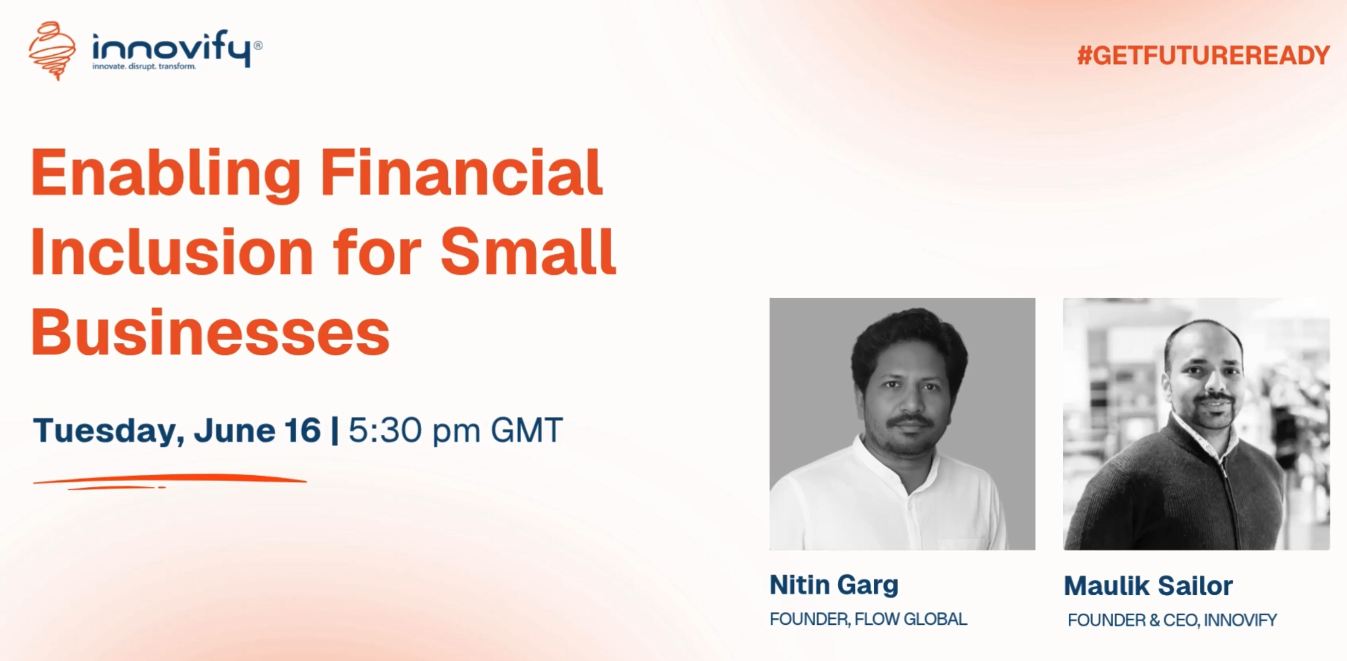
In this conversation, we explore Nitin Garg's journey from advising businesses across some of the world's most complex and underserved markets to co-founding Flow, a fintech lender delivering innovative small business financing solutions across Africa, Southeast Asia, and Latin America. Drawing on deep market insights, Nitin built Flow to help SMEs access growth capital through financing models designed around real-world cash flow patterns and business realities. Using transactional data and alternative credit signals to power underwriting, Flow has created a scalable, profitable, and impact-driven business serving entrepreneurs often overlooked by traditional financial institutions. The conversation highlights the opportunities in financial inclusion, SME lending, embedded finance, and emerging market innovation, while exploring how Flow is helping reshape the future of small business finance through intelligent underwriting and accessible funding solutions.
Maulik (00:02.586)
Thanks a lot, Nitin. So why don't we start with a quick intro about your background and what you've done before starting this company. And before we start, thanks, BDO BDO is also a global auditor. That's actually when we came in, me and my co-founder, we sent the photo to our video colleagues. My co-founder is also a mic.
Yeah, so when we were entering into the business we send the photo to auditors. Okay guys, come on send us the final report. It's been some time. Yeah, yeah, it's good to be there. thank you. So I yeah, so I'm one the co-founders of Flow. We started in 2019. Me and Michael, we were consulting before that and even before that I started my, an engineer.
I started my career in Dubai and like came back to India joined you cannot hear sorry so joined like an NGO which was doing microfinance in Mumbai that is where I kind of started on this space where of financing small businesses so for good two years we were financing small businesses in the slums in Mumbai in India and that is where I kind of
got introduced to the idea of small businesses and how these small businesses are so different to the usual small businesses that we look at. So when I talk about small businesses, mean the corner shops, mean someone who is running his business like it can die within three years, almost 60 % of them don't survive after five years, they usually die.
It's usually because of the capital. They usually operate at the same scale for quite a good time. if you think about the emerging economies, that is where our markets are, which are basically Africa, Southeast Asia, and Latin America, almost 70 to 75 % of the economy is run by the small businesses. So they are so important.
Maulik (02:24.055)
So that is where I started in Mumbai. Then I joined a consulting company. We were operating on the same space. We were consulting with lot of banks and microfinance institutions, helping them to crack the mass market. So I worked a lot in India. Initially, when the whole Aadhaar thing was starting, I was lucky that I got an opportunity to work on the Aadhaar project when the whole NPCI was being thought about. So it was a lot of good for me. I was very young. It was more of an opportunity. I learned more of...
Because being a consultant, think consulting is the best position to be in, especially when you are young, because you absorb so much if you want to, but you can learn so much. So I just learned on all these projects. Then we started working outside India, starting with Africa, Kenya, when we worked with a large bank called Equity Bank. We helped them to do the whole mass market strategy. And then slowly we're working across the globe. We worked in Icav or other banks in...
worked with in South Africa, with bank Colombia in Colombia, with banks in Papua New Guinea, even so, basically traveling, having the best life as a consultant, you get paid for traveling and also for learning. So yeah, I was doing that for quite some time, but then, and then I met Michael, co-founder in Papua New Guinea, when we were doing the policy for the government. We basically used to work a lot with the government.
governments across the globe on the financial inclusion policies. We were doing the financial inclusion policy for the government. And then that's where we met and we decided we'll join forces. We consulted for some time and then in 2019, then we were in Mozambique on one of the missions, we decided that we want to start something on our own. So that is where, so we went from there to Uganda. We registered a company immediately. Then we came back and we registered a company.
UK and we always knew that these are our markets because we want to be everywhere we working as consultants because we know that there is still a huge gap which is not being supplied to by the banks, by financial institutions and there's a huge opportunity and a huge need which we want to work on. So yeah, we'll just start there.
Maulik (04:45.939)
You already kind of answered my next question, which was like how the idea came along. But if you want to elaborate more, then okay, what did you saw in the market? You know, what sparked between you and your co-founder to go for, you know, to turn the force and start this particular startup? So we worked a lot with the banks. We used to work a lot with the banks, helping them to design the products and even the channel. like in Africa, for example, the main channel is Mobile Money.
And if you look at their economy, like 90 % of it is based on mobile money and not through the banks. Most of the transactions are done through the mobile money. And so we, so I basically, me and my partner, we have worked a lot with the banks, helping them to build these channels where you can go to a shop and do a financial transaction, like put money into your bank account. So we did that almost across the markets.
But we knew always that there is this challenge that the shop has to invest their own money to be able to do it. And then we saw that if we want to work with small businesses, we need to start at a place where we can see something. So when we talk about these transactions that were happening at the shop using mobile money, we saw, this is the place where we can start. So that is why we started mobile money agents, because we knew that we can see a
of data. So like right now when we find this mobile money agents, we can see every single transaction that they do. And our underwriting is actually stronger than anyone can do on any business. I can challenge any bank on the underwriting because I do my underwriting based on every single sale transaction that happens at the shop for that particular product. So that's why, yeah, that's what we saw.
Now you've got your idea started, you join forces, you get the hit-and-run running, but typically in a FinTech and regulated space, you know, have, you know, the cost of regulation, right? And a lot of FinTech tend to race upfront to how those regulations or licenses or permissions in place work, right? Can you describe how it was for you first, you know, 100 days for six months for you to like, okay, we're going to do it.
Maulik (07:10.093)
to actually doing it. I think it started pretty soon and thanks to the Ugandan market and the regulator because the Ugandan regulator is very smart. He used to work at the Ugandan regulator. he knew that that is where we can start. So they have a very light license, which was microfinance license, which is not even under the central bank, which is under the microfinance authority. So it's still regulated space.
But it's easy to get in. It's not that difficult. when we started, applied for licenses in both Uganda and Rwanda. In Rwanda, we applied for a central bank license. In Uganda, we applied for a microfinance license. For the microfinance license, actually we got it almost immediately. We already had the license. We started only when we got the license, but we didn't have the tech. So when we started, we...
We decided that we'll not build the tech first. We decided we actually lent on Google Sheets for about five, six months. And before we started building our tech. So when I started building my tech, used to, for close one year, I used to challenge my engineers with my Google Sheet and tell them, okay, this is what I had with Google Sheets. Can you still build it on the app?
So that's how we started. We immediately started.
And I believe or I know that your company is completely remote with a lot of people in working in quite a few places. Would you like to describe the staff you have at the moment? So, yeah, so UK is like the holding entity and then we have subsidiaries in different markets. We have a subsidiary in Uganda. have almost 100 people now. But it's like a structure like a proper bank almost.
Maulik (09:10.743)
We have the CEO, CEO, have all the departments. And it's like proper, of proper like a bank, structured like a bank. And in Rwanda also it's kind of similar, kind of smaller team, around 30 to 25 people. Then we have a big engineering team in India, which is almost now we are at 55, I think by the end of this year we will be around 100. That is in India. Then we have a small team in Madagascar. And now, yeah.
That's pretty much it.
Yeah. And if I am not wrong, you set up this whole thing during the lockdown or the post COVID phase? During the lockdown, it was basically, yeah, we were in Uganda in India during the lockdown and we applied for the license. We were still waiting for the license in Rwanda. I think we got the license just after the COVID, that sort of thing. But in Uganda, we had the license already. We started COVID, yes. Right.
So, you know.
If I were to summarize this whole thing, it's like you are solving a market where there's a lot of manual broken processes, lack of documentation, right? Working with people or trying to get people on board in your team during the lockdown phase so you may not be able to meet them either in person, right? So, and again, trying to do landing on the exit without the tech, right? Which probably a lot of it not.
Maulik (10:46.861)
What do you think has been the most challenging part for you during those years before you got your product market fit Like initially when we were doing it, it was basically finding the right people to do it on the ground because we were not able to travel to these markets. And we were also learning to be very honest when we started, we thought me and Michael, we will have to do rounds every three months to our markets.
So we decided that, we'll go two rounds and we'll just manage it like that. But during COVID, we learned that we can actually work remote. So we also learned that we during COVID that we can work remote. And then accordingly, we kind of adjusted everything that we were doing to the reality, which was that we cannot travel. So even in India, we had this small engineering team that we had to build. And that was really difficult.
finding the people who can manage the business without us traveling to these regions. We were lucky in Uganda actually the impact was there but because of the sector we operate in, mobile money is so central to everything because even when the banks were not working people were still using mobile money to do their transactions. So we still had customers who were asking for
credit for mobile money because there were still customers who wanted to pay their bills using mobile money. So during COVID actually on the business side, we were still running because the need was so much. Now, the key thing is, you generally like given your setup, you bought our based in London, right? London being the fintech, you know, like the capital of the world. Generally a lot of fintech coming out.
they would be trying to the developed economy, right? You know, how can I build the next products in the market? How can I build a platform to comply for the upcoming new regulation, right? How can I move the money faster, whatever, right? But you focused on a market which was like completely opposite than what you would have in the UK, for example. You know, what's your view?
Maulik (13:09.901)
trying to build for a market, which is often a world of trade. And even like a, I mean, I speak to a lot of founders, you know, and even I do my own research about, and generally, okay, you've got your data of countries and you want to get the solution there because you've got a good price point. And then you look for emerging market, like, you know, places like India, China, Brazil, know, the biggest countries and, know, Middle East and so forth. But you went for a completely different end of the market, right?
What's your view there? Like, you know, are there this market full of opportunities? You know, where do you see, you know, if let's say somebody wanted you something in those markets, you know, what would you tell them? We would say these are future markets. But also like being very honest, I have not worked in the developed markets. Probably also I'm not informed of how good they are or they are not. I've only worked all my life.
as a consultant in emerging markets. I know how good they are. I can only speak for them and not really for the other markets. But our markets are future markets. These are markets, if you look at the demographic dividend, there are so many young people there. All these people are going to be, if you look 20 years after, what will it be in Europe? You can see the average age here versus the average age in
our markets are like, huge difference. So those are the future markets. So we are building for future. So one more thing we tell them is the margins would blow their mind. So we make 95 % yield on our loan portfolio. We make a risk adjusted interest margin of 55%. Like no banker here can say that about themselves. And so we would also tell people here, you can participate.
You can be issued a bond here. So people make between 10 and 15 percent depending on what they invest on Bonds that we issue so people get an app they see that we fund the small businesses that mentioned small corner shops in rural Uganda So people feel good because they do something but they also make way more than HSBC and JP Morgan
Maulik (15:35.394)
When on the other side for the customer, so there was like a third party study which was done across 55 institutions in East Africa. We were the first in terms of the first access. Like most of our customers are the first time borrowers. They have never received any loan in the past and they have been running their business. So we were the first in first access and also a lot of other factors. So we're creating a huge impact.
and the same time being able to generate a yield that Michael is mentioning. And that is because we're working in a market business. There's no one, because it's so challenging. And if you want to be in that market, you have to create everything on your own. So we created the whole payment infrastructure on our own. It's our own thing. We have no integrations with any third parties. We build everything on our own because there is nothing. So just talking of that, right, you generally,
Again, when you talk of FinTech and the payment and protocols, then historically you had all the facts and Swift and whatever, right? And then in last 10 years, quite a few interesting protocols came up. Like in India, for example, the UPI, right? And suddenly...
In my view, the way they built it was not to copy what was already there, but just to build completely new depending on the needs of a particular market. And in turn, they ended up creating something much better than the top players. And slowly, I think there's a lot of talks about UPI being integrated into Swift and the Euronet payment systems and so forth. So in your experience in all these countries,
Have you seen something interesting that could like, know, let's say for what to brought together in the UK or know, any kind of economics would be a game changer? I think definitely like there are some ways in which those markets are more advanced because look, look for the small businesses, the gap that we see emerging economies, we still see that gap in the UK. I still see
Maulik (17:57.226)
We have done our studies in the UK. We are still kind of in our mind thinking about whether we should apply for the FCA approval here or not. Should we do it in the UK or not? But the demand for what we do in our markets is very much there in this market also. Because it's the same kind of thing. Like people want to work in the developed markets in the same way people want to work with the clients who can afford it.
But we are talking about clients who actually cannot afford what is existing. They want a new product. They want something that works for them and not really something that works for something which is much more. So demand is still there in these markets. And if you think about something like mobile money, there is a lot to learn even for this work here. Because mobile money makes it so easy for anyone to participate, something like UPI.
UPI is such a good example because you can see now in India, there is so much data available on the small merchants, even someone who is selling like food on the streets, there is data available on that guy. So institutions like us can actually provide an opportunity for this small retailer to also grow. That is what we do. Our tagline is we help small businesses to grow.
That is what we exist for. But things like this make it possible for us to do. That's what I think is still not like these developed countries still haven't reached there. There is still a segment which cannot be reached to. And even if you go to small businesses in the UK, even in London, even anything else, you will still see people walking with like there are these local
people who will go and go to each of the shops and do savings in cash. I have seen it personally in the UK, in London, people go to these shops and collect savings in cash and they keep a record of their diaries So there are these kinds of things also happening in London, but we don't know that. I think we have to be more inclusive with these models also.
Maulik (20:16.673)
You know, this is all about opportunity, you where they want to build and so forth. of course, building a FinTech needs a lot of investment. You would have raised from angels and VCs, right? Generally VCs would say, okay, you've got to be in the market that you're selling. You did you get those kind of business? We used to initially. Initially, used to get that a lot. Yeah. But now we always used to say, look, we want to build a global company. And I don't want like, we don't want any dependencies for the local businesses.
on us. We don't want us to make decisions for Uganda. So that's why I think now we have passed that. We have definitely passed that because now nobody pushes it because they have seen our record on how we have built Uganda, how we have built Rwanda. They have seen how we are able to build the tech which is now being used by banks and banks which are much bigger than us in Zambia, Kenya, Ghana
And now we also sign a contract for Papua New Guinea. We have a contract for Madagascar. There are banks which are using our platform. And we have built it being here. Our engineers are based in India. So now there was a stage where it was like a big challenge. It was always like part of the discussions, but now no one asked for that. We have passed that. Before we come to conclusion, we'd just like to open up.
you the audience if you have any questions. Yeah, you just finished your last thank you for the talk by the way really interesting. You finished your last statement saying you had a lot of big challenges. Where do you continue to find your motivation to grow and push your company forward? Just because we want to build it and we are just too small right now from where we want to be. We want to be a better. Right now we are just in
six markets and we are just in Africa still. We are starting in Peru very soon. We have already registered the company and we have a person there. We are building a team there slowly. So we want to be everywhere and that's it. That's what keeps us trying because we are just very smaller than where we want to be. So you're going conquer Latam next then? Yeah, we want to do Latam.
Maulik (22:45.773)
What's the kind of underlying key challenge on thinking distribution and underwriting models and things like that? But what are they in your words? It depends on at what level you look at. So there are lot of challenges like initially when you start capital is always the biggest challenge for especially for a business like us. It's like fuel for us, right? So you cannot
It's not a software company. It's like we need a camera. So that is like the biggest challenge and it continues to be. And then after a stage, you start hitting a place where you, the manpower becomes like a challenge. But operationally, like what you're asking, yes, underwriting is a challenge, but not really that much because we still deal with the segment where we get a lot of data on basis of which we can do a lot of underwriting.
It's just that we know it's good. It's difficult to convince the investors initially on the underwriting that we do because they cannot believe it. They cannot believe it that we can see every single transaction and underwriting is so strong. It's difficult to build that initial thing with the investors. And on the ground, it's just difficult to keep building the team. We have frauds every year. It's like a...
because there's always a race between the tech team and the guys on the ground like okay who's faster like who gets there first but yeah challenges are part of this game I think that's the best part also of building a business if you don't have challenge you don't have fun it gets going so what do you need investment? yeah definitely we need investment and we need partners
Maulik (24:42.197)
Both both both But equity is more pressing. got lot of have huge amounts of debt like that. Okay. So on the equity side, we don't fit into clear VC records. VC is like, well, that or they like asset light, or skill.
We see some really bad plans to jump.
This is well backed. The problem is how strong is your competition? Because we have this one company that came to us and they turned it over to 2 billion. Take a guess what their gross margin is from 2 billion. 8 billion. Oh well. That is that much. So it's possible. So they have a check.
Yeah, definitely. But that's why we want to grow. That's where we want to That's like the next stage. Cool. Yes, please.
Maulik (26:07.798)
It's just a perceived challenge. It's just a product design problem actually because when you design for the market it will work. Our on-time repayment rates have always been between 98 to 99 percent and always been like this, always in that bracket.
And it is because the product that we have designed actually suits the cash flows, it suits the business. We talk in the same language as they do in terms of like the product and their business. Like we have to understand the businesses that we are dealing with. These businesses don't have B They don't understand what is profit. They don't understand what is balance sheet. They don't even know what are their margins. For them, it's cash flow.
I am running a small business, I will have some cash which I will use to buy the stock and I keep running on it. I sell the stock, then I know I have extra money so I buy extra stock. And when I need money for my expenses at home, I just take it from the same cash. So that is how these businesses operate. So first we need to understand these businesses that we are dealing with and if we design for them, it works. It works better than the bigger businesses. So this is just a perceived risk.
I would say and this also a product design issue because no one wants to design for them because it's just perceived as a small opportunity, a smaller opportunity than dealing with a bigger one.
because our average size is $300. Now if you go and talk to a bank here to do a loan for $300, it's too small. It's not worth the pain, is what they will say, right? So that is the problem. It's not really the risk is not high. If you design well. Sorry, just a coordinate. You said earlier though that you're, I think that you're selling kind of technical infrastructure to banks.
Maulik (28:06.059)
Yeah, also. So why does it work? Why does it work for those banks? On the one hand, you're saying it's too small for a bank. that. Yeah, those financial institutions do it because they use our platform. Otherwise, they'll not be able to do it. So we don't use our cost and easy. Yeah, so we don't only give them the platform. We also give them the know-how, right? Because we want to expand. We want to be present in all these markets. So, example, Zambia, when he started with this partner in Zambia, which is like a big lending institution.
at least 10 times of us in terms of size, even more actually. When we started with them in Zambia, they were able to see growth within the first six months. And they were so excited that they immediately signed the contract with Kenya and Ghana. So now we are bringing three countries with them. And they also want to do other markets where they are not even there. So it's just a matter of being able to see it, that it can happen. Otherwise, the opportunities are small. Any other questions?
Yeah, so you said one of the best things that you did with your underwriting. That's your strongest thing here, My understanding of underwriting is also understanding your audience, understanding the business, and therefore you were able to do this. Have you operated in Africa, sure each of the markets are very different. You making a a big leap which is up in New Guinea and Peru. Very different styles of working, very different cultures, very different things. How are you dealing with that radiation that you see?
So we have worked in all these markets as consultants. I did this product in Colombia, a bank in which is like the most popular product there, it's called Ahoro Lomano. I worked in Papua New Guinea with a bank there, to build my own channel. So I understand there are differences, but there are lot of similarities. Because end of the day, these are markets with the same kind of people, with the same kind of businesses, with the same kind of challenges.
The only thing that differs is a little bit how you do it, what are the regulatory challenges, what does the market understands. We have to just design the product. For that market. For that market. We always need local people. We never do it without local people. So like in Peru right now, where they're building a team, all three people are from Peru. When we started in Uganda we started with a local guy who also was a partner in the local business. And we started building a team.
Maulik (30:33.131)
So that's why we have like 100 people in Uganda, we have close to 25 in Uganda and now we building in Peru. So in our lending markets we are doing that and when we work with the banks usually they have their teams in these markets. We always need local people but I would say like there's not really, problem is not very difficult. We used to work on the same problem everywhere, tracking the mass market and designing products for the mass market
And as I did a lot of research as a consultant on savings and loans and everything, the mass markets, the problem of the world is everywhere the same.
Maulik (31:18.669)
I believe that's the end. Cool. Thanks a lot, Nitin. thanks. Wonderful. Thank you very

.png)

.png)
.png)

.jpg)