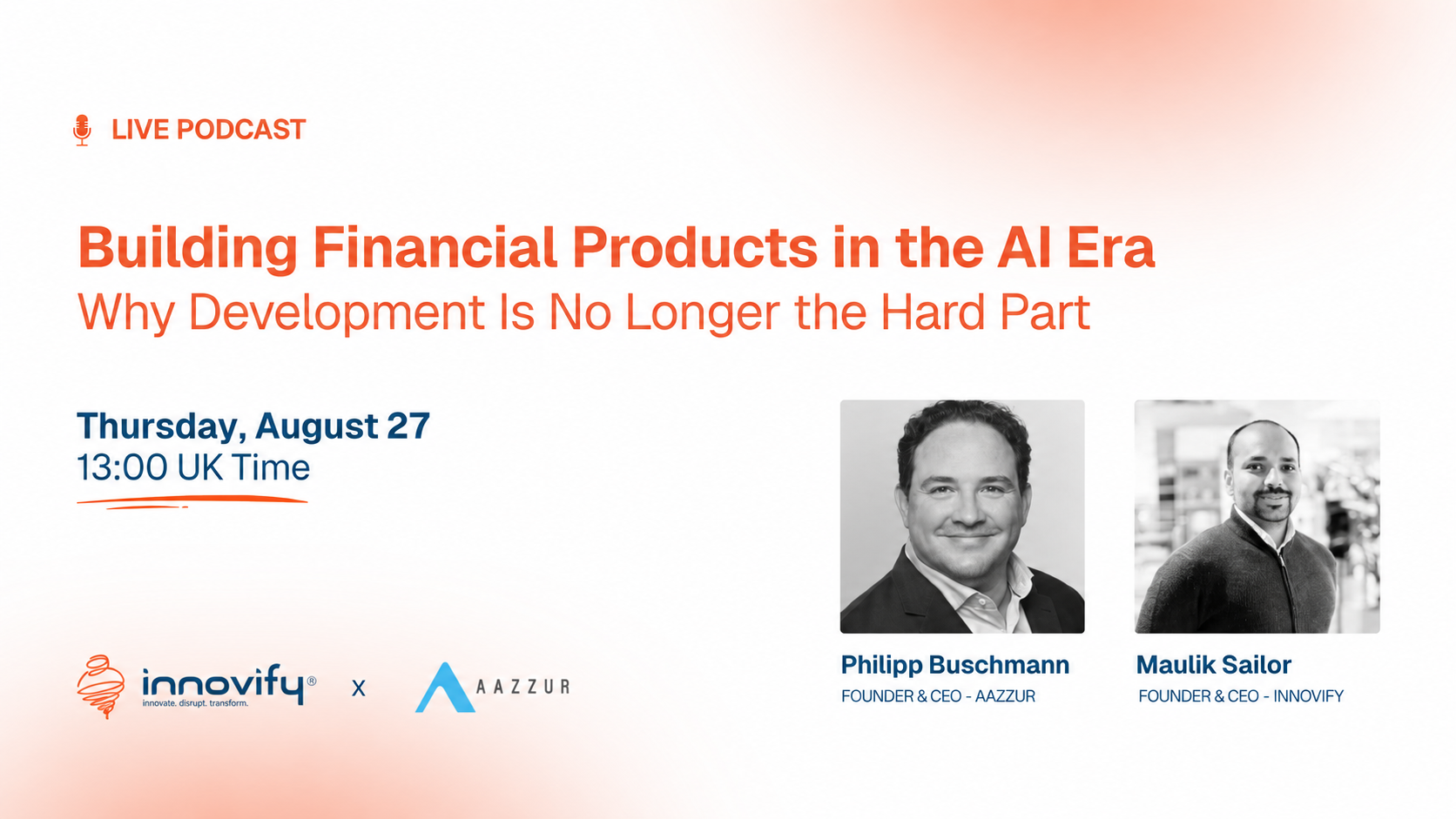
Building Financial Products in the AI Era: Why Development Is No Longer the Hard Part
Host: Maulik Sailor, Founder & CEO, Innovify
Guest: Philipp Buschmann, Founder & CEO, AAZZUR
Introduction
Maulik Sailor:
Welcome to another episode of the Get Future Ready Podcast.
Today, we're exploring how AI is reshaping financial product development and why building software is no longer the primary challenge for businesses operating in financial services.
Over the years, I've spoken with hundreds of business leaders across FinTech, eCommerce, and technology. One topic consistently comes up: AI is transforming every part of the business, from operations and compliance to product development and customer experience.
While technology has made it easier than ever to build products, successfully launching them remains incredibly challenging. The real questions now revolve around regulation, customer adoption, operational readiness, governance, and strategic execution.
To help us explore this topic, I'm joined by Philipp Buschmann, Founder and CEO of AAZZUR. Philipp has spent decades building financial technology products and helping organizations launch embedded finance solutions.
Philipp, welcome to the podcast.
Philipp's Background and the AAZZUR Mission
Philipp Buschmann:
Thank you for having me.
I've been building financial technology products for nearly three decades. I started as a developer, moved into strategy consulting, became an entrepreneur, and today focus on helping businesses access embedded finance capabilities through AAZZUR.
We launched AAZZUR because we saw a recurring problem. Many businesses can benefit from embedded finance, but accessing those capabilities is often difficult, expensive, and time-consuming.
Our goal is to bridge the gap between brands, platforms, and financial institutions. We help businesses launch financial products significantly faster and at a fraction of the traditional cost.
Too many companies rebuild the same financial infrastructure repeatedly. We productize that infrastructure so businesses can focus on creating value for their customers.
Why Building Financial Products Has Changed
Maulik Sailor:
What's interesting today is that AI has dramatically reduced the effort required to build software.
Many businesses are considering launching wallets, payment products, lending services, embedded banking capabilities, or branded financial products.
However, software development is becoming cheaper and faster. The challenge is no longer simply building the technology.
If you were advising a board considering an embedded finance strategy, what would they need to think about beyond product development?
The Build vs Buy Decision
Philipp Buschmann:
The first question is whether financial services are part of your core competence.
If you're a retailer, you're an expert in retail. If you're a travel company, you're an expert in travel. If you're a manufacturer, you're an expert in manufacturing.
Financial services require specialized knowledge.
Boards need to decide whether they want to build that capability internally or work with experts who already understand payments, banking, compliance, cards, and lending.
On one side, you can build everything from scratch. That gives you flexibility, but it requires significant resources and deep expertise.
On the other side, you can use an off-the-shelf solution. That may get you to market faster, but it often lacks flexibility and may not fit your customer journey perfectly.
The most effective approach is often somewhere in the middle: leveraging proven infrastructure while maintaining enough flexibility to create a differentiated customer experience.
Building for Customers, Not Products
Maulik Sailor:
Ultimately, organizations aren't launching financial products for their own benefit. They're doing it to serve customers better.
How should leaders think about that?
Philipp Buschmann:
The biggest mistake I see is organizations becoming product-centric instead of customer-centric.
Financial services professionals often focus on product features, rates, technical capabilities, and functionality.
Customers don't think that way.
Customers care about outcomes.
If someone is on holiday and needs additional spending power, they don't care how the lending product works behind the scenes. They care about getting access to funds quickly and seamlessly.
The most successful businesses start with the customer journey.
The question should always be:
"How does this improve my customer's experience?"
Not:
"How many features can we add?"
Organizations that focus on customer outcomes consistently outperform organizations that focus exclusively on product features.
The Importance of Seamless Experiences
Maulik Sailor:
Customer experience is critical. Businesses want financial services integrated naturally into their platforms rather than forcing customers onto separate systems.
Philipp Buschmann:
Absolutely.
Customers expect seamless experiences.
However, there is a challenge.
The more integrated a financial service becomes, the more organizations need to consider regulatory requirements, privacy obligations, data governance, and compliance obligations.
Businesses want unified experiences, but they also need to avoid turning their entire organization into something that must operate like a regulated bank.
The good news is that modern infrastructure providers can help organizations strike that balance much more effectively than they could in the past.
Regulation and Compliance
Maulik Sailor:
Regulation is often one of the biggest concerns for organizations entering financial services.
What should leaders be aware of?
Philipp Buschmann:
It depends on the type of financial service.
Embedded finance includes:
- Banking
- Payments
- Cards
- Insurance
- Lending
Each area has different regulatory requirements.
Businesses often assume they need banking licenses or financial regulatory permissions themselves.
In reality, many can partner with regulated providers and leverage established compliance frameworks.
The key is ensuring that regulated activities remain properly governed while still delivering great customer experiences.
Organizations operating in higher-risk industries will naturally face greater scrutiny and more restrictions.
Why Embedded Finance Is Becoming Essential
Philipp Buschmann:
Embedded finance isn't simply a trend.
It's increasingly becoming a competitive necessity.
Organizations that provide integrated payments, financing, loyalty programs, or financial services can improve customer retention, increase transaction volumes, and create new revenue opportunities.
In many industries, businesses that fail to embrace embedded finance risk being left behind by competitors that do.
The question is becoming less about whether organizations should explore embedded finance and more about how they should implement it.
Launching Financial Products Successfully
Maulik Sailor:
Many organizations underestimate the complexity involved in launching financial products.
There are integrations, compliance requirements, infrastructure providers, data flows, and operational processes.
What does success look like?
Philipp Buschmann:
If you build everything yourself, you may need a large specialist team.
If you use experienced providers, the effort required internally can be dramatically reduced.
Typically, organisations need a product owner who understands customer impact and a business owner who understands commercial impact.
From there, much of the financial infrastructure, compliance management, monitoring, integrations, and regulatory complexity can be handled by specialist partners.
That's one of the advantages of modern embedded finance platforms.
AI and the Future of Financial Products
Maulik Sailor:
AI has changed how products are built.
How do you see its impact on financial services?
Philipp Buschmann:
AI is already transforming software development.
You can generate interfaces, build workflows, create prototypes, and accelerate development dramatically.
But regulated financial products are different.
You need auditability.
You need security.
You need governance.
You need regulatory compliance.
If AI sits between a customer and a financial transaction, organizations need to know exactly what happened, who made the decision, and how accountability is maintained.
That's why a significant amount of work is currently focused on creating trusted frameworks that allow AI-powered systems to operate safely within financial environments.
Agentic Commerce and Agentic Payments
Maulik Sailor:
Agentic commerce is becoming a huge topic. What's your perspective?
Philipp Buschmann:
No one knows exactly what the future will look like, but change is happening quickly.
Some businesses may experience minimal impact in the short term.
Others will be transformed.
I think there are three broad categories.
The first is businesses where AI has relatively little impact.
The second is businesses using AI primarily to improve productivity and efficiency.
The third is organizations that are fundamentally AI-native.
Those organizations are designing entirely new products and experiences around AI capabilities.
That is where things become particularly interesting.
Where Agentic Commerce Works
Maulik Sailor:
I think agentic commerce works very well for certain use cases.
For example, if I know exactly what headset I want to buy, I can ask an AI agent to find the best price and place the order.
That saves time and effort.
But for more complex decisions, such as travel planning, there are often personal preferences and contextual factors that AI may struggle to fully understand.
Some experiences are about exploration rather than optimization.
Philipp Buschmann:
I agree.
But the important thing is that businesses should not make decisions based solely on what AI can do today.
They should also consider what AI will likely be capable of two or three years from now.
Technology is evolving extremely quickly.
Organizations need to build for where the world is going, not where it is today.
Leadership and Technological Change
Maulik Sailor:
One lesson that has stayed with me comes from my experience at Nokia.
When I joined, Nokia dominated the mobile industry. The company had market leadership, resources, talent, and tremendous momentum.
Yet within just a few years, the market changed dramatically.
The lesson for me was that even successful companies can underestimate disruptive change.
Today, I see similar risks with AI.
Organizations often assume they have time.
The reality is that by the time a trend becomes obvious, competitors may already be ahead.
Philipp Buschmann:
That's a great example.
One reason Apple succeeded was that they focused obsessively on customer experience.
Many competitors focused on market share and operational metrics.
Apple focused on how people would interact with technology.
I think the same principle applies to AI and embedded finance.
Organizations that focus on improving customer lives tend to outperform organizations that focus solely on technology or financial optimization.
AI as the Next Interface
Philipp Buschmann:
I believe AI is more than a tool.
It represents a new interface between humans and the digital world.
We've seen major transitions before:
- Command-line computing
- Graphical interfaces
- Personal computers
- Mobile devices
- Cloud services
AI may represent the next major transition.
Every time a new interface emerges, the competitive landscape changes.
That transition is already underway.
AI Governance and Data Privacy
Audience Question: How should organizations govern AI and protect sensitive data?
Philipp Buschmann:
I think we'll increasingly see AI operating closer to where data is stored.
Organizations will maintain control of sensitive information while using AI within secure environments.
The challenge is ensuring governance, privacy, accountability, and transparency from the beginning.
Governance is not something to add later.
It must be part of the design process.
What Leaders Should Stop Doing
Audience Question: What should FinTech leaders stop doing and start doing in the AI era?
Maulik Sailor:
I think leaders should stop over-relying on data.
Everyone now has access to increasingly similar tools and information.
If everyone looks at the same data, they often arrive at the same conclusions.
What differentiates great products is customer understanding, intuition, experience, and strategic judgment.
Those things still matter enormously.
Philipp Buschmann:
I would summarize it this way:
In a world where rationality can be bought, competitive advantage comes from what makes your organization unique.
If everyone uses the same tools, examines the same data, and reaches the same conclusions, differentiation disappears.
Organizations still need creativity, insight, and vision.
Closing Remarks
Maulik Sailor:
Philipp, thank you for joining us and sharing your insights on embedded finance, AI, product development, and the future of financial services.
Philipp Buschmann:
Thank you. It was a pleasure.
To anyone building products, leading businesses, or exploring embedded finance opportunities, I'd encourage you to stay curious, keep learning, and continue preparing for the changes ahead.
Maulik Sailor:
Thank you everyone for joining us. We'll see you in the next episode of the Get Future Ready Podcast.










.png)

.png)
.png)

.jpg)