



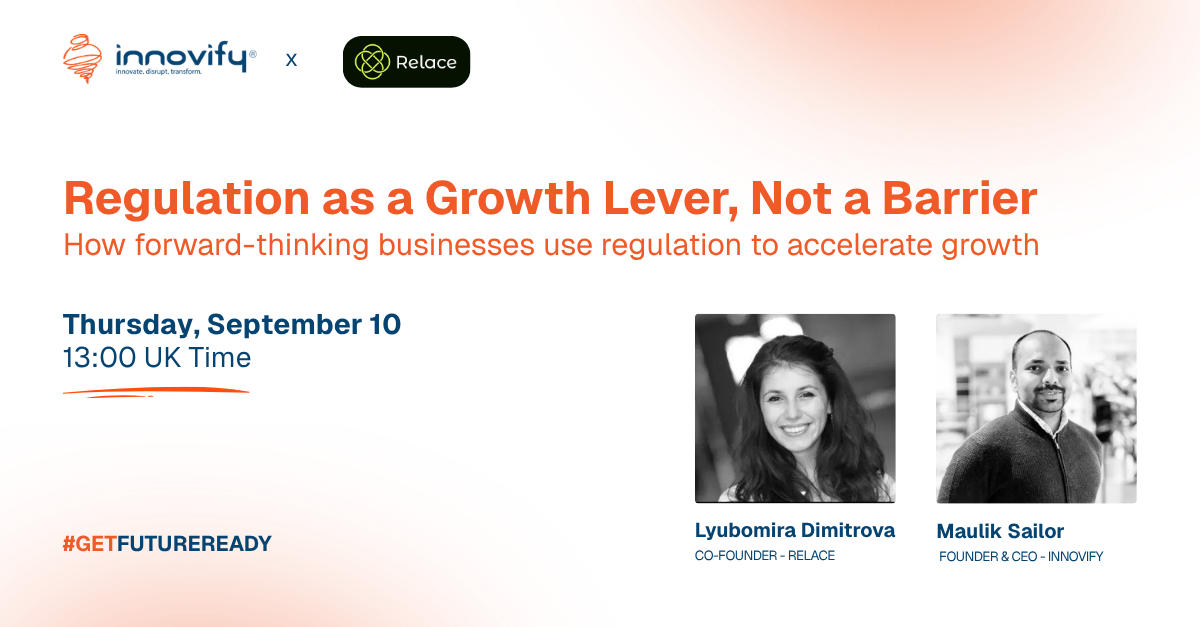
Regulation is often viewed as a cost of doing business. Many founders, startup teams, and scaling organisations see compliance as an obstacle that slows innovation, delays product launches, and increases operational complexity.
The reality is often very different.
The most successful businesses increasingly use regulation as a strategic advantage. By embracing compliance early, they build stronger businesses, improve investor confidence, create trust with customers, and establish foundations that support sustainable growth.
In this episode of the GetFutureReady Podcast, Maulik Sailor, Founder and CEO of Innovify, speaks with Lyubomira Dmitrova, Co-Founder of Relace, about why regulation should be viewed as a growth lever rather than a barrier.
The discussion explores startup compliance, RegTech, financial services regulation, AI governance, investor readiness, operational resilience, embedded finance, agentic payments, and the growing importance of regulatory intelligence in modern businesses.
As AI, digital finance, embedded payments, and global software platforms continue to transform industries, regulatory expectations are evolving rapidly.
Businesses today must navigate increasingly complex requirements around:
Companies that proactively address these challenges are often better positioned to scale, attract investment, and establish long-term competitive advantages.
One of the central themes of the conversation is the relationship between regulation, trust, and innovation.
While lightly regulated environments may enable rapid experimentation, trusted regulatory frameworks often create the confidence needed for customers, investors, and businesses to adopt new products at scale.
Effective regulation can help organisations:
Rather than restricting innovation, regulation can provide the structure necessary for long-term success.
Many startups postpone regulatory planning until late in the product lifecycle. This creates avoidable risks and often leads to expensive redesigns, delayed funding rounds, and compliance challenges.
According to Lyubomira, founders should shift regulatory thinking earlier into product development and business planning.
By understanding their regulatory perimeter early, companies gain greater clarity around:
This approach helps create stronger and more resilient business models from the outset.
Regulation is often perceived as an operational cost. However, the discussion highlights how compliance can become an investment that supports growth.
Businesses that demonstrate strong governance and risk management frequently benefit from:
For startups approaching Seed or Series A funding, regulatory maturity can become a meaningful differentiator.
The financial impact of regulatory breaches extends far beyond penalties and fines.
In today's digitally connected world, non-compliance can trigger reputational damage, negative publicity, customer distrust, and long-term brand challenges.
The conversation explores how even seemingly minor regulatory oversights can result in significant consequences when amplified through media coverage and public scrutiny.
The cost of non-compliance is increasingly measured not only in money, but also in trust.
Regulatory environments continue to evolve across industries and geographies.
From AI legislation and digital privacy requirements to sustainability reporting and financial services frameworks, businesses must continuously monitor emerging developments.
This process, often called horizon scanning, enables organisations to:
For modern businesses, regulatory awareness is becoming a continuous capability rather than a periodic activity.
Artificial Intelligence is creating entirely new regulatory questions across virtually every sector.
The discussion highlights growing focus areas such as:
As AI capabilities expand, organisations will require stronger processes, documentation, and governance structures to maintain compliance and trust.
The conversation also examines the emerging world of agentic commerce and AI-driven payments.
As intelligent systems begin making purchasing decisions on behalf of customers, new regulatory questions emerge:
These questions will play an increasingly important role in shaping the future of commerce, payments, and financial services.
One of the strongest takeaways from this discussion is that regulatory thinking should become part of everyday business operations.
Successful organisations are not simply reacting to regulations. They are actively monitoring changes, documenting decisions, understanding risks, and using compliance frameworks to make better business decisions.
When embedded into company culture, compliance becomes less about avoiding problems and more about enabling responsible growth.
RegTech refers to technology solutions that help organisations manage regulatory compliance, risk management, governance, and reporting requirements more efficiently.
Early regulatory planning helps reduce future compliance costs, strengthens investor confidence, and prevents expensive rework as businesses scale.
Strong compliance practices can improve customer trust, increase investor confidence, reduce risk, and create competitive advantages in regulated industries.
Horizon scanning is the process of continuously monitoring regulatory developments to understand how future changes may affect a business.
AI introduces new requirements around governance, transparency, accountability, disclosures, intellectual property, and responsible use of data.
Financial services, FinTech, healthcare, insurance, AI platforms, payments businesses, and digital marketplaces are among the sectors experiencing the fastest growth in regulatory obligations.
Maulik Sailor (00:10)
You know, I'm your host, Maulik Sailor. we run this podcast on every bi weekly basis and we bring experts who are doing things that can help solve some of the critical problems that you may be facing in your business to scale or grow or anything else. this is your Get Future Ready podcast. we wanna hear from the leaders and operators who are doing and tackling some real
business
challenges directly from them, not fluff talk, but directly on their own experiences. And today, I have a wonderful guest today. But before I introduce the guest, let me just introduce what we're going to talk about. Now we operate largely we focus on financial services as our as our core offering. And most of the clients and the fintech products that we end up doing
there's always, you know, you you naturally think that there will be a lot of regulations and compliances that you need to cover when you go to the market or even post market, you know. there are so many things that you need to you need to look at. Even if you're not a fintech business, but just generally let's say an e-commerce platform or a website, Shopify website or whatever, there are still regulations that you may need to you need to be aware of and may impact your business.
And this is becoming a big hot potato right now because with the AI, you know, things are changing really fast and there are a lot of concerns around around data, privacy, you know, authenticity, you know, fraud, com and and compliance are you know, there are a range of compliances out there, but there are also new compliances coming up across the board. And
How does that impact your business, right? To be honest, I don't think most of the founders know that. or maybe they know to a degree, but you know, when you're launching and then when you really start looking into a particular regulation, that's when you really realize that okay, what do you need to do? So today our topic is all about regulation. You know, a lot of businesses, a lot of founders and startup would consider regulation as a inhibitor to growth, but that could be your growth lever.
And that's exactly what we're gonna talk today with our expert, Lyubomira Dmitrova, and she's a co founder of a of a regtech platform called Relace. And she's gonna take us all through you know, why regulations are important and what can you do to leverage them for your growth. Welcome, Lyubomira How are you?
Lyubomira (Relace) (02:58)
Hello. I'm very well. Thank you. And thank you for having me. I'm really, really excited about this conversation because as you mentioned, it's a very, very hot topic and there is a lot of activity and things happening.
Maulik Sailor (03:09)
Yeah. That's great. Now Luba Luba Mira, you I I'll struggle with your name. So can I just call you Luba or Lubo?
Lyubomira (Relace) (03:17)
Yes.
Yeah, perfect, perfect. Don't worry about it.
Maulik Sailor (03:20)
Yeah, okay, cool. Thanks a lot. so so I and I have a friend, you know. I think I told you that I have a friend with a name Lubo, right? So I think I I get carried away with that. but for Yes, yes, true, true.
Lyubomira (Relace) (03:25)
Yeah. Exactly. Another Lubomira from Bulgaria, right?
Maulik Sailor (03:33)
but you know, let's let's for the audience's sake, you know, why don't we start with your introduction, your background, and then
Lyubomira (Relace) (03:40)
Mm. Mm-hmm.
Maulik Sailor (03:42)
also about your company. What does your company do and why you are doing that?
Lyubomira (Relace) (03:47)
Yeah, brilliant. No, thank you so much. with pleasure. So maybe I'll start with Relace and why we started this project. So together with my co-founder Justin, we started the project because of actually a few core reasons. The first one is we really believe that there is just so much opportunity to build value in this space, right? we both believe that actually
You know, regulation it's a very interesting space, right? Because it is often kind of you know being blamed for kind of stifling growth or innovation, right? but in our company we believe it also has been instrumental in building high trust societies, right? And then high trust societies have been amazing at driving innovation, right, with trust.
And we can talk more about that later, but we do really believe that there is a structural problem that is fundamental to actually a successful society and innovative society. And then we believe that it's a really big opportunity to build a valuable company, but also to help the ecosystem. And you know, I really developed this belief in my previous role. So I was part of the core team at Onfido
Which some people in the financial services ecosystem may know. we were one of the kind of most successful AI companies in the UK, right? homegrown technology company, and we developed identity verification technology, right? which was really used for KYC right? Also financial services, right?
Maulik Sailor (05:32)
So you you work with Hussein, Hussein Kasai.
Lyubomira (Relace) (05:35)
Indeed, indeed. And we are very lucky that Hussein is also an angel investor in our business as well. So he he believes in what we are doing and in the opportunity in the space, right? But like I think what is really important is Umfido really played such a pivotal role in helping the entire generation of fintechs, right? The most successful fintechs and the ecosystem that we developed here of the past ten plus years, right?
what Onfido was doing and that generation of technology really helped them to be successful, right? By really abstracting the challenge of identity verification in KYC from their plate. So they were able to focus on their business growth, right? And they were actually leaning into kind of new regulatory management technology.
These businesses were able to to scale. So now obviously a lot of the kind of innovation and technology has gone into AI/ML and KYC more KYP as well recently. but there's just so many other aspects of regulatory adherence that the company has to deal with to be successful, to really operate, to be a viable business in this space. And this is exactly what we are tackling with Relace right now.
Maulik Sailor (06:52)
That's great. You know, that's a great introduction. but before we move on, you know, you you I think you still need to introduce yourself.
Lyubomira (Relace) (06:59)
So real well, I don't really like talking about myself, which so my name is I'm originally from Bulgaria. I think we kinda touched upon that. but I've been in the UK for over ten years. worked at various sizes of organizations, always in technology innovation, right?
large global enterprises and afforded scale ups and startups startups alike. as I already mentioned I spent a good chunk of my career at Onfido really enjoying the the phenomenal growth and rocket ship that this was so I have really developed a deep passion for
how technology can actually be a force for good, right? And can enable us to do more and better and find better ways to do good things.
Maulik Sailor (07:51)
That's
great, that's great. Now, Lubomira, you know, I'm going to deviate a little bit off topic, because you said something interesting which I which I picked up upon, right? So you said that regulation can be lever of can enable innovation within a particular society or industry, right?
Lyubomira (Relace) (08:07)
Mm.
Maulik Sailor (08:09)
but you will also hear that you know you can easily kill an industry by overregulating it. Right? And and and
Lyubomira (Relace) (08:13)
Absolutely. Agree. Agree.
Maulik Sailor (08:16)
also, you know.
you can have like you know, in the beginning of any major innovation, you know, let's say AI right now, but you know,
Lyubomira (Relace) (08:23)
Mm-hmm.
Maulik Sailor (08:24)
back in the days when Bitcoin started and the whole Silk Route things and then even going back further, you know, when internet started and nobody really knew what to do with internet and whatever, right?
Lyubomira (Relace) (08:32)
Right.
Maulik Sailor (08:34)
you know, there's always an initial phase when there is hardly any regulation in in in the space and
Lyubomira (Relace) (08:40)
Yeah.
Maulik Sailor (08:41)
you know, it can end up becoming a wild west.
But that also allows people to move really fast, innovate faster,
Lyubomira (Relace) (08:47)
Mm.
Maulik Sailor (08:47)
and figure out, you know, what is the dominant design or a business model that works, right? So we got two extreme. Wild
Lyubomira (Relace) (08:52)
Mm-hmm.
Maulik Sailor (08:54)
West, no regulation, fast move, you know, innovate as much as you want.
Lyubomira (Relace) (08:59)
Mm.
Maulik Sailor (09:00)
overregulation could be an innov innovation lever, but it could also
Lyubomira (Relace) (09:04)
We don't
Maulik Sailor (09:05)
kill your your business and industry, right? Where do you think, you know, where where do you think is the right sweet spot?
Lyubomira (Relace) (09:11)
Yeah.
Maulik Sailor (09:11)
Difficult
question, you know, for maybe for Bank of England governor to answer.
Lyubomira (Relace) (09:15)
Yeah,
absolutely. I think this is so interesting. So it's such a big question, right? It has so many facets. So maybe there are a couple of things there that or a couple of angles that we can take this question. So I think the first thing that I really I kinda mentioned this in the introduction, but I really believe it's important to discuss because I I really think it's not being discussed and it's usually a point that has been kind of dismissed, like
Regulation again through history, right? And we can talk about over and under, but it has played an impivotal role in actually building a high trust society, right? And me as an individual believing that I will be protected, right? There's some protections, right? And there's some systemic kind of protections for me. And I think this is important for two things, right? I come from a low-trust society, right? And if you think about it.
The argument, well, they regulate so we can innovate more so we can move faster. Well, if I look at my kind of the country where I come from, we're lower on the regulation, right? But we're also low trust society and we haven't exactly over innovated in the world, right? and and haven't been more successful than let's say the UK. So I think it's really important to kind of keep that lens because the impact of this really is that me as a consumer, right?
I have more trust and I actually have more risk appetite to try new products because I believe there are some protections, right? That will ensure that if something goes wrong, I will be protected, right? And that if somebody is trying to kind of offer me a new product, the risk for me of trying this product is actually lower. So I think that's an important kind of framing of the problem. Now I think to your point over and under regulation and kind of Wild West, right?
So I think whenever kind of the the question of kind of shall we deregulate, I find it just a little bit of to be honest, lazy argument in general, because what I would ask always is let's talk about what is actually the problem here, right? So is the problem a rule, for example, that prevents certain activities or prevents certain product to be offered to a to a group of people or to to the general public or etc.
So is it a rule that prevents certain activity? Right? That's that's one set of conversations and one type of problem. Is it that you actually don't understand, right? What what is expected, what are the rules and what to do about it, right? That's another problem. and the the third one, is it actually that it's just too burdensome, right? Like, for example, like it requires you to do so much that you know it's not business viable, right? So I think
That's really important when we talk about actually what are the dynamics, and if you know, if the regulation is actually the right conversation to be had, right? What is actually the problem within that, then for which we can find the right answer, if that makes sense.
Maulik Sailor (12:27)
Yeah. Yeah. Cool. Look, this is a big political line you know, line f minefield, right?
Lyubomira (Relace) (12:31)
Mm.
Maulik Sailor (12:34)
and and I wanna bring the conversation back to to our audience, you know, it may be relevant to our audience. So you know, we operate in FinTech space. you know, I believe your product also largely covers financial products and financial services, right?
Lyubomira (Relace) (12:51)
Yep.
Maulik Sailor (12:52)
as a as a wider range.
So, you know, let l let's tackle that. You know, I can talk about so many cowboy industries, right? Maybe maybe not today. yeah.
Lyubomira (Relace) (13:00)
That's separate one, yeah, absolutely.
Maulik Sailor (13:02)
Yeah. you know, I just thinking out loud, you know, whenever you talk about no regulations or you know, you talk wild wires and cowboys. You know, not anywhere else in the world, right? anyways, coming back to our topic. so imagine you are a scaling fintech, you are just about to raise your series A.
you know, you can pick a sector you like within the financial services, right? But let's imagine you are a founder, you're scaling well, you are just about to close your series A round and now you need to really double down on your growth, right? pick a pick a segment you like, but can you summarize what are the key major regulations that such founders would need to absolutely make sure that they they have it covered?
Lyubomira (Relace) (13:53)
Yeah, that's an interesting question. I think in look, I think what here actually it's important is the the approach and the rigor, right? So one of the things that we it has been happening, right, is that usually regulation is actually quite a bit of an afterthought, right? and the kind of teams and founders are really excited about their business idea and the product that they want
offer and they're kind of really seeing the future which is amazing. but in a regulated space it leaves with obviously it leaves you with actually a weaker business plan if you haven't considered the the regulations that that kind of you're in scope of I think one of the interesting examples here is a lot of there are a lot of applications out there right now and a lot of businesses which are striding on
the line of investment advice, right? I think you see that a lot with obviously all of your kind of you know, even Chat GPT, right, and Cloud and all of the other apps. So there is a a lot of products right now out there which are striding a very fine line between am I investment advice or not.
Am I only executing or not? Am I just providing information or not? And we've worked with a few startups, even pre series A right? So at kind of seed level, and teams that have already built product, even started servicing customers, right? So that's individuals like me and you, and without considering truly what they are kind of.
regulatory perimeter is now I think what is really important before I kind of talk about like specifically what maybe is in scope, I think this is where it's really important to bring to shift left, right? And to think about the different ways you're approaching the product and exactly the flows that you're building, the communication that you're displaying, right? almost screen by screen, right? But also in its entirety, how are you being categorized?
Right. And what is the perimeter you're driving? We're seeing a lot of teams that believe they're just providing information all the while they're really sitting inside the investment advice, right? Because it's very strongly suggestive around you should buy this portfolio, and this portfolio of stocks are moving in this direction, and these are the returns, sort of that you can expect, right? So I think
Maulik Sailor (16:36)
Yeah,
Lyubomira (Relace) (16:38)
this one is is a particularly interesting area.
Yeah, the moment.
Maulik Sailor (16:41)
Okay,
cool. you know, it just got me thinking about this whole prediction markets. You know,
Lyubomira (Relace) (16:48)
Mm-hmm. That's all.
Maulik Sailor (16:50)
Calci and Polymarket, they had amazing growth.
Lyubomira (Relace) (16:54)
Mm.
Maulik Sailor (16:54)
you know, but then there's always there's a lot of news about their their regulatory stare status, you know, where do they fall? in the US is like, you know,
Lyubomira (Relace) (17:05)
Mm-hmm.
Maulik Sailor (17:06)
a lot of you know ambiguity.
on those b those businesses in Europe. You know, you have not Europe generally to gambling and to gaming stuff, Europe is fairly better regulated, but still you're not seeing any any like you know major prediction markets coming up or coming out of Europe.
Lyubomira (Relace) (17:22)
Mm-hmm. Yeah.
Maulik Sailor (17:24)
so, you know, I'm just taking a a a small deviation here. But let's say if I were to launch a prediction market platform today in Europe, what are the biggest regulatory hurdles that you think I will face?
Lyubomira (Relace) (17:37)
So this is this is really interesting, right? So
Couple of points there. So sometimes in business and in life, right, in general, you see the same idea being packaged differently. And we try again and we try again, right? Like with just slightly different packaging. my personal opinion is that there is a little bit of that going on with prediction markets, right? Without going kind of political and and all that. The interesting part there is that I believe, at least from kind of what I understand, I have read.
A lot of the profits in Calci and Polymarket actually really come from sports. Right? So this is and again it's betting on sports. And sports betting is a very well regulated industry, right? very, very well regulated in in UK, Europe, etc. So if you then take away the sports side of these businesses, what is left and how is that structured?
Right. So I think that's kinda a little bit like it's really the majority of this business is actually sports betting, right? Yeah. So I would
Maulik Sailor (18:51)
Yeah. Okay.
Lyubomira (Relace) (18:52)
say for them like you would need to really consider like the regulations of sports betting, right? Or you would really out out separate them, right? Because otherwise it's it's just not going to to fly.
Maulik Sailor (19:06)
Okay, cool. so let's go back to our original topic. You know, sorry for deviating a bit, you know, I you know, as we're talking, you know, new new things, new thoughts come to mind, right? but anyways, let's go back to our topic, right? So regulation
Lyubomira (Relace) (19:16)
of course, of course. Yeah.
Maulik Sailor (19:21)
as your growth advantage, right? Now I can talk about a a company that we work with, like Zilch, for example, you know, Buy now Pay later one of the fastest growing unicorns in Europe. We worked with them right from day zero, you know, to
to
design and launch their MVP and bring it to the market. And one thing that they were they have always been clear about is that they want to get this whole space regulated, you know, Buy now pay later. Because
Lyubomira (Relace) (19:43)
Yeah. Yep.
Maulik Sailor (19:46)
you know, it was you know, in a way, as you say, is a different packaging, right? It is a different way of packaging a consumer loan. which, you know, going in without going into nitty gritties, you know, it's a it's a grey area which is not really properly regulated.
Lyubomira (Relace) (20:01)
Mm-hmm.
Maulik Sailor (20:01)
within
the UK and Zilch was like, okay, you know what, we we need to make sure that you know the space starts getting regulated fairly quickly and they took a very proactive approach with the UK regulators to to get through. and something you said earlier on that regulation if you embrace them early can help you with your with your startup growth, right? Or
Lyubomira (Relace) (20:24)
Mm-hmm.
Maulik Sailor (20:26)
leapfrog your competition, right? Can you elaborate more on that? Like you know what are you seeing in the market?
Lyubomira (Relace) (20:31)
Yeah, I think it's such a good such a such a good point, right? And I think Zilcher is particularly interesting because I've had the pleasure of speaking with with their chief risk officer, right? and he's fantastic. the interesting part is as well that he's an active mentor in FCA supercharge sandbox, right? Which is one of the programs the regulator is running for innovation, right? and we are also part of so it's been a fantastic support.
I think what they really show is the power of actually you really have two approaches there, right? You either lean in and as a regulated business, use regulation as actually a tool, really, to create a stronger, more viable business, or you run away and kind of like just do the minimum and the and the tick box exercise, right?
Because you don't want to engage. Now, Zilch have very much taken the first approach, right? They've leaned in. And I think what we're seeing more and more is actually companies are shifting, especially startups, right? They're shifting into I lean in and let me understand and let me see how to use this as a as a growth lever. Now, what does a growth lever really mean, right? So there are a couple of things, right? We've worked with a few very early stage startups, right? Who
With whom we've helped to understand again their perimeter and put in compliance for infrastructure. and what this has helped them with is their investor conversations, right? Because ultimately the questions that regulation are asking for you are questions around your product, right? It's questions towards your
Target market, have you thought that through? Have you thought about what the benefit is, right? What is the consumer getting out of this product? This is this are the how are you going? What is the infrastructure that you're providing this product, right? Are you building it yourself? Are you partnering? How are you partnering? If you think about it, these same conversations you as a founder should ask yourself. And if you have good answers to these questions, you're ultimately building a better business, right? It's a stronger business case.
And we see this approach being more powerful for for younger businesses who are at the moment seeking investment and and and kind of building their their products. So so that is one side. I think a proactive conversation with you know your your regulator, whoever that is, wherever you are, is really useful. What I think what is often misunderstood as well is it's really important from a regulatory perspective to show you thinking.
To show your process, right? Not just to do, show your work, show your process, show your thinking, collect the evidence. Because with that, you really have the flexibility to kind of manage risk and to make decisions, right? So that's really important. I think and I think it's often a point that is being completely misunderstood, right? It's not about anti-innovation, anti-growth. Engage in this innovative model, but show me your thinking.
And show show me your work, show me your process, show me how you're dealing with certain things, right? And where the trade-offs are. And if you're able to show that, engage, right? We're talking at the moment with another company and they're looking at completely new innovative model, right? And they're like, We're looking at the at a new business model, new structure, new this, new that. And they're actively leaning in in regulation to help them the risk, to help them with their investment conversations, right? Because it's one thing you can actually control.
so I think that's a that's a fundamental shift. and the other thing maybe here to mention as well is it's really exciting right now because over the past couple of years you're seeing a lot of technology coming into the space, which really helps founders and teams to shift left again, and really being kind of regulatory understanding and what applies and how towards more the product development and the rest of the functions. And I'm particularly most excited about this part.
Maulik Sailor (24:43)
Okay. Cool. Now there's always a cost to regulation, right? And you know, particularly in the early and the growth stage where you are making sure you get the most returns on your investment, there's always an argument as a founder or or your early, you
know,
Lyubomira (Relace) (25:00)
Mm.
Maulik Sailor (25:00)
leadership team that okay, should we invest for growth? We will grow hopefully we'll grow fast and then we'll deal with deregulation later on, right?
Lyubomira (Relace) (25:09)
Yeah. Mm-hmm.
Maulik Sailor (25:11)
Or okay, you know what, let's let's build for regulation, you know, let's make sure everything is, you know, done properly and all. But there's
Lyubomira (Relace) (25:16)
Is it?
Maulik Sailor (25:17)
a cost involved, which means we'll not be inv able to invest as much in the growth and we might not grow as fast as we need to. You know, that's a trade off that you're making, right? Now, yes, you justified the case why you should basically focus on regulation and lean in right early on. But
Lyubomira (Relace) (25:30)
Mm-hmm. Yeah.
Maulik Sailor (25:34)
what are the risks of not doing it?
Lyubomira (Relace) (25:36)
Yeah, look, I think it's it's such an interesting topic, right? And everything in life has trade-offs, right? I mean, I as a founder I I constantly make trade-off decisions, right? What am I going to invest? Am I going to invest in in marketing? Am I going to invest in this and in that? So everything has costs, right? And and trade-offs. That's that. I think and some costs in a regulated environment, with respect to regulatory adherence, they will never go away, right?
And it comes, it's a structural fact for a third of the economy, which is in regulated space. Not just financial services. Actually, a third of the economy in general is in regulated spaces. And that's really interesting to think about, right? so I think what I would do is I would think proportionally, right? I think there are two things that are happening. And I mentioned one of them: technology is coming in, which is bringing the cost down. A lot of the higher costs and timelines which were kind of
a feature of of the overall kind of space and industry was coming because the way the way the whole thing was delivered is through very expensive and slow services, which are three or four degrees of interpretations, right? And point in time, which then founders and teams were left with like, okay, what exactly do I do with this? Right? So I think the cost element and these trade-offs are changing rapidly, right? Where now there is technology.
that can actually help you set up and put infrastructure compliance infrastructure in place across your business, right? So actually that that conversation is changing a little bit. And I think as I said, if you if founders are thinking about how do the how do they use this as a tool to actually create a stronger business case. Again, I think that's that's really exciting and changes that calculation a little bit. I think like anything else, I would really look to prove my my the value that I can bring, right?
And as soon as I have signs of that, I'll I'll be putting my infrastructure in place to actually help me grow, right? Yeah.
Maulik Sailor (27:39)
Okay, cool. Yeah.
Yeah, th that that that makes sense, right? I'm I'm just reminding of of you know instance I I had to deal with, right? So this is like many years back. I used to
Lyubomira (Relace) (27:52)
Okay.
Maulik Sailor (27:52)
work for one large, you know, FinTech company, financial services company.
Lyubomira (Relace) (27:57)
Okay, sure.
Maulik Sailor (27:58)
of course, you know, market leaders, so they are heavily regulated, everything is fine. they sponsor a particular event and they put their
you know, ATM terminals at at a venue that they were sponsoring and so forth. And then they get penalized. They get fined. You know?
Lyubomira (Relace) (28:18)
Okay.
Maulik Sailor (28:20)
and for a for a regulation that actually do not directly impact their core product or whatever, right? So it goes in like an ancillary general wider public generic regulation about common exercise around disabilities and all.
And they literally did not even think about it.
Lyubomira (Relace) (28:38)
Yeah, yeah, yeah, yeah.
Maulik Sailor (28:39)
Right.
and that was an interesting
Lyubomira (Relace) (28:42)
Mm-hmm.
Maulik Sailor (28:42)
case for me because or everyone in the business back then, you know, all the leadership team that okay, yeah, you know what, we spent whatever millions and billions in doing this particular event and all, everything went to the plan except one thing that nobody really thought of. Right? And then
Lyubomira (Relace) (28:56)
Yep, yeah. Mm-hmm.
Maulik Sailor (28:58)
they had to like, you know, because they got a lot of bad PR, they had to like really like go an extra mile to
Lyubomira (Relace) (29:05)
Mm-hmm.
Maulik Sailor (29:06)
recover from it.
Lyubomira (Relace) (29:07)
Yeah. Yeah.
Maulik Sailor (29:08)
basically
not only address the like a like a product concern, but then also like, you know, really working with the regulatory the relevant regulatory body and then getting them, their the stakeholders in the office, you know, talking to them that like, look, we are doing they they went overboard after that. They hey, you know what, we are doing this, we are doing that. You know, everything next we're gonna do, we're gonna make sure that, you know, we're gonna we're gonna take care of your things and your regulatory rules or whatever are and so forth, right?
and and the reason I'm talking about this is because this is about Disabilities Act, right? So the particular like I I I can't tell you too much about the insider story, but you know, the particular breach they had or non compliance they had, what's relatively very minute compared to their overall business.
Lyubomira (Relace) (29:59)
Mm.
Maulik Sailor (30:00)
But that one minute, you know, non compliance resulted
Lyubomira (Relace) (30:04)
Mm-hmm.
Maulik Sailor (30:05)
in the massive
Lyubomira (Relace) (30:06)
Mm-hmm.
Maulik Sailor (30:07)
you know, anti-brand PR campaign against them. Right?
Lyubomira (Relace) (30:11)
I see. Okay.
Maulik Sailor (30:13)
And they had to really work through it, right? and nowadays, you know, particularly now with the in the age of AI and social media, you know, everything can like, you know, the negative stories spread like wildfires. And then very difficult to control them, right?
Lyubomira (Relace) (30:24)
Mm-hmm. Mm-hmm.
Maulik Sailor (30:27)
and and and so forth, right? So I think at least I can say that whether you are a startup even as an established
entity, corporates, you know, running for maybe 15-100 years, you still need to take care of what regulations, maybe an ancillary regulation could impact the product and services that you are you are offering. And that also brings me on another topic. Another thing which you know we worked with a client
Lyubomira (Relace) (30:55)
Mm-hmm.
Maulik Sailor (30:56)
about the changing regulatory space, right? So let's say you are you're a company, you already have products in the market, you kind of think about
all the major regulations that you then the that you need to comply with. But then this regulations change, particularly right now regarding AI, privacy, you know, climate, you know, carbon and all those things, right? sustainability. These are fairly fast changing regulation, regulatory space where is oftentimes it's quite difficult to keep up with. Right?
Lyubomira (Relace) (31:26)
Mm-hmm, mm-hmm, mm-hmm. Yeah.
Maulik Sailor (31:28)
so you know what would you advise companies to, you know?
to
make sure that, you know, at least you know how the space is changing and are they are they not like, you know, falling falling behind the changing space.
Lyubomira (Relace) (31:43)
Yeah, I think it's such a good point. And I think your so your example for me it illustrates just the cost of noncompliance, right? Which is the cost of noncompliance from, you know, just a regulatory perspective, but from a reputational perspective, right? And PR perspective. you describe it very well, and I think the costs right now are just is so huge, right? The risk is so big. and especially with kind of the regulatory landscape just developed
So much, and there've been so much change, that cost is exponential as well, especially if you're a global company and operating across different markets. So I think that's something else to be factored in. It's not just the fine that you might get, but it's the reputational cost and the PR and those ancillary costs that come with it. which is a strong argument to me, to be honest. This is a stronger argument to again lean in and use it as a tool, right? and I think then what that leads me to is.
You know, I think if you talk about the big banks, right, and the big financial institutions, they have co-teams, right? They're they're well used to the process of horizon scanning, right? Or regulatory scanning, which basically means they have whole teams constantly reading, engaging, keeping up to date with any change, trying to then translate this throughout the organization, figure out the change.
Maulik Sailor (33:04)
What?
Lyubomira (Relace) (33:05)
Smaller companies don't have this muscle, right? Smaller companies in financial services don't have this muscle.
companies in general don't have this muscle. And I think there are a couple of points there. Regulatory scanning technology and kind of change technology. we're really at kind of like we have V1, and now there is a cohort of a few of us building V2 of this technology, which is quite quite exciting because it will bring a lot of dynamism to the space and bring the cost down, right? Which then will enable.
more organizations to engage in the activity, which we see this is a very good thing, right? I think what you what your example also highlighted, and I have seen can't talk about that, but like I have seen also any business right now can face a regulatory challenge because of an aspect of their operations, right? and I think it's actually there is a wider point around most businesses these days
We need to keep an an eye on regulatory change and understand how that will impact them. It's not just the core regulated businesses that you would think of naturally, right? So for
me, the market for this is expanding. The need for this is expanding and it's a growing, growing market. That that's what I
Maulik Sailor (34:24)
Yeah.
Lyubomira (Relace) (34:24)
takeaway.
Maulik Sailor (34:25)
Yeah, totally. You know, one one thing which again, you know, very much in in in discussion at this moment, you know, across across the board is about agentic payments, right?
Lyubomira (Relace) (34:36)
Mm-hmm. Yep.
Maulik Sailor (34:37)
now generally within payments
Lyubomira (Relace) (34:40)
Mm-hmm.
Maulik Sailor (34:40)
you always end up passing the liability to the end user, right? The person who initiated the payment. Right?
Lyubomira (Relace) (34:45)
Yep. Mm-hmm. Yep. Yep. Yep.
Maulik Sailor (34:50)
That's a general rule of thumb, right?
you know, so when you put in your PIN or when you put your fingerprint means okay, you
Lyubomira (Relace) (34:56)
Yes.
Maulik Sailor (34:56)
authenticated and authorized, so you know if things go wrong, you are you are responsible for it. apart from system and other problems, right? but with agentic payments, it's you know, the big unknown is like, okay, what happens if the agents get it wrong? Right?
Lyubomira (Relace) (35:13)
Mm-hmm.
Maulik Sailor (35:14)
Who is who is liable for that? is it the end user? Is it the
Lyubomira (Relace) (35:16)
Mm-hmm.
Maulik Sailor (35:19)
like you know, the payments company?
Is
it the underlying AI models? You know, who
Lyubomira (Relace) (35:22)
Mm-hmm. Yeah.
Maulik Sailor (35:24)
is responsible for what part of
Lyubomira (Relace) (35:27)
Yeah.
Maulik Sailor (35:27)
you know, this let's say agentic payment going wrong, right?
Lyubomira (Relace) (35:29)
Yeah. Yeah.
Maulik Sailor (35:33)
and this space is like changing, you know, I think at this moment is not completely defined, right? You know, there are still companies coming up with their own versions and their own interpretation,
Lyubomira (Relace) (35:41)
So is there
Maulik Sailor (35:43)
right?
Lyubomira (Relace) (35:43)
now? Yeah.
Maulik Sailor (35:45)
Taking
a blue sky thinking, you know, w what what do you think could be an ideal scenario to protect the end user?
Lyubomira (Relace) (35:54)
Yeah,
this is so interesting. So I guess the first thing to say it's such a moving space, right? Really, really moving space. I think there are several and I have a few friends building in this space, which is very interesting, kind of seeing their journey and the challenges that they're facing. couple of things, right? So firstly, it's interesting because ultimately if I it depends on the the way kind of the infrastructure
And the setup evolves, right? I think one of the big kind of car payment scheme providers, they're thinking about their own infrastructure and harnesses and how to facilitate that, right? So they're actively thinking about the infrastructure that is needed to facilitate this, right? and they're developing their own kind of harnesses. I read a really interesting piece from one of them, I think can be found. but they're actively thinking about it, right?
And the things that are concerning them is indeed what is the hardness, what are the approvals, what are the checks that need to be present for us to execute this, right? I think that's quite interesting. So are the newer guys kind of building around this space, they're thinking about what are the correct harnesses, right? what are the what are kind of the checks, what what data needs to be present for this to be executable. so so so that's important. I think we're not going to
have
Maulik Sailor (37:21)
Yeah.
Lyubomira (Relace) (37:22)
a scenario in which, well, you know, you know, if if I produce something with AI, ultimately I am the the responsible, right? I think financial institutions in general take this stance for their own internal work, right? Which is which is right. so I think it's really exciting because there is a whole infrastructure layer that is being developed right now, right? people are paying attention to this asking these questions. leaning in
the regulation. One very interesting side effect of this is because of the programmatic nature of of of these right agentic payments, you're able to collect evidence throughout the chain, right? What was considered, the pricing, the approval, etc. So actually compliance is much easier in that sense, because you're able to trace
Right? Because if I go and and log a complaint because of a payment that I don't recognize, right? The investigation around this is challenging. Having to prove intent, having to prove what's you know the situation which has happened, etcetera. Actually with the genting payments, this is much easier. So it's actually really exciting. So lean into it and actually we can do more compliance wise.
Maulik Sailor (38:38)
Yeah.
Cool. okay, anyways, we have some questions coming in from the audience actually. So I'm I'm going
to ask you that.
Lyubomira (Relace) (38:47)
Sure.
Maulik Sailor (38:48)
so if a startup is just beginning to think about compliance and regulation, what's the first thing they should focus on to support growth rather than slow it down?
Lyubomira (Relace) (39:00)
Okay, to support growth. So, okay, I think do a few things. The first thing is again, as I mentioned, what regulation is asking you is to consider what is the product that I'm selling that I'm building. yeah, thank you. I can see the question on the screen also. so what what what regulation is asking you to do is what is the product, who are you servicing, right? How, etc. If you're answering this question for your business.
Think about it from a growth perspective from a regulatory perspective and and record this, right? I think one of the things to do that you can do these days, again, I'm in this space as well, but there's a lot of fantastic technology that can help you to experiment and draw the perimeter of the different activities that you're trying that you want to do, right? And get feedback much quicker, much cheaper around the different cost benefits.
Between the different paths that you can take, and that gives you more confidence in your business plan. So I would say that.
Maulik Sailor (40:04)
Okay, cool. second question. looking ahead two, three years, you know, what regulatory trend do you think forward think think forward thinking businesses should start preparing today? So this is more generic question, you know, further like looking out, you know, what are the new regulatory space that you need to start thinking from today?
Lyubomira (Relace) (40:27)
Mm-hmm. I mean, I think I guess this question assumes UK, maybe Europe or or global. So a couple of things, right? So obviously anything around AI, right, globally, there are changes happening. So I'll keep an eye on that. I think one change that I think is really positive and I think it's something that in general it's it's a good practice you should look to adopt is showing your process.
Right. So we're not just talking about kind of very proactive, looking in the in the in the mirror, you know, scramble, but just really think about how you can show your process and can and what you're considering, right? So this is your evidence collection and really kind of recording what you're doing, because with that you can always show your thinking process and how you're approaching things.
so AI regulation. I think in general we're we're seeing a lot around as you mentioned agending payments as well, a lot of BMPL movement here in the UK as well. so yeah.
Maulik Sailor (41:42)
Yeah,
I mean this is a very wide ranging question, right? You know, very open ended, right? I can think of a few, right? You know, I totally agree
Lyubomira (Relace) (41:48)
Yeah.
Maulik Sailor (41:48)
with the AI part. You know, AI is moving at a very fast pace and the regulatory space around that is catching up. You know, particularly around data ownership, you know, copyright, you know, of IP ownership, that is gonna become more and more strict than, you know, disclosure of the of the AI to the end user. Now that is gonna become
even more difficult because oftentimes you don't really know what part of your product is impacted, right? Because
Lyubomira (Relace) (42:14)
Yeah.
Maulik Sailor (42:17)
let's say you use a third party platform for one or two of your features, and that platform might be using some AI enablers or whatever, right? And it kind of indirectly impacts you. But this space is gonna become fairly messy very quickly, I think. another thing which I can think of and again this is coming from one of the client projects we did.
was around around the climate change, you know, the carbon reporting, you know, with data center consuming a lot of waters about sustainability, you know, global warming. It's it's all in trend right now and it's just gonna be coming more and more like intense regulated space, impacting pretty much
Lyubomira (Relace) (42:56)
Yeah.
Maulik Sailor (42:56)
all kinds of businesses.
Lyubomira (Relace) (42:58)
Yeah. I think your point around disclosures is really important. I would definitely focus on that as well, just disclosures on what you're using, your your setup. And again that ha it really helps if you just get into the habit of doing your work.
Maulik Sailor (43:10)
You know,
another one, you know, which quite unrelevant as well in nowadays, right? You know, with all these global wars and everything going on, you know, sanctions, you know, huge things, you know,
Lyubomira (Relace) (43:19)
Okay.
Maulik Sailor (43:22)
sanctions about individuals, about businesses, about products and all. you know, you won't believe me, but you know, we were we had a situation a few years back where
Lyubomira (Relace) (43:31)
Mm.
Maulik Sailor (43:31)
we had a lot of remote talents working for us. You know, of course we had people in Russia as well
Lyubomira (Relace) (43:35)
Yeah.
Maulik Sailor (43:36)
working for us, before the war and then the war breaks out.
And suddenly, you know, you can't send any payments to them. they're good employees and but you can't send any payments to them. a lot of
Lyubomira (Relace) (43:43)
Yeah. Yeah. I yeah.
Maulik Sailor (43:47)
l a lot of them basically move to neutral countries like you know, Turkey, Georgia, but still,
Lyubomira (Relace) (43:51)
Mm.
Maulik Sailor (43:52)
you know, you think that you're paying them in Turkey or Georgia,
Lyubomira (Relace) (43:55)
Yeah.
Maulik Sailor (43:55)
but then you know, you you might be actually back channeling funds and in the long run you might actually, you know, get get get in trouble. so you know, these kind of things can can come to haunt you.
Right. And it's better to seek advice early on. because you know sometimes, you know, on a good day everything works. On a bad day even this even this silliest, minutest, you know, mistake is gonna haunt you.
Lyubomira (Relace) (44:23)
Yeah, yeah, I think so. I think so. And I think the last point kinda to just to make to to put here is like just keep your eyes open. I think it's actually the the main thing is one thing one thing is the the few areas we touched upon right now, but it's again, regulatory change scanning and monitoring should be a habit of your business, right? Just so you don't get caught out by any of these things.
Maulik Sailor (44:48)
Yeah, true. So continuous monitoring, you know, I think that is one thing and and that is exactly
Lyubomira (Relace) (44:52)
Thank you.
Maulik Sailor (44:53)
what we did for for this client, right? You know, to just keep we built an AI agentic workflow to monitor certain regulations and identify what's changed and how is that gonna impact your business. Of course with the human in the loop model, right? Anyways,
Lyubomira (Relace) (45:07)
Yeah.
Maulik Sailor (45:07)
I think we've been talking for for a good amount of an hour now, you know, and before it's too late, I just wanna
say that you know thanks to to everyone who who joined the live stream. It was pretty last minute so thanks a lot. and also sending for sending us the questions. and you know thanks a lot Luba you know for joining us today. You know it's an interesting space, you know, regulations, you know people like it's a it's an unsexy business. but you know that's where you you you unsexy businesses are some of the most profitable businesses. You know.
on Friday you tested
Lyubomira (Relace) (45:43)
Most interesting.
Maulik Sailor (45:43)
on in the UK, you know, Vanta in the US. been a massive success story, right? so
Lyubomira (Relace) (45:48)
some of it fantastic business.
Maulik Sailor (45:51)
yeah, so I think that could be an interesting space. So, you know, thanks a lot, Lubal, for, you know, joining us today and sharing your your experience and insights into this hot topic. Yeah. And those
Lyubomira (Relace) (46:01)
Thank you.
Maulik Sailor (46:04)
who who managed to join in early or late, you know, thanks a lot again for joining us and stay tuned for more episodes like this.
We will be doing more talks around regulations, you know, growth, financial services, innovations, AI, Agentic payments and commerce. so stay tuned and just sign up to join Future AD community. Thanks a lot.
Lyubomira (Relace) (46:25)
Thank you.

.png)

.png)
.png)
.jpg)