


.png)

Executive Summary
Online retail has undergone multiple waves of transformation over the past two decades.
Businesses adapted to ecommerce, mobile commerce, social commerce, and marketplace-driven commerce.
Today, another shift is beginning to emerge.
Agentic Commerce is changing how products are discovered, evaluated, purchased, and fulfilled.
Instead of consumers manually browsing websites, comparing products, and completing transactions, AI agents are increasingly capable of performing these tasks autonomously on behalf of shoppers.
For established retailers, this represents both an opportunity and a challenge.
The businesses that prepare their infrastructure, product data, payment systems, and customer experiences for AI-driven purchasing will be better positioned to capture future demand.
Those that continue optimizing solely for human browsing behaviour risk becoming increasingly invisible in agent-led purchasing journeys.
In this article, we explore practical steps retailers can take today to prepare for the rise of Agentic Commerce and position themselves for success in an increasingly autonomous marketplace.
What Is Agentic Commerce?
Agentic Commerce is a model of digital commerce in which AI agents can discover products, compare alternatives, negotiate terms, complete purchases, and manage post-purchase interactions on behalf of consumers or businesses.
Unlike traditional ecommerce, where users manually navigate websites and complete transactions, Agentic Commerce shifts the focus from browsing to intent.
Instead of asking:
"Which running shoes should I buy?"
Consumers may simply tell an AI agent:
"Find the best running shoes under £150 for marathon training with next-day delivery."
The agent performs the discovery, evaluation, selection, and transaction process automatically.
As discussed in our playbook, How to Build an Agentic Commerce System That Turns Intent Into Action, commerce is evolving from interaction-driven experiences toward intent-driven ecosystems.
https://innovify.com/playbook/how-to-build-an-agentic-commerce-system-that-turns-intent-into-action
Why Traditional Ecommerce Was Built for Human Browsing
Most ecommerce platforms were designed around human interaction.
The traditional journey typically follows:
- Search
- Browse
- Compare
- Read reviews
- Add to cart
- Checkout
- Payment
Every stage assumes that a human is actively participating.
Website design, merchandising, product descriptions, promotional banners, recommendation engines, and checkout experiences have all been optimized for human users.
However, AI agents do not browse websites the way people do.
They consume structured information.
They compare products at scale.
They optimize for outcomes rather than visual experiences.
This means retailers must begin preparing for a future where digital shelves are increasingly evaluated by algorithms rather than people.
Traditional Ecommerce vs Agentic Commerce
The difference is not simply automation.
It is a fundamental shift from interaction-driven commerce to intent-driven commerce.
The Evolution of Retail Commerce
Retailers that understand this evolution early will gain a significant competitive advantage.
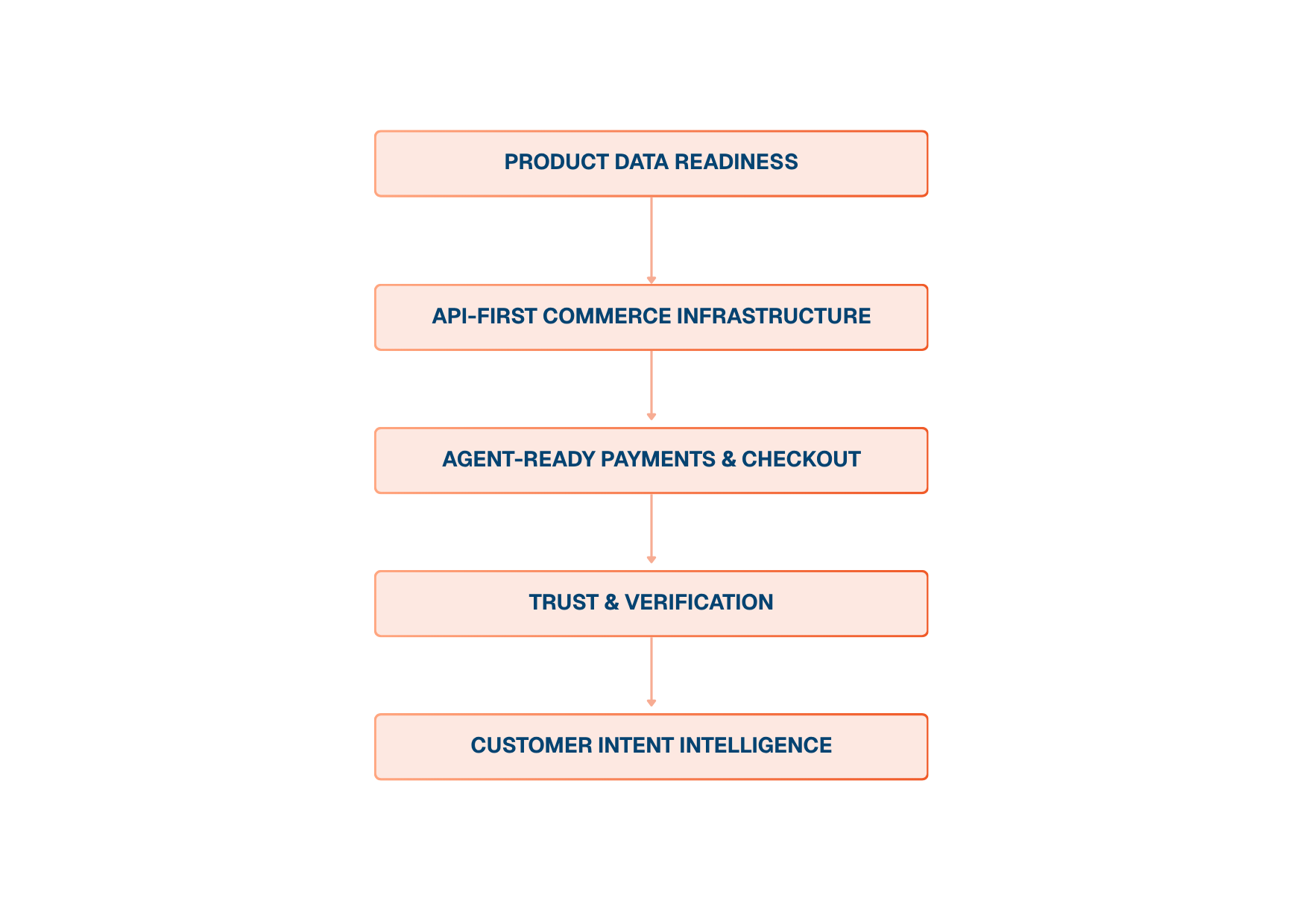
The Five Pillars of Agentic Commerce Readiness
To prepare for Agentic Commerce, retailers should focus on five foundational pillars.
Product Data Readiness
AI agents rely on structured, high-quality product information.
Retailers should ensure:
- Accurate specifications
- Standardized attributes
- Detailed descriptions
- Inventory visibility
- Pricing transparency
- Delivery information
Poor product data will reduce discoverability in agent-driven ecosystems.
API-First Commerce Infrastructure
AI agents will increasingly interact with commerce systems through APIs.
Retailers should evaluate:
- Product APIs
- Inventory APIs
- Pricing APIs
- Checkout APIs
- Loyalty APIs
The easier it is for agents to access information, the more likely products are to be considered during automated evaluations.
Agent-Ready Checkout and Payments
Future transactions may increasingly be initiated by AI agents operating within approved spending limits.
Retailers should begin evaluating:
- Embedded payments
- Digital wallets
- Tokenized payment systems
- Autonomous checkout capabilities
- Identity verification frameworks
The goal is not simply faster payments but trusted machine-to-machine commerce.
Trust and Verification
Trust will become a critical differentiator.
AI agents will increasingly evaluate:
- Merchant reputation
- Customer reviews
- Return policies
- Sustainability commitments
- Delivery performance
- Service quality
Retailers must ensure trust signals are transparent and machine-readable.
Customer Intent Intelligence
Traditional ecommerce focuses on clicks and conversions.
Agentic Commerce focuses on intent.
Retailers should invest in understanding:
- Customer goals
- Purchase motivations
- Behaviour patterns
- Product preferences
- Lifetime value indicators
Organizations that understand customer intent will be better positioned to influence agent-driven purchasing decisions.
The Agentic Commerce Readiness Framework
Innovify Perspective
The retailers most likely to succeed in Agentic Commerce will not necessarily have the best websites.
They will have the most accessible, trusted, and machine-readable commerce infrastructure.
How Agentic Commerce Could Work in Practice
Imagine a customer planning a family holiday.
Instead of manually researching products, they instruct their AI assistant:
"Prepare everything I need for a two-week beach holiday in Spain under £2,000."
The agent:
- Identifies travel requirements
- Sources products
- Compares retailers
- Evaluates reviews
- Negotiates discounts
- Completes purchases
The retailer that provides the best combination of availability, trust, pricing, delivery, and accessibility wins.
Not necessarily the retailer with the most attractive website.
The Emerging Retail Landscape
Several trends are likely to accelerate adoption.
AI Shopping Agents
Personal shopping assistants will become increasingly sophisticated.
Agent-to-Agent Commerce
Buyer agents may interact directly with retailer agents.
Autonomous Replenishment
Products may be reordered automatically based on usage patterns.
Embedded Payments
Payments will become increasingly invisible and automated.
These themes are explored in our podcast:
Rise of Agentic Commerce
https://innovify.com/podcasts/rise-of-agentic-commerce
Which Retailers Are Best Positioned?
The strongest candidates include:
- Multi-brand retailers
- Large ecommerce marketplaces
- Subscription businesses
- Consumer electronics retailers
- Fashion retailers
- Grocery and replenishment-focused businesses
Organizations with strong data foundations will likely benefit first.
What Retailers Should Do Today
Retail leaders should:
- Audit product data quality
- Invest in API-first architecture
- Improve inventory transparency
- Evaluate agent-ready checkout capabilities
- Strengthen trust signals
- Build customer intent models
- Explore autonomous commerce use cases
Waiting for Agentic Commerce to become mainstream may leave retailers reacting rather than leading.
The Future of Retail in an Agentic World
The future of retail is not simply about replacing customers with AI.
It is about enabling customers to delegate increasingly complex purchasing decisions to trusted agents.
As this transition accelerates, retailers will need to optimize not only for human experiences but also for machine decision-making.
The long-term winners will be those that make their products, services, pricing, and trust signals accessible to both humans and AI systems.
In many ways, the future of retail will be less about attracting attention and more about earning algorithmic trust.
Frequently Asked Questions
What is Agentic Commerce?
Agentic Commerce is a model where AI agents can discover, evaluate, and purchase products on behalf of consumers.
Why should retailers care about Agentic Commerce?
Because AI agents may increasingly influence product discovery and purchasing decisions.
How can retailers prepare for Agentic Commerce?
By improving product data, APIs, trust signals, checkout systems, and customer intelligence capabilities.
Will AI agents replace ecommerce websites?
No. However, websites may become one component of a broader commerce ecosystem.
What technologies power Agentic Commerce?
AI agents, APIs, embedded finance, digital identity systems, autonomous payments, and commerce orchestration platforms.
Which retailers are most likely to benefit first?
Retailers with strong digital infrastructure, high-quality product data, and mature ecommerce operations.
Conclusion
Agentic Commerce represents the next major evolution of digital retail.
While the technology is still emerging, the foundations required for success are already clear.
Retailers that invest in product intelligence, API-first architecture, trust frameworks, and agent-ready commerce experiences today will be significantly better positioned for the future.
The question is no longer whether AI agents will influence commerce.
The question is whether retailers will be ready when they do.
Preparing Your Business for Agentic Commerce
Retailers that prepare today will be better positioned for tomorrow's autonomous commerce ecosystem.
Explore Our Agentic Commerce Capabilities
https://innovify.com/solutions/agentic-commerce-and-payments
Download Our Playbook
https://innovify.com/playbook/how-to-build-an-agentic-commerce-system-that-turns-intent-into-action
Ready to Build AI-Powered Commerce Experiences?
Speak with our team to explore how your organization can prepare for Agentic Commerce and build future-ready customer experiences.