

.png)

Executive Summary
Many organizations begin their AI transformation journey by investing in engineering tools, copilots, automation platforms, and AI-powered development environments.
While these initiatives can deliver significant productivity gains, they often fail to generate sustainable transformation because management systems remain unchanged.
Technology organizations continue to rely on planning models, reporting structures, resource allocation processes, and leadership frameworks that were designed for a pre-AI era.
As AI becomes embedded into daily execution, enterprise leaders must rethink how technology teams are managed.
The management layer acts as the bridge between strategy and execution.
It determines how work is prioritized, how resources are allocated, how teams collaborate, how performance is measured, and how decisions are made.
Organizations that successfully modernize their management layer can improve delivery predictability, increase organizational agility, optimize workforce capacity, and unlock significantly greater value from their AI investments.
In this article, we explore the management layer of the AI Native Enterprise Operating Model, the pillars that define AI Native leadership, and the practical steps technology executives should take to prepare their organizations for the next generation of intelligent enterprise delivery.
What Is the Management Layer in an AI Native Organization?
The management layer is the operating system that governs how technology organizations plan, coordinate, measure, and optimize work.
In traditional organizations, management activities typically include:
- Workforce planning
- Capacity management
- Project governance
- Delivery oversight
- Performance measurement
- Budget allocation
- Strategic planning
In AI Native organizations, these activities become increasingly data-driven, intelligent, and adaptive.
Rather than relying on static plans and periodic reviews, AI Native management models leverage continuous intelligence to improve decision-making and organizational responsiveness.
The objective is not to replace managers.
The objective is to augment leadership with better visibility, faster insights, and more effective decision-making capabilities.
Why Traditional Technology Management Models Are Breaking Down
Technology delivery environments have become significantly more complex.
Organizations must now manage:
- Distributed teams
- Hybrid workforces
- Cloud-native environments
- Rapid technology change
- Growing cybersecurity demands
- Increasing customer expectations
- Accelerated release cycles
Traditional management models often struggle because they depend heavily on:
- Manual reporting
- Static planning cycles
- Hierarchical decision-making
- Historical data analysis
- Periodic performance reviews
These approaches create delays between events and decisions.
By the time management receives information, circumstances may have already changed.
As AI capabilities mature, organizations have an opportunity to move from reactive management toward intelligent, adaptive management.
Traditional Technology Management vs AI Native Management
The shift is not simply operational.
It represents a new management philosophy.
The Five Pillars of AI Native Management
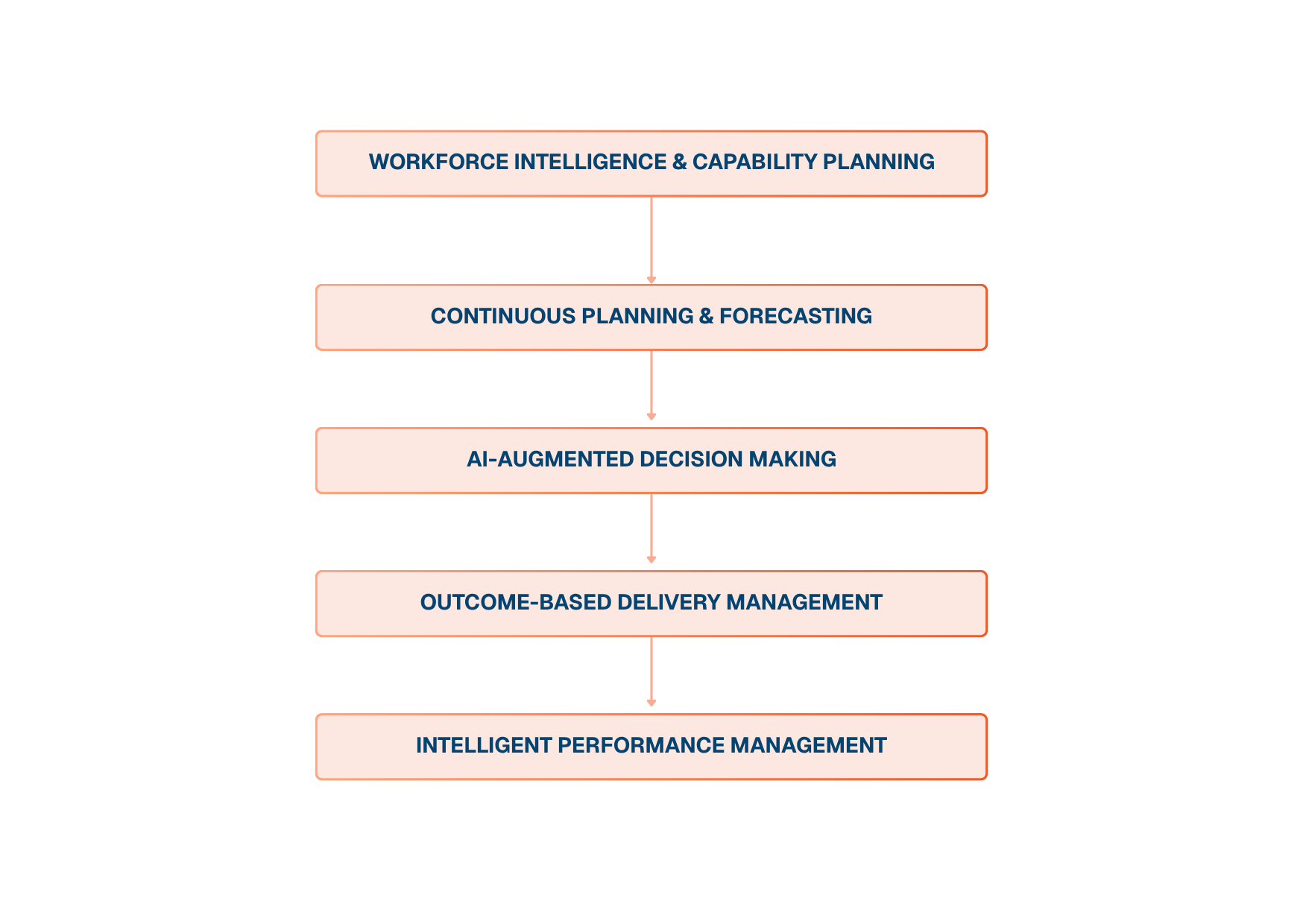
To understand how leadership evolves within AI Native organizations, it is useful to view transformation through five foundational pillars.
Workforce Intelligence and Capability Planning
Traditional workforce planning focuses on headcount.
AI Native organizations focus on capabilities.
Leaders increasingly need visibility into:
- Skills availability
- Capability gaps
- Workforce utilization
- Learning requirements
- Future talent needs
AI can help organizations identify workforce trends, predict skill shortages, and optimize talent allocation.
The goal is to align capabilities with business outcomes rather than simply filling roles.
Continuous Planning and Forecasting
Traditional planning cycles often occur quarterly or annually.
AI Native organizations move toward continuous planning models.
These systems leverage real-time operational data to:
- Forecast delivery risks
- Predict resource constraints
- Identify project bottlenecks
- Improve prioritization
- Optimize investment decisions
Planning becomes an ongoing activity rather than a periodic exercise.
AI-Augmented Decision Making
Enterprise leaders face an overwhelming volume of information.
AI systems can assist by:
- Identifying patterns
- Detecting anomalies
- Surfacing risks
- Generating recommendations
- Supporting scenario analysis
Decision-making remains a human responsibility, but leaders gain access to richer and more timely intelligence.
This improves both speed and quality of decision-making.
Outcome-Based Delivery Management
Traditional technology organizations often focus on outputs.
Examples include:
- Features delivered
- Projects completed
- Tickets closed
AI Native organizations increasingly focus on outcomes.
Examples include:
- Customer satisfaction
- Revenue impact
- Operational efficiency
- Business value creation
- Risk reduction
The emphasis shifts from activity measurement to value creation.
Intelligent Performance Management
Performance management is evolving beyond annual reviews and static KPIs.
AI Native organizations use data-driven approaches to evaluate:
- Team effectiveness
- Collaboration patterns
- Delivery performance
- Learning progression
- Business outcomes
These systems provide continuous feedback loops that support organizational improvement.
The Five Pillars of AI Native Management Framework
Innovify Perspective
The biggest challenge in becoming AI Native is rarely technology.
Most organizations can deploy AI tools.
Far fewer can redesign management systems to fully capitalize on those tools.
The organizations that will lead the next decade are those that transform not only how work is executed, but also how work is planned, managed, measured, and optimized.
How AI Native Management Works in Practice
Consider a large enterprise technology department responsible for multiple product portfolios.
In a Traditional Environment
- Managers rely on status meetings
- Resource planning occurs quarterly
- Risks are identified manually
- Capacity forecasting is largely spreadsheet-driven
- Decision-making is reactive
In an AI Native Environment
- Delivery intelligence dashboards provide real-time visibility
- Workforce capabilities are continuously assessed
- Forecasting models predict delivery risks
- AI identifies capacity constraints
- Leaders receive proactive recommendations
The result is faster decisions, improved alignment, and greater organizational agility.
The Emerging AI Management Landscape
AI-Powered PMOs
Project Management Offices are evolving from reporting functions into intelligence hubs.
Dynamic Capacity Planning
Organizations are beginning to forecast capacity continuously rather than periodically.
Intelligent Portfolio Management
AI is helping leaders optimize investments across projects, products, and initiatives.
Human-AI Leadership Models
Managers increasingly collaborate with AI systems to evaluate options and guide decisions.
Autonomous Organizational Insights
AI systems can surface trends and opportunities that might otherwise remain hidden.
Management Challenges and Adoption Barriers
While the benefits are substantial, organizations must address several challenges.
Leadership Readiness
Managers must learn how to operate effectively in AI-enhanced environments.
Workforce Concerns
Employees may have concerns about transparency, measurement, and automation.
Data Quality
Management intelligence depends heavily on accurate and accessible data.
Process Alignment
Legacy processes may conflict with AI-driven operating models.
Cultural Transformation
Successful adoption requires trust, communication, and organizational buy-in.
Which Organizations Will Become AI Native First?
Several categories of organizations are particularly well positioned.
- Digital Native Enterprises
- SaaS Providers
- Enterprise Product Organizations
- Fintech and Technology Firms
- Global Capability Centers
What Technology Leaders Should Do Today
Technology leaders should begin by:
- Assessing current management practices
- Evaluating workforce intelligence capabilities
- Introducing continuous planning frameworks
- Modernizing performance measurement systems
- Implementing delivery intelligence platforms
- Strengthening leadership capabilities
- Preparing teams for AI-assisted decision-making
Organizations that begin this journey today will be better positioned to manage increasingly intelligent and autonomous execution environments.
The Future of AI Native Management
The future of management is not autonomous leadership.
It is augmented leadership.
Human judgment will remain essential for vision, strategy, culture, and accountability.
However, AI will increasingly support planning, forecasting, performance management, resource optimization, and decision-making.
Organizations that embrace this evolution will be able to respond faster, allocate resources more effectively, and create stronger alignment between technology investments and business outcomes.
The management layer represents the second critical step in becoming a truly AI Native enterprise.
Frequently Asked Questions
What is the management layer in an AI Native organization?
The management layer governs how work is planned, coordinated, measured, and optimized across technology teams.
Will AI replace technology managers?
No. AI will augment managers by providing better visibility, forecasting, and decision support.
What is workforce intelligence?
Workforce intelligence uses data and AI to improve talent planning, capability management, and workforce optimization.
Why is continuous planning important?
Continuous planning allows organizations to respond more effectively to changing priorities and business conditions.
What is outcome-based delivery management?
Outcome-based management focuses on business value and customer impact rather than simply measuring activity.
What is the biggest management challenge in AI transformation?
Adapting leadership practices and organizational processes is often more difficult than implementing technology.
Is AI Native management only relevant for large enterprises?
No. Organizations of all sizes can benefit from AI-enhanced planning, forecasting, and decision-making.
Conclusion
While execution determines how work gets done, management determines how organizations operate.
Technology departments that modernize workforce planning, decision-making, performance management, and delivery oversight will be far better positioned to unlock the full value of AI.
The journey toward becoming AI Native does not end with engineering transformation.
It requires a fundamental evolution in how technology organizations are led, managed, and optimized.
Building an AI Native Technology Organization?
Transforming execution is only the first step.
Sustained AI transformation requires leadership models, planning frameworks, and management systems that are designed for a world where humans and AI work together continuously.
Explore Our AI Engineering and Digital Transformation Capabilities
Discover how Innovify helps organizations modernize software delivery, transform technology operations, implement AI-powered management practices, and build future-ready enterprise ecosystems.
Ready to Accelerate Your AI Transformation Journey?
Speak with our team to explore how your organization can build AI Native management capabilities, improve decision-making, optimize workforce performance, and prepare for the next generation of intelligent enterprise operations.