


.png)
Executive Summary
Over the last decade, enterprise technology organizations have invested heavily in digital transformation, cloud modernization, DevOps, and agile delivery methodologies.
Yet many teams continue to face the same challenges: increasing delivery backlogs, growing technical debt, rising development costs, and pressure to release software faster than ever before.
Artificial Intelligence is creating an opportunity to fundamentally rethink how technology organizations operate.
However, becoming AI Native is not simply about deploying copilots, chatbots, or automation tools.
It requires reimagining how software is designed, developed, tested, deployed, documented, and maintained.
The execution layer is where AI transformation becomes visible.
It is where engineers, architects, DevOps teams, QA specialists, and platform teams interact with AI capabilities on a daily basis.
Organizations that successfully transform their execution layer can accelerate delivery, improve software quality, reduce operational overhead, and unlock entirely new levels of productivity.
In this article, we explore what it means to become AI Native at the execution level, the foundational pillars required to support that transformation, and the practical steps enterprise technology leaders should take today.
What Does It Mean to Be AI Native?
An AI Native technology organization is one where artificial intelligence is embedded into the core operating model rather than being treated as a standalone tool or isolated initiative.
AI becomes part of how work is executed.
Instead of using AI occasionally to improve productivity, AI Native organizations design workflows where humans and AI collaborate continuously across the software development lifecycle.
This includes:
- AI-assisted engineering
- Intelligent testing
- AI-powered DevOps
- Automated documentation
- Agentic delivery workflows
- Continuous learning systems
The objective is not to replace engineers.
The objective is to augment human expertise and eliminate repetitive, low-value activities so technology teams can focus on innovation, architecture, problem solving, and business outcomes.
Why Traditional Technology Delivery Models Are Breaking Down
For decades, enterprise software delivery relied heavily on human effort.
Engineering teams manually wrote code.
QA teams manually tested applications.
Operations teams manually monitored infrastructure.
Documentation was created manually.
Knowledge transfer depended on meetings and institutional memory.
While these approaches helped build the modern digital economy, they struggle to keep pace with today's environment.
Technology leaders face several challenges:
- Increasing application complexity
- Growing cybersecurity requirements
- Rising customer expectations
- Talent shortages
- Technical debt accumulation
- Faster release cycles
- Multi-cloud infrastructure management
The result is a delivery model that often struggles to scale.
AI is emerging as a powerful mechanism for addressing these challenges.
Traditional Technology Teams vs AI Native Technology Teams
The difference is not simply productivity.
The difference is the operating model itself.
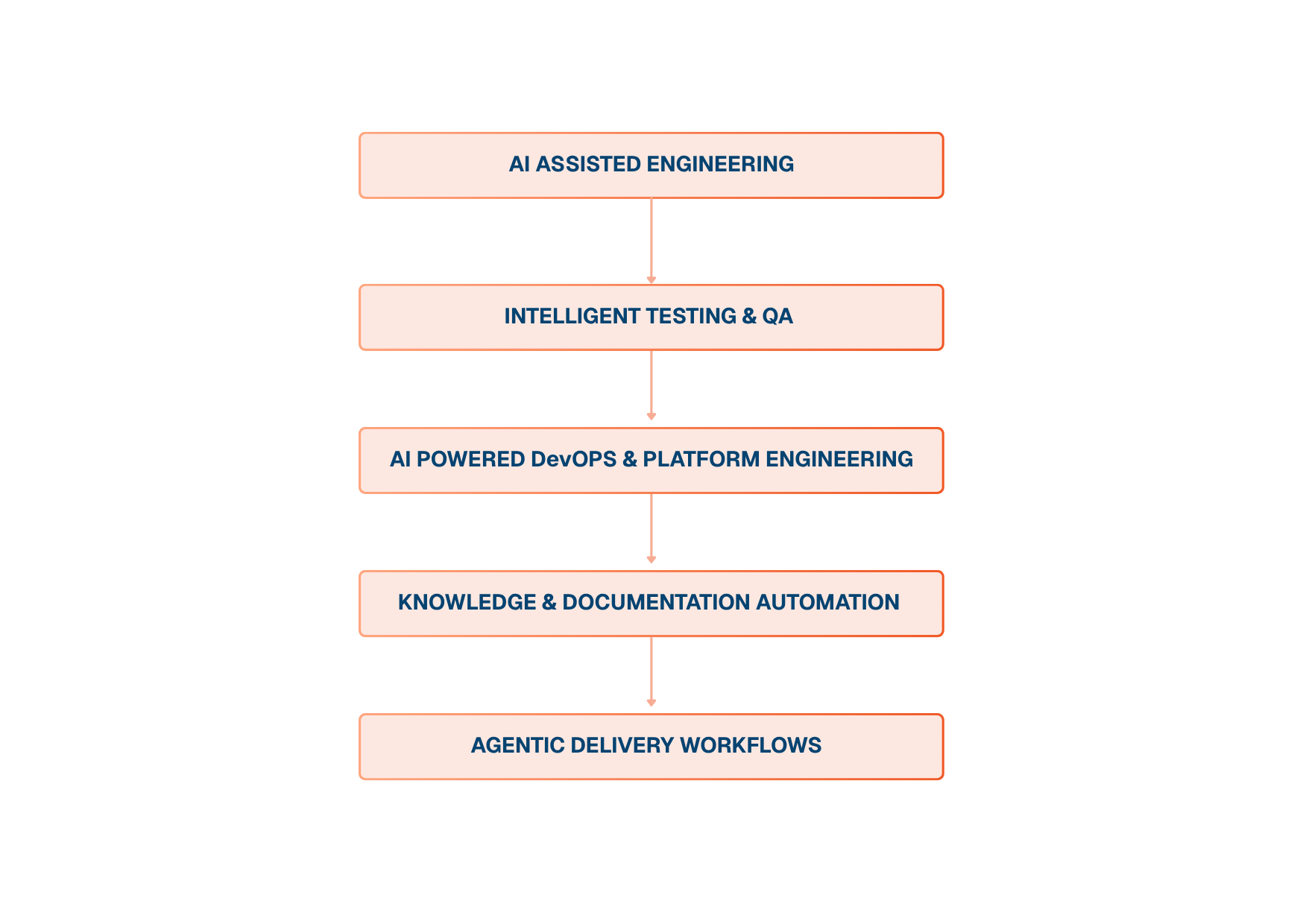
The Five Pillars of AI Native Execution
To understand how execution evolves inside AI Native organizations, it is useful to view transformation through five foundational pillars.
Pillar 1: AI Assisted Engineering
Software development is rapidly evolving from purely human-generated code toward collaborative engineering environments.
AI-powered coding assistants can:
- Generate boilerplate code
- Suggest architecture patterns
- Identify bugs
- Refactor legacy applications
- Accelerate feature development
Engineers remain responsible for design, validation, and decision-making, but AI increasingly handles repetitive implementation tasks.
The result is faster development cycles and improved developer productivity.
Pillar 2: Intelligent Testing and Quality Assurance
Testing has traditionally been one of the most resource-intensive activities within software delivery.
AI Native organizations increasingly use intelligent testing systems to:
- Generate test cases automatically
- Detect edge cases
- Predict defects
- Prioritize regression testing
- Improve test coverage
Rather than testing every scenario manually, AI helps teams focus effort where risk is highest.
This improves quality while reducing release bottlenecks.
Pillar 3: AI Powered DevOps and Platform Engineering
Modern infrastructure environments generate enormous amounts of operational data.
AI can help technology teams:
- Predict infrastructure failures
- Identify security risks
- Optimize cloud costs
- Improve resource utilization
- Detect anomalies
- Automate incident response
As AI capabilities mature, infrastructure management becomes increasingly proactive rather than reactive.
Pillar 4: Knowledge and Documentation Automation
Enterprise knowledge is often trapped in:
- Wikis
- Emails
- Tickets
- Chat applications
- Documentation repositories
AI Native organizations use AI to continuously capture, organize, and surface knowledge.
Documentation becomes a living asset rather than a neglected deliverable.
This reduces onboarding time, improves collaboration, and minimizes knowledge loss.
Pillar 5: Agentic Delivery Workflows
Perhaps the most transformative pillar is the emergence of agentic workflows.
Instead of assisting with individual tasks, AI agents can orchestrate multi-step activities.
Examples include:
- Requirement analysis
- Test generation
- Sprint preparation
- Code review
- Deployment coordination
- Incident investigation
These workflows allow AI systems to act as active participants in software delivery.
The Five Pillars of AI Native Execution Framework
Innovify Perspective
AI Native organizations do not replace engineers with AI.
They amplify engineering capacity by embedding AI into the software delivery lifecycle.
The organizations that achieve the greatest success will be those that redesign workflows around human-AI collaboration rather than attempting to automate everything.
How AI Native Execution Works in Practice
Consider a typical enterprise product development initiative.
In a Traditional Environment
- Requirements are manually analyzed
- Development tasks are manually estimated
- Engineers write code from scratch
- QA teams create test cases manually
- Documentation is generated at project completion
In an AI Native Environment
- Requirements are analyzed by AI systems
- User stories are generated automatically
- Coding assistants accelerate development
- AI generates and prioritizes test cases
- Documentation is continuously updated
- Deployment pipelines leverage predictive intelligence
The result is faster delivery, improved quality, and more efficient resource utilization.
The Emerging AI Engineering Landscape
Agentic SDLC
AI agents are beginning to participate across the software development lifecycle.
Autonomous Testing
Testing systems are becoming increasingly self-managing.
AI Generated Architecture
Architecture recommendations are becoming increasingly sophisticated.
Predictive Operations
Operations teams are moving from reactive monitoring toward predictive management.
Multi-Agent Collaboration
Multiple AI systems may soon collaborate across engineering, testing, operations, and support functions.
Execution Challenges and Adoption Barriers
While the benefits are compelling, organizations must address several challenges.
Skills Transformation
Teams require new capabilities to work effectively alongside AI systems.
Process Redesign
Existing workflows may need significant restructuring.
Tool Fragmentation
AI ecosystems remain highly fragmented.
Trust and Validation
Organizations must ensure AI-generated outputs are reliable and accurate.
Change Management
Cultural transformation is often more difficult than technology adoption.
Which Organizations Will Become AI Native First?
Several categories of organizations are particularly well positioned.
- Digital Native Enterprises
- SaaS Providers
- Fintech Organizations
- Enterprise Product Teams
- Global Capability Centers
What Technology Leaders Should Do Today
Technology leaders should begin by:
- Assessing current delivery workflows
- Identifying repetitive engineering activities
- Evaluating AI-assisted development tools
- Introducing intelligent testing frameworks
- Modernizing DevOps platforms
- Building AI governance foundations
- Establishing workforce upskilling programs
Organizations that start early will gain significant advantages as AI Native delivery models mature.
The Future of AI Native Execution
The future of software delivery is not fully autonomous development.
It is collaborative intelligence.
Human expertise will remain critical for strategy, architecture, creativity, and decision-making.
However, an increasing percentage of execution activities will be handled by AI systems.
Technology organizations that successfully embrace this model will deliver software faster, operate more efficiently, and respond more effectively to market demands.
The execution layer represents the first step in becoming truly AI Native.
Frequently Asked Questions
What does AI Native mean?
AI Native organizations embed AI into their core operating model rather than treating AI as a standalone tool.
Will AI replace software engineers?
No. AI is more likely to augment engineers by automating repetitive activities and accelerating delivery.
What is AI-assisted engineering?
AI-assisted engineering involves using AI tools to support coding, design, testing, documentation, and software delivery activities.
What are agentic workflows?
Agentic workflows involve AI agents performing multi-step activities with minimal human intervention.
What is the biggest challenge in becoming AI Native?
For most organizations, the biggest challenge is redesigning processes and operating models rather than deploying technology.
Which industries are adopting AI Native delivery first?
Technology companies, SaaS providers, fintech organizations, and digital-first enterprises are leading adoption.
Is becoming AI Native a technology project?
No. It is an organizational transformation that affects people, processes, and technology.
Continue the AI Native Enterprise Series
This article explored the Execution Layer of the AI Native Enterprise Operating Model.
In Part 2, we will examine the Management Layer and how workforce planning, delivery management, performance measurement, and leadership models must evolve in AI Native organizations.
In Part 3, we will explore the Governance Layer and the frameworks required to manage security, compliance, risk, and responsible AI adoption at scale.
Conclusion
The journey toward becoming AI Native begins with execution.
Organizations that successfully embed AI into engineering, testing, DevOps, documentation, and delivery workflows will establish the foundation required for broader AI transformation.
The question is no longer whether AI will change software delivery.
The question is whether enterprise technology departments will adapt quickly enough to capture its full potential.
Building an AI Native Technology Organization?
Transforming execution is only the first step in becoming truly AI Native.
Enterprise technology departments that successfully integrate AI into engineering, testing, DevOps, documentation, and delivery workflows will establish the foundation required for scalable AI transformation.
However, long-term success also requires modern management practices and governance frameworks that enable organizations to operate safely and effectively at scale.
Explore Our AI Engineering and Digital Transformation Capabilities
Discover how Innovify helps organizations modernize software delivery, accelerate engineering productivity, implement AI-powered development practices, and build future-ready technology ecosystems.
Ready to Accelerate Your AI Transformation Journey?
Speak with our team to explore how your organization can build AI Native engineering capabilities, modernize technology operations, and prepare for the next generation of intelligent enterprise delivery.