


.png)

Executive Summary
The first stage of becoming AI Native focuses on execution.
The second stage focuses on management.
The third and perhaps most important stage focuses on governance.
As AI becomes deeply embedded within software delivery, business operations, decision-making, and enterprise workflows, organizations face a new challenge.
How do you scale AI responsibly?
Without governance, AI can introduce significant risks including security vulnerabilities, compliance failures, data exposure, model drift, biased decision-making, and reputational damage.
The challenge for enterprise leaders is not simply adopting AI.
It is creating governance frameworks that enable innovation while maintaining control.
The governance layer provides the guardrails that allow organizations to deploy AI confidently and at scale.
Organizations that establish strong governance foundations will be able to accelerate AI adoption while minimizing risk.
Those that neglect governance may find themselves struggling with regulatory pressure, operational uncertainty, and growing organizational complexity.
In this article, we explore the governance layer of the AI Native Enterprise Operating Model, the foundational pillars required for responsible AI adoption, and the practical steps enterprise technology leaders should take to build trusted AI ecosystems.
What Is the Governance Layer in an AI Native Organization?
The governance layer defines how AI systems are controlled, monitored, audited, secured, and managed across the enterprise.
In traditional technology organizations, governance activities typically focus on:
- Information security
- Compliance
- Risk management
- Data protection
- Change management
- Technology policies
AI Native organizations require a significantly broader governance framework.
Modern AI governance includes:
- Model governance
- Agent governance
- AI security
- Data governance
- Compliance oversight
- Responsible AI frameworks
- Continuous monitoring
The objective is not to slow innovation.
The objective is to enable trusted innovation.
Governance creates the confidence required for organizations to scale AI safely.
Why Traditional Governance Models Are Breaking Down
Most governance frameworks were designed for predictable software systems.
Traditional applications typically behave according to fixed rules.
AI systems do not.
Modern AI introduces new challenges:
- Dynamic decision-making
- Autonomous agents
- Model evolution
- Synthetic content generation
- AI-generated code
- Continuous learning systems
- Human-AI collaboration
Traditional governance approaches often rely on:
- Periodic audits
- Static controls
- Annual reviews
- Manual assessments
These methods struggle to keep pace with AI environments that evolve continuously.
As AI adoption accelerates, organizations require governance models that are equally adaptive.
Traditional Governance vs AI Native Governance
The difference is not merely compliance.
It is the creation of a trusted AI operating environment.
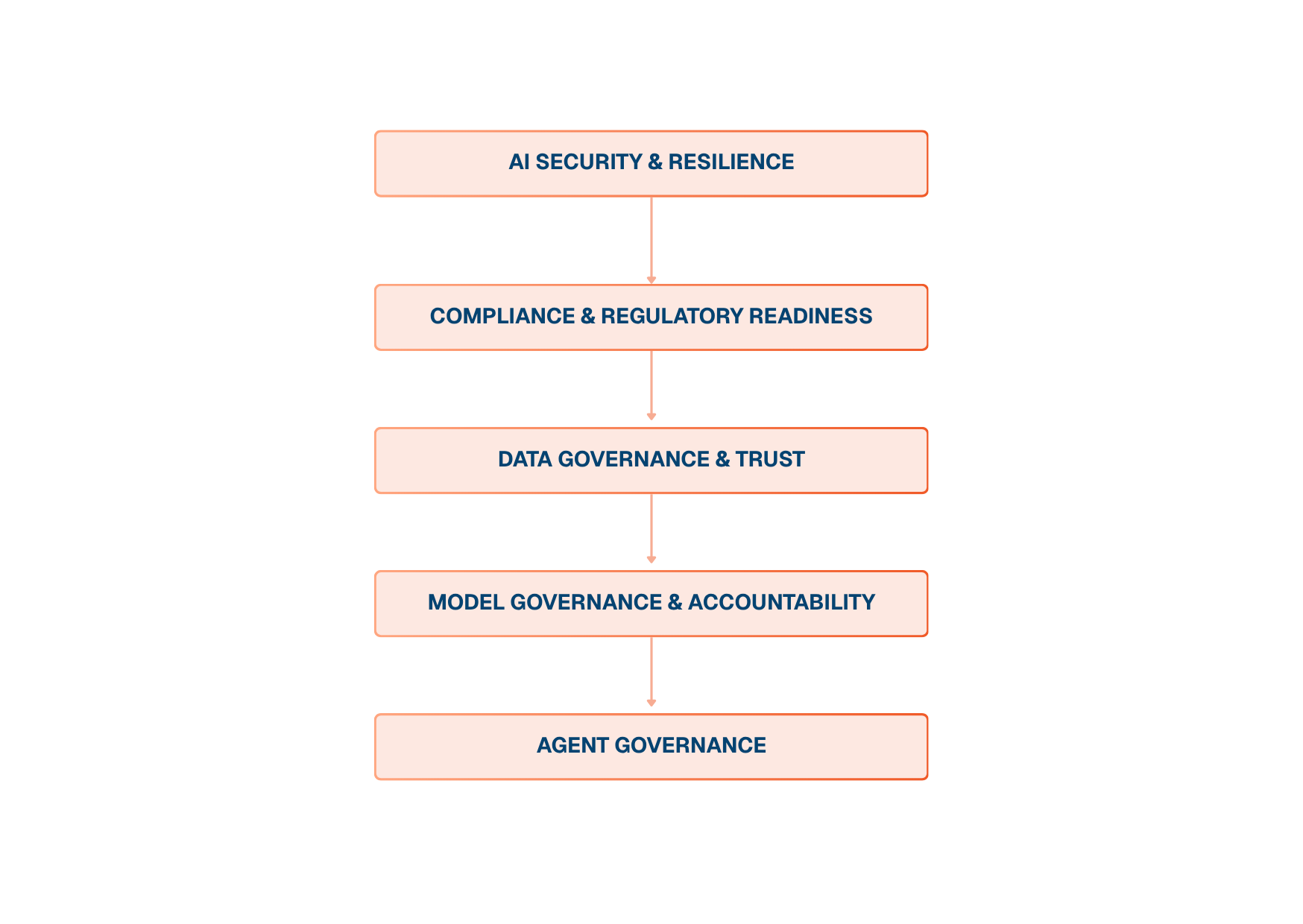
The Five Pillars of AI Native Governance
To understand how governance evolves within AI Native organizations, it is useful to view transformation through five foundational pillars.
AI Security and Resilience
As AI systems become integrated into critical business operations, security becomes increasingly important.
Organizations must address:
- Model vulnerabilities
- Prompt injection attacks
- Data leakage risks
- Unauthorized access
- Infrastructure security
- Agent exploitation risks
AI security must evolve beyond traditional cybersecurity practices.
The goal is to protect both systems and decision-making processes.
Compliance and Regulatory Readiness
AI regulations are rapidly evolving across global markets.
Organizations must prepare for:
- Industry regulations
- Data privacy requirements
- AI transparency obligations
- Audit requirements
- Sector-specific compliance mandates
Governance frameworks should be designed to adapt as regulations continue to mature.
Data Governance and Trust
AI systems are only as reliable as the data that supports them.
Effective governance requires:
- Data quality standards
- Data lineage visibility
- Access controls
- Data ownership frameworks
- Data lifecycle management
Trustworthy AI begins with trustworthy data.
Model Governance and Accountability
Organizations need visibility into how AI models are developed, deployed, monitored, and maintained.
Key considerations include:
- Model versioning
- Performance monitoring
- Bias detection
- Explainability
- Drift management
- Lifecycle oversight
Model governance ensures that AI systems remain reliable over time.
Agent Governance
As AI agents become more autonomous, organizations require mechanisms to govern their behaviour.
This emerging discipline focuses on:
- Agent permissions
- Decision boundaries
- Escalation rules
- Audit trails
- Accountability structures
- Autonomous action controls
Agent governance may become one of the most important governance disciplines of the next decade.
The Five Pillars of AI Native Governance Framework
Innovify Perspective
The organizations that derive the greatest value from AI will not be those that deploy the most models.
They will be the organizations that create the most trusted AI environments.
Governance should not be viewed as a barrier to innovation.
It should be viewed as the foundation that enables innovation at scale.
How AI Native Governance Works in Practice
Consider a global enterprise deploying AI across customer service, software delivery, operations, and business intelligence functions.
In a Traditional Environment
- Governance reviews occur periodically
- Security assessments are performed manually
- Compliance checks happen after deployment
- AI usage is largely decentralized
In an AI Native Environment
- AI systems are continuously monitored
- Compliance controls are embedded into workflows
- Governance dashboards provide real-time visibility
- Agent activities are audited automatically
- Risk models identify emerging threats proactively
The result is greater transparency, stronger compliance, and reduced operational risk.
The Emerging AI Governance Landscape
Agent Governance
Organizations are beginning to establish policies specifically designed for autonomous AI systems.
AI Risk Management Platforms
Dedicated platforms are emerging to monitor AI risk continuously.
Compliance Automation
AI systems are increasingly helping organizations manage regulatory requirements.
Responsible AI Programs
Enterprises are formalizing ethical AI frameworks and governance structures.
Autonomous Audit Systems
Future governance models may leverage AI to perform continuous audits and oversight activities.
Governance Challenges and Adoption Barriers
While governance is essential, organizations face several obstacles.
Regulatory Uncertainty
AI regulations continue to evolve globally.
Governance Skills Gaps
Many organizations lack AI-specific governance expertise.
Tool Fragmentation
Governance solutions remain fragmented across vendors and platforms.
Organizational Complexity
Large enterprises often struggle to establish consistent governance standards.
Balancing Innovation and Control
Leaders must avoid creating governance frameworks that slow progress unnecessarily.
Which Organizations Will Become AI Native First?
Several categories of organizations are particularly well positioned.
Financial Services Organizations
Strong regulatory environments encourage governance maturity.
Healthcare Enterprises
Data protection and compliance requirements drive structured governance.
SaaS Providers
Software companies require scalable governance models to support AI-driven products.
Global Enterprises
Large organizations often possess the resources necessary to establish governance frameworks.
Government and Public Sector Organizations
Regulatory requirements make governance a strategic priority.
What Technology Leaders Should Do Today
Technology leaders should begin by:
- Establishing AI governance committees
- Defining responsible AI principles
- Strengthening AI security capabilities
- Implementing data governance frameworks
- Introducing model governance processes
- Evaluating agent governance requirements
- Preparing for evolving regulations
Organizations that act early will be better positioned to scale AI responsibly.
The Future of AI Native Governance
The future of governance is not about increasing bureaucracy.
It is about creating intelligent control systems.
Human oversight will remain essential.
However, AI will increasingly support monitoring, compliance, auditing, risk management, and governance operations.
The most successful organizations will establish governance models that evolve as quickly as the technologies they oversee.
The governance layer represents the final and most critical component of becoming an AI Native enterprise.
Frequently Asked Questions
What is AI governance?
AI governance refers to the frameworks, policies, controls, and processes used to manage AI systems responsibly and securely.
Why is governance important in AI Native organizations?
Governance enables organizations to scale AI safely while managing risk, compliance, security, and accountability.
What is model governance?
Model governance focuses on monitoring, maintaining, auditing, and managing AI models throughout their lifecycle.
What is agent governance?
Agent governance establishes rules and controls for autonomous AI agents, including permissions, accountability, and decision boundaries.
Will AI governance slow innovation?
Effective governance should accelerate innovation by creating trust and reducing uncertainty.
What is the biggest governance challenge in AI adoption?
Balancing innovation, compliance, security, and operational flexibility is often the greatest challenge.
Which industries need AI governance most?
Financial services, healthcare, government, SaaS, and highly regulated industries are among the earliest adopters.
Conclusion
While execution determines how work gets done, management determines how organizations operate.
Technology departments that modernize workforce planning, decision-making, performance management, and delivery oversight will be far better positioned to unlock the full value of AI.
The journey toward becoming AI Native does not end with engineering transformation.
It requires a fundamental evolution in how technology organizations are led, managed, and optimized.
Building an AI Native Technology Organization?
Transforming execution is only the first step.
Sustained AI transformation requires leadership models, planning frameworks, and management systems that are designed for a world where humans and AI work together continuously.
Explore Our AI Engineering and Digital Transformation Capabilities
Discover how Innovify helps organizations modernize software delivery, transform technology operations, implement AI-powered management practices, and build future-ready enterprise ecosystems.
Ready to Accelerate Your AI Transformation Journey?
Speak with our team to explore how your organization can build AI Native management capabilities, improve decision-making, optimize workforce performance, and prepare for the next generation of intelligent enterprise operations.