


A Practical Framework for Deploying and Scaling Machine Learning in Production
MLOps, or machine learning operations, is the discipline that enables machine learning models to move reliably from experimentation into real-world production systems.
Innovify’s MLOps services help organisations design, deploy, and operate machine learning systems that are scalable, secure, and governed. Instead of stalled proofs of concept, teams gain production-ready AI platforms that evolve safely alongside business needs.
This page explains what MLOps is, why it matters, and how Innovify delivers end-to-end MLOps services for modern AI-driven products.
Why MLOps Is Critical for Modern AI Systems
Building machine learning models is only the beginning.
Many organisations struggle to deploy models reliably, monitor performance over time, and adapt to changing data. Models degrade, pipelines break, and production risks increase without operational discipline.
MLOps addresses these challenges by applying software engineering, DevOps, and platform practices to the full machine learning lifecycle. It ensures that models remain accurate, observable, compliant, and scalable in real-world environments.
For AI-driven products, MLOps is not optional. It is foundational.
What MLOps Means at Innovify
At Innovify, MLOps is treated as an engineering capability rather than an experimental activity.
MLOps services cover the full lifecycle including:
- Data pipelines
- Model training
- Model deployment
- Monitoring and observability
- Retraining workflows
- Governance and compliance
Models are treated as production assets with the same reliability, security, and compliance expectations as software systems.
The focus is on operational excellence, not just model performance.
How MLOps Fits into Modern Product and Platform Lifecycles
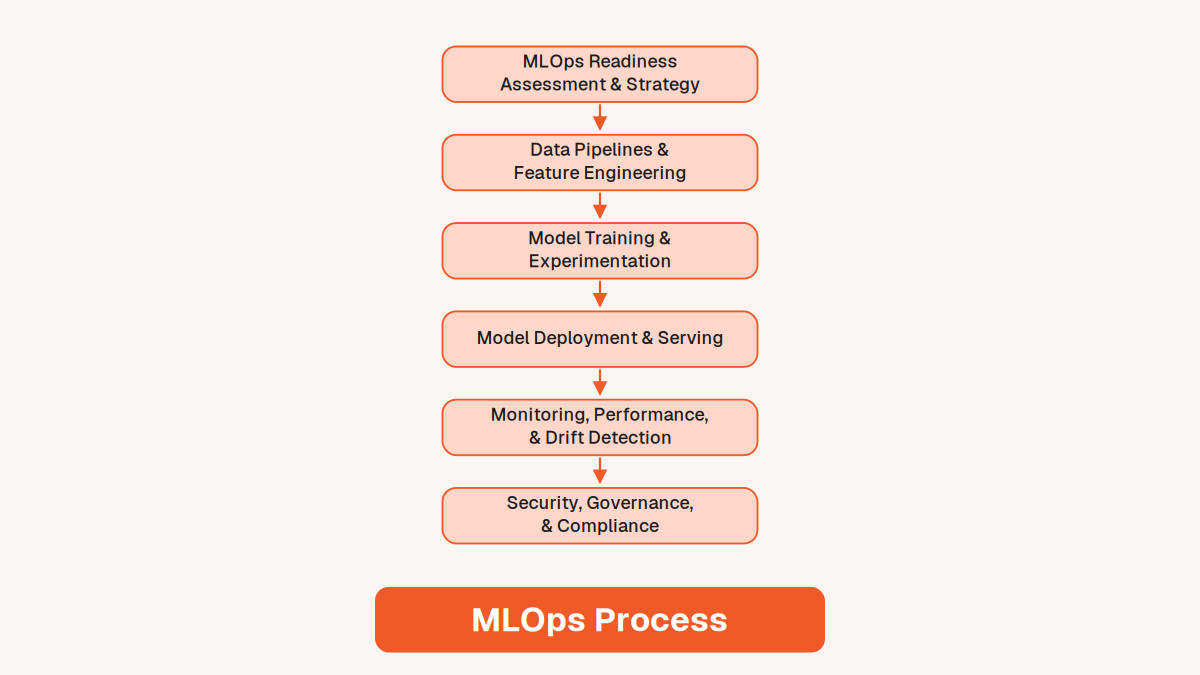
MLOps integrates directly into existing software delivery pipelines.
Models, data, and code are versioned, tested, and deployed through automated workflows. Monitoring and feedback loops ensure that ML systems adapt safely as user behaviour, data distributions, and business requirements change.
For cloud-native platforms, MLOps runs alongside DevOps, enabling software and intelligence to scale together.
Stage 1: MLOps Readiness Assessment and Strategy
Every engagement begins with understanding the current state.
Innovify assesses data quality, existing pipelines, model maturity, infrastructure readiness, and governance requirements. Operational risks and bottlenecks are identified early.
The outcome is a clear MLOps strategy aligned with product goals, compliance needs, and scalability requirements.
Assessment Areas
- Data quality evaluation
- Existing pipeline analysis
- Model maturity assessment
- Infrastructure readiness review
- Governance requirement analysis
- Operational bottleneck identification
- Risk assessment
Stage 2: Data Pipelines and Feature Engineering
Reliable ML systems depend on reliable data.
Innovify designs and implements secure, scalable data pipelines that support training, inference, and continuous learning. Feature engineering workflows are standardised to ensure consistency across environments.
Data becomes traceable, reproducible, and production-ready.
Data Pipeline Capabilities
- Secure data ingestion
- Scalable pipeline architecture
- Feature engineering workflows
- Data reproducibility
- Environment consistency
- Production-ready datasets
- Continuous learning support
Stage 3: Model Training and Experimentation Pipelines
Model experimentation must be structured, not ad hoc.
MLOps pipelines support reproducible training, version control, and experiment tracking. Metrics, parameters, and datasets are captured to ensure transparency and repeatability.
Teams can iterate confidently without losing control.
Experimentation and Training Functions
- Reproducible model training
- Experiment tracking
- Model version control
- Dataset tracking
- Parameter logging
- Metrics management
- Controlled experimentation
Stage 4: Model Deployment and Serving
Deploying models to production requires consistency and safety.
Innovify implements automated model packaging and deployment pipelines for batch and real-time inference. Models are versioned, validated, and rolled out using controlled release strategies.
Deployment becomes predictable and repeatable across environments.
Deployment and Serving Capabilities
- Automated model packaging
- Batch inference deployment
- Real-time inference serving
- Version-controlled releases
- Validation workflows
- Controlled rollout strategies
- Cross-environment consistency
Stage 5: Monitoring, Performance, and Drift Detection
Once in production, models must be continuously observed.
MLOps services include monitoring model performance, data quality, and operational health. Drift detection identifies changes in data or behaviour that can degrade accuracy.
This enables proactive intervention before issues impact users or business outcomes.
Monitoring and Drift Detection Areas
- Model performance monitoring
- Data quality tracking
- Operational health monitoring
- Drift detection
- Behavioural change analysis
- Alerting and observability
- Proactive issue identification
Stage 6: Model Retraining and Continuous Improvement
Machine learning systems evolve over time.
Innovify designs retraining workflows that allow models to adapt safely as data changes. Retraining can be automated or triggered based on performance thresholds and business signals.
Continuous learning becomes controlled rather than risky.
Retraining and Improvement Functions
- Automated retraining workflows
- Threshold-based retraining triggers
- Business signal integration
- Continuous learning pipelines
- Controlled model updates
- Performance optimisation
- Lifecycle management
Stage 7: Security, Governance, and Compliance
Production AI systems must meet enterprise and regulatory standards.
MLOps services integrate access controls, auditability, version history, and compliance checks into ML pipelines. This supports responsible AI practices and regulated environments.
Governance is embedded rather than enforced manually.
Governance and Security Capabilities
- Access control management
- Audit trails and observability
- Model version history
- Compliance validation
- Responsible AI governance
- Regulatory alignment
- Embedded security controls
When MLOps Services Make Sense
MLOps services are particularly valuable when organisations:
- Have promising ML use cases but struggle with production deployment
- Face reliability or governance challenges
- Operate AI-driven products at scale
- Work within regulated industries
- Manage ML systems across multiple teams or environments
- Need stronger operational discipline for AI systems
MLOps removes friction between innovation and operational reality.
Common Challenges Without MLOps
Without MLOps, teams face fragile deployments, inconsistent results, and declining model performance.
Manual processes, poor visibility, and lack of ownership increase operational risk. Models become difficult to trust and harder to scale.
MLOps provides the structure needed to turn experiments into dependable systems.
Common Operational Challenges
- Fragile deployments
- Inconsistent model behaviour
- Model performance degradation
- Poor observability
- Manual operational workflows
- Lack of ownership and governance
- Difficulty scaling ML systems
Innovify’s Approach to MLOps Services
Innovify combines platform engineering, DevOps, and machine learning expertise to deliver MLOps services end-to-end.
The approach focuses on:
- Automation
- Reliability
- Security
- Scalability
- Operational excellence
- Alignment with business objectives
MLOps systems are designed to integrate seamlessly with existing product architectures and DevOps pipelines.
The result is production-ready AI that scales responsibly.
Conclusion
MLOps services enable organisations to move beyond experimentation and operate machine learning systems with confidence.
By applying engineering discipline to the ML lifecycle, teams gain reliable deployments, continuous improvement, and scalable intelligence.
For organisations building AI-driven products, MLOps is not an enhancement. It is the foundation for sustainable, production-grade AI.