



A Modern Framework for Asset Intelligence and Operational Reliability
Industrial IoT predictive maintenance uses real-time sensor data, connected systems, and advanced analytics to anticipate equipment failure before it occurs.
Instead of reactive repairs or rigid scheduled servicing, predictive maintenance enables condition-based and intelligence-driven interventions. Assets are monitored continuously, anomalies are detected early, and maintenance actions are planned with precision.
This approach is becoming critical for industries operating complex, high-value equipment in remote and demanding environments.
Why Predictive Maintenance Matters in Industrial Environments
Traditional maintenance models create unnecessary downtime and cost.
Scheduled maintenance often results in replacing components that are still functional, while reactive maintenance leads to unplanned outages and safety risks. In industrial environments, these issues compound quickly across fleets and sites.
Predictive maintenance addresses these challenges by using Industrial IoT data to understand actual asset health and act before failure impacts operations.
What Industrial IoT Predictive Maintenance Really Means
Predictive maintenance is not just about sensors and alerts.
At scale, it requires a unified platform that can ingest vast volumes of data, model asset behaviour, surface actionable insights, and integrate seamlessly into engineering workflows.
True predictive maintenance combines IoT telemetry, real-time data pipelines, analytical models, and decision-support systems into a coherent asset intelligence platform.
Core Components of Predictive Maintenance
- IoT telemetry systems
- Real-time data pipelines
- Analytical and ML models
- Asset intelligence platforms
- Workflow integration systems
- Operational decision support
How Predictive Maintenance Fits into Industrial Digital Transformation
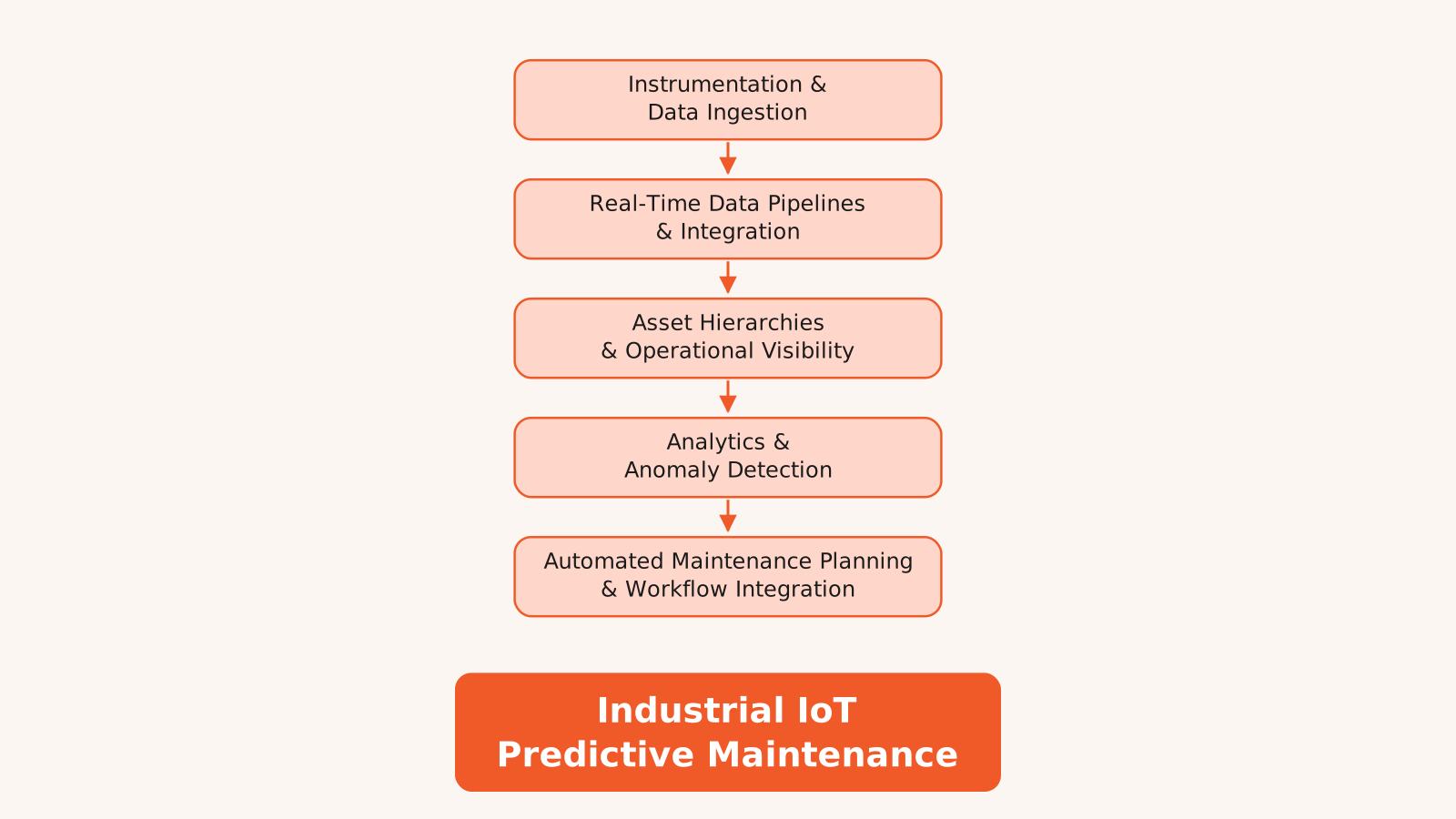
Predictive maintenance is often the most impactful starting point for industrial digitalisation.
It creates immediate operational value while laying foundations for broader asset intelligence, AI-driven optimisation, and autonomous maintenance planning.
When designed correctly, predictive maintenance systems become central operational platforms rather than standalone monitoring tools.
Stage 1: Instrumentation and Data Ingestion
Effective predictive maintenance begins with reliable instrumentation.
Sensors, monitoring devices, and field systems collect operational data such as vibration, temperature, pressure, and load. These signals are ingested continuously from distributed environments into secure, centralised systems.
In complex infrastructures, data must flow reliably from offshore, onshore, and remote assets without latency or loss.
Data Collection Areas
- Vibration monitoring
- Temperature tracking
- Pressure measurement
- Load monitoring
- Remote asset telemetry
- Distributed sensor integration
Stage 2: Real-Time Data Pipelines and Integration
Raw data is only valuable if it can be processed in real time.
Industrial IoT predictive maintenance platforms require low-latency pipelines that aggregate data from multiple sources and systems. API-first integration enables existing instrumentation, legacy systems, and third-party platforms to contribute to a single operational view.
This integration layer becomes the backbone of asset intelligence.
Integration Capabilities
- Low-latency data processing
- Multi-source aggregation
- API-first architecture
- Legacy system integration
- Third-party platform connectivity
- Unified operational visibility
Stage 3: Asset Hierarchies and Operational Visibility
Understanding asset health requires structure.
Innovative predictive maintenance systems organise assets into hierarchical models, enabling engineers to navigate from fleet level down to individual components. Health indicators, alerts, and trends are mapped across this hierarchy to provide contextual clarity.
This approach reflects real-world engineering reasoning rather than isolated data points.
Operational Visibility Features
- Fleet-level monitoring
- Asset hierarchy modelling
- Component-level visibility
- Health indicator tracking
- Trend analysis
- Contextual engineering insights
Stage 4: Analytics, Anomaly Detection, and Predictive Signals
With structure in place, analytical models can surface early warning signals.
Statistical analysis and machine learning models identify deviations from normal operating patterns. These anomalies indicate emerging risk long before traditional failure thresholds are crossed.
Predictive signals inform maintenance planning with greater confidence and reduced uncertainty.
Analytical Capabilities
- Statistical analysis
- Machine learning-based anomaly detection
- Predictive risk identification
- Operational pattern analysis
- Early warning systems
- Failure prediction modelling
Stage 5: Automated Maintenance Planning and Workflow Integration
Insight must drive action.
Predictive maintenance platforms integrate analytics with engineering workflows. Maintenance tasks are scheduled automatically based on detected conditions or predicted service windows.
Every action is logged, traceable, and compliant with regulatory requirements, reducing manual coordination and operational friction.
Workflow Automation Functions
- Automated maintenance scheduling
- Condition-based task creation
- Predictive service planning
- Engineering workflow integration
- Compliance tracking
- Operational auditability
How Innovify Solved Predictive Maintenance at Enterprise Scale
Innovify delivered a cloud-native engineering management and asset intelligence platform for Karsten Moholt as part of an Innovate UK and Eurostar-funded program.
The challenge involved managing complex turbine fleets operating across harsh offshore environments where downtime is costly and safety is critical. Asset data was fragmented across legacy systems, limiting engineers to surface-level insights.
Innovify designed a unified Industrial IoT platform that consolidated instrumentation data into a single operational system. Engineers gained full fleet visibility with hierarchical navigation from site and turbine level down to individual components. Real-time data pipelines enabled low-latency insight, while visual intelligence dashboards translated complex signals into actionable maintenance priorities.
Automated scheduling workflows allocated engineering tasks based on system-detected risk, significantly reducing unplanned downtime. The platform was engineered to support future AI research and continuous improvement, ensuring long-term value beyond initial deployment.
Results Achieved Through Predictive Maintenance Intelligence
The platform established a single source of truth for global asset health. Engineers achieved faster fault identification, improved workforce efficiency, and significantly reduced operational downtime.
Cloud-native architecture enabled seamless scaling across fleets and regions while supporting advanced research and AI-driven optimisation initiatives.
Outcomes Achieved
- Reduced operational downtime
- Faster fault identification
- Improved workforce efficiency
- Unified asset visibility
- Scalable cloud-native infrastructure
- AI-ready operational foundations
Common Challenges in Industrial Predictive Maintenance
Many organisations struggle due to fragmented data, unclear asset models, and analytics that lack operational context.
Predictive maintenance fails when systems are built as monitoring tools rather than decision platforms. Without integration into workflows, insight remains unused.
Successful systems treat predictive maintenance as an operational capability, not a technical experiment.
Common Challenges
- Fragmented operational data
- Weak asset modelling
- Lack of workflow integration
- Poor operational visibility
- Analytics without context
- Isolated monitoring systems
Innovify’s Approach to Industrial IoT and Predictive Maintenance
Innovify approaches predictive maintenance as an engineering and intelligence problem.
By combining Industrial IoT integration, real-time data engineering, analytics, and workflow automation, Innovify builds platforms that deliver durable operational value. Systems are designed to withstand real-world complexity, regulatory scrutiny, and evolving analytical needs.
The focus is on clarity, reliability, and scale.
Innovify’s Capabilities
- Industrial IoT integration
- Real-time data engineering
- Predictive analytics platforms
- Workflow automation systems
- Scalable cloud-native infrastructure
- AI-driven operational intelligence
Conclusion
Industrial IoT predictive maintenance transforms how organisations manage high-value assets.
When implemented correctly, it reduces downtime, improves safety, and enables data-driven operations across complex infrastructures. The difference lies not in sensors alone, but in how data is structured, analysed, and operationalised.
With proven experience delivering enterprise-grade asset intelligence platforms, Innovify helps organisations move from reactive maintenance to predictive, insight-led operations.