



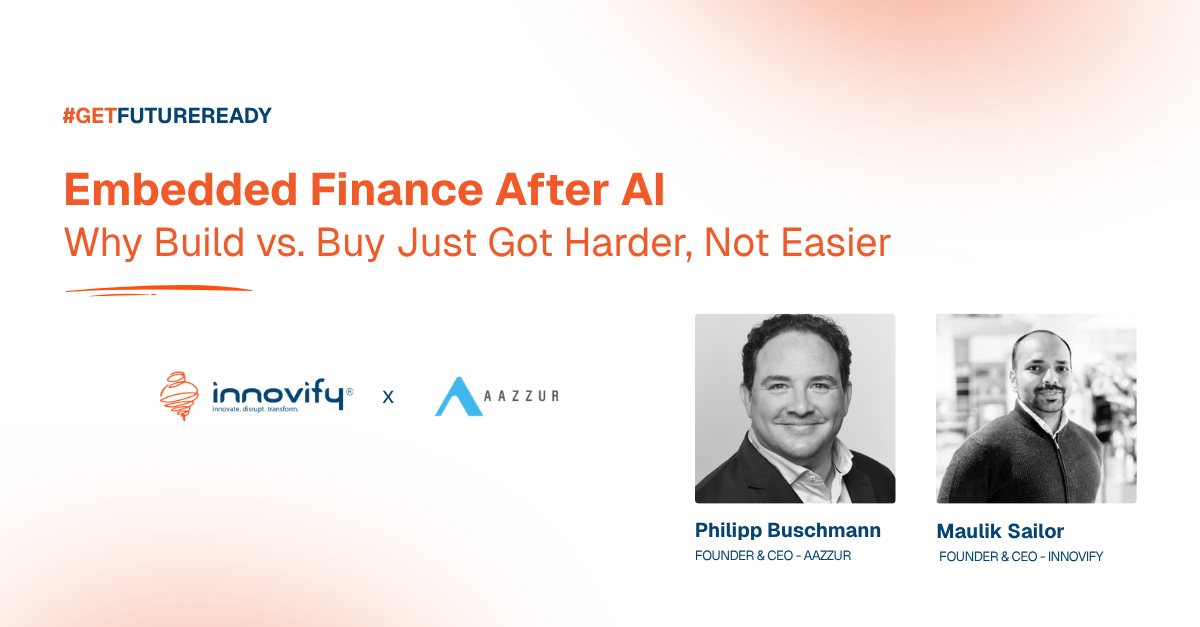
Embedded Finance After AI: Why Build vs. Buy Just Got Harder, Not Easier
Most software arguments about embedded finance are already settled.
A team equipped with modern AI tooling can prototype a wallet, a lending journey, or a branded card experience in weeks rather than quarters. Five years ago, that was the difficult part. Today, it is increasingly the easy part.
The hard part is everything that begins after the prototype works.
That was one of the central themes explored in Innovify's GetFutureReady podcast episode with Philipp Buschmann, Founder and CEO of AAZZUR.
Buschmann has spent nearly three decades building financial technology businesses and helping organisations launch financial products at scale. His perspective is direct: AI has dramatically reduced the cost of software creation, but financial services were never primarily a software problem. They were a regulation, governance, and trust problem wearing a software costume.
That distinction matters more than ever because organisations are now facing a different version of the build-vs-buy decision. The question is no longer whether something can be built. The question is whether it should be built, operated, governed, and maintained internally.
For businesses evaluating embedded finance strategies today, that changes everything.
The Conversation Behind This Perspective
The ideas in this article originate from a discussion between Innovify Founder and CEO Maulik Sailor and Philipp Buschmann on the GetFutureReady podcast.
The conversation examined:
- AI's impact on financial product development
- The future of embedded finance
- Agentic commerce and AI-driven transactions
- Governance requirements for regulated environments
- How organisations should approach build-vs-buy decisions in the AI era
The discussion is particularly relevant because Innovify and AAZZUR recently partnered to help organisations accelerate the delivery of AI-native financial products by combining AAZZUR's embedded finance infrastructure with Innovify's product engineering and AI expertise.
What Embedded Finance Actually Means
Embedded finance refers to the integration of financial services such as payments, wallets, lending, insurance, cards, or banking capabilities directly into a non-financial product or platform.
Examples include:
- A marketplace issuing branded payout cards
- A retailer offering financing at checkout
- A SaaS platform embedding payment capabilities
- A logistics company providing insurance inside its booking workflow
- An eCommerce platform launching digital wallet functionality
The objective is not to become a bank.
The objective is to make financial services available precisely when and where customers need them.
That creates a critical strategic question:
Which parts of the stack should be owned, and which should be sourced from specialised partners?
Three Insights From Philipp Buschmann
1. Building Software Is No Longer the Bottleneck
According to Buschmann, modern AI-assisted development fundamentally changes what small teams can accomplish.
Interfaces can be generated faster.
Integrations can be developed faster.
Testing can be accelerated.
Documentation can be created faster.
The cost of converting an idea into working software continues to fall.
However, reducing software-development effort does not eliminate the complexity surrounding financial products.
A working demo and a production-ready financial product are not the same thing.
The bottlenecks that remain are:
- Compliance
- Operational readiness
- Risk management
- Customer trust
- Auditability
- Regulatory oversight
Those constraints do not disappear simply because development cycles become shorter.
2. Trust Is a Product Feature
One of the strongest themes from the discussion was that organisations often think about financial products from the wrong perspective.
Product teams frequently focus on:
- Features
- Rates
- Technical capabilities
- Integrations
Customers rarely do.
Customers care about outcomes.
A traveller needing additional spending power cares about immediate access to funds.
A marketplace seller cares about receiving payouts faster.
A consumer cares about completing a transaction without friction.
The underlying financial infrastructure is important, but only because it enables a trusted customer experience.
Organisations that begin with customer journeys typically outperform organisations that begin with product specifications.
3. Compliance Is Becoming a Competitive Advantage
Many businesses still view compliance as a hurdle.
Buschmann's view suggests the opposite.
As AI lowers software-development barriers, compliance, governance, and operational maturity become stronger differentiators.
When every competitor can launch a prototype quickly, the winners become the organisations capable of scaling safely.
That means:
- Clear governance models
- Regulatory readiness
- Audit trails
- Security controls
- Operational resilience
The businesses that treat these as day-one design requirements move faster later because they avoid expensive remediation after launch.
AI Changed the Economics. Not the Responsibility.
AI has undoubtedly shifted the economics of product development.
Through approaches like Innovify's AI Labs, organisations can move from idea to validation significantly faster than before.
But speed alone does not create viable embedded-finance products.
Financial products introduce responsibility.
Someone must still answer questions such as:
- Who carries the licence?
- Who handles compliance obligations?
- Who performs monitoring?
- Who manages disputes?
- Who owns fraud controls?
- Who satisfies regulatory reviews?
- Who maintains audit trails?
These questions determine whether a product can operate at scale.
They are governance questions, not engineering questions.
Build vs. Buy: The Framework That Actually Matters
Historically, build-vs-buy conversations focused on engineering capability.
Today's conversations should focus on operational ownership.
A useful framework is:
Can We Build It?
AI has made this easier.
Should We Build It?
This is where strategy begins.
Can We Govern It?
This is where many initiatives stall.
Can We Scale It?
This is where operational maturity matters.
The organisations making the best decisions are increasingly separating customer-facing differentiation from regulated infrastructure. They maintain ownership of customer experience while leveraging specialised partners for the underlying regulated components.
That model allows businesses to innovate without inheriting unnecessary complexity.
Why Market Behaviour Matters More Than Marketing Claims
One of the most revealing indicators is how the market behaves.
Across financial services, established players continue to acquire infrastructure, capabilities, and regulated assets instead of rebuilding them from scratch.
The reason is straightforward.
Software can be replicated.
Operational maturity cannot.
Licensing histories cannot.
Regulatory relationships cannot.
Years of compliance processes cannot.
As financial products become easier to build, the value of proven infrastructure increases rather than decreases.
That reality explains why many organisations choose a hybrid model rather than pursuing a fully custom build.
Where Agentic Commerce Fits Into the Picture
The podcast also explored the emergence of agentic commerce.
As discussed in Innovify's work around Agentic Commerce & Payments, AI agents are increasingly becoming capable of making purchases, completing workflows, and transacting on behalf of users.
However, agentic capability does not eliminate governance requirements.
In many cases, it increases them.
Any system capable of influencing or initiating financial decisions must be:
- Auditable
- Explainable
- Governed
- Secure
- Accountable
The same risk-management principles that apply to human-driven financial transactions apply equally to AI-driven ones.
Perhaps even more so.
What a Readiness Discussion Should Cover
For leadership teams evaluating embedded finance initiatives in 2026, the most valuable conversation is no longer about APIs.
The conversation should focus on:
Regulatory Scope
Which regulated activities are involved?
Ownership
Who owns outcomes?
Governance
How will decisions be monitored and audited?
Customer Experience
What customer problem is actually being solved?
Infrastructure Strategy
Which capabilities provide differentiation and which represent operational burden?
Answering these questions first usually accelerates delivery later.
Why Innovify and AAZZUR Are Working Together
One of the recurring themes throughout Maulik Sailor's conversation with Philipp Buschmann was that embedded finance success rarely comes from infrastructure alone.
Organisations need both:
- Robust financial infrastructure
- Exceptional customer experience
That alignment is precisely why Innovify partnered with AAZZUR.
AAZZUR provides embedded finance infrastructure designed to accelerate financial product launches.
Innovify helps organisations design, build, launch, and govern AI-native products and customer experiences on top of that foundation.
Together, the focus is simple:
Help businesses launch financial products faster while maintaining the governance, compliance, and operational integrity required for long-term success.
Conclusion
AI did not make embedded finance easier.
It made the software layer cheaper and faster to build.
That only highlights the importance of everything that was never a software problem in the first place:
- Governance
- Compliance
- Operational readiness
- Customer trust
The next generation of embedded finance winners will not be the organisations that build the fastest.
They will be the organisations that understand exactly which parts of the stack are worth owning and which parts are worth sourcing from partners that have already earned the right to operate them at scale.
If you'd like to explore these themes further, watch the full conversation between Maulik Sailor and Philipp Buschmann on the GetFutureReady Podcast.
FAQ
What is embedded finance?
Embedded finance is the integration of financial services such as payments, lending, cards, insurance, or banking functionality directly into a non-financial product or platform.
Has AI made embedded finance easier?
AI has made software development faster and cheaper. It has not significantly reduced the complexity of governance, compliance, licensing, risk management, and customer trust.
Is it better to build or buy embedded finance infrastructure?
Most organisations benefit from a hybrid approach that combines specialised infrastructure partners with ownership of customer-facing experiences and differentiation.
Do companies need a banking licence to launch embedded finance products?
Usually not. Most businesses partner with licensed institutions and embedded-finance providers that handle regulated activities within established compliance frameworks.
What is the biggest embedded finance challenge in 2026?
The biggest challenge is no longer building software. It is governing, operating, and scaling financial products within regulatory and customer-trust requirements.
Where can I learn more about these ideas?
Listen to Innovify's podcast episode with Philipp Buschmann, Founder and CEO of AAZZUR: https://innovify.com/podcasts/building-financial-products-in-the-ai-era


