



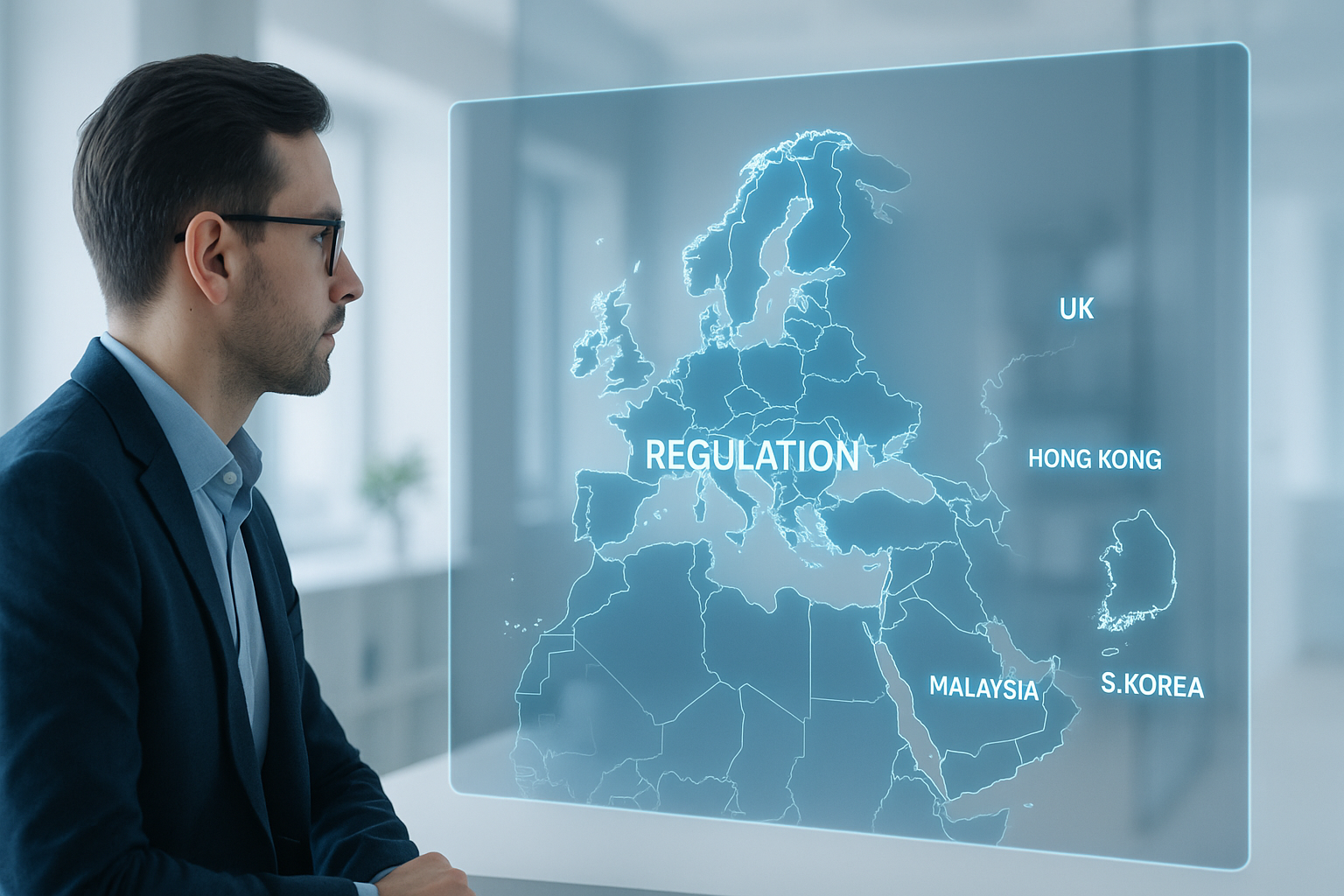
A Practitioner's Five-Region AI-Regulation Briefing: EU, UK, Hong Kong, Malaysia and South Korea Compared
Three independent competitors in the fintech-delivery space have published AI-governance content in the same window this year. That's not a coincidence — it's a category forming in real time, as AI regulation shifts from a background compliance topic to a genuine buying criterion for fintech platforms operating across more than one market. One of those competitors, Vacuum Labs, published a five-region briefing covering the EU, Hong Kong, Malaysia, South Korea and the UK. This article takes the same five-region scope, but anchors it in something none of that content had: a confirmed, dated UK regulatory signal — the FCA CEO's own 24 June 2026 speech, in which the FCA disclosed it is exploring agentic AI as a wholesale-market "first responder," alongside the Bank of England governor's systemic-risk warning on AI in financial services. The rest of this briefing is a practitioner's framework, not a legal audit — and we say exactly where that line sits.
Why a five-region briefing, and why now
Governance and compliance content is becoming a genuine differentiator in how fintech-delivery partners compete for attention, not just a defensive legal necessity. That's worth naming plainly: when multiple delivery partners start publishing comparative regulatory content in the same period, it signals that buyers are actually asking for it — multi-market fintech platforms are under real pressure to understand which AI-regulation regime applies where, and how the regimes differ, before they can make confident product and engineering decisions.
For a Series A-D fintech platform expanding across two or three of these five markets, that pressure is not abstract. A feature that's compliant to ship in one jurisdiction can require a materially different disclosure, human-oversight, or audit-trail posture in another. Getting that wrong late in a product cycle is expensive — rework at the architecture level, after a feature is already live with real customers, costs considerably more than designing for the stricter of two regimes from the outset. Getting a structured way to think about it early, before the engineering roadmap is locked, is the point of this briefing.
How to read this comparison — and where its limits are
Before the detail: this is a framework for thinking about multi-jurisdiction AI regulation, not a substitute for legal advice in any of the five markets it covers. AI-regulation regimes are moving targets, and the specific provisions in each jurisdiction change faster than any single article can track reliably. What a practitioner briefing like this can responsibly do is give your team the right dimensions to compare across markets, go deep where we have strong, dated, attributable evidence (the UK), and tell you plainly where you need to verify current local requirements with qualified local counsel rather than take a blog post's word for it. That's the standard we're holding this briefing to.
The five dimensions that actually differ across regimes
Rather than trying to summarise five separate bodies of live regulatory text in one article, it's more useful — and more durable as those regimes keep evolving — to compare them along the dimensions that consistently matter to a fintech engineering and product team:
- Risk-tiering approach — does the regime classify AI use cases by risk level and apply different obligations accordingly, or apply a more uniform standard across use cases?
- Explainability and disclosure expectations — what must a firm be able to explain to a regulator, an auditor, or a customer about how an AI-assisted decision was reached?
- Regulatory sandboxes and pilot pathways — is there a formal route to trial an AI capability under supervision before full compliance obligations apply?
- Which body has oversight — a single named regulator, multiple overlapping bodies, or a general-purpose data/AI authority sitting alongside financial-services-specific rules?
- Enforcement posture — principle-based and outcomes-focused, or more prescriptive and rules-based in practice?
Score your own use case against these five dimensions in each market you operate in, and you have a working comparison — one that stays useful even as the specific provisions underneath each dimension continue to shift.
The UK column, in detail
The UK is where we have the strongest, most current evidence, so it's worth treating in depth rather than at the same general level as the other four markets. Two signals stand out from 2026. First, the Bank of England governor issued a systemic-risk warning specifically addressing AI's role in financial services — a signal that UK prudential regulators are now treating AI adoption as a financial-stability question, not only a conduct or data-protection one. Second, and more specifically, the FCA's chief executive gave a confirmed speech on 24 June 2026 in which the FCA disclosed that it is actively exploring the idea of agentic AI acting as a "first responder" in wholesale markets — language that signals UK regulators are thinking seriously about where autonomous AI systems might sit inside regulated market infrastructure, not just inside back-office processes.
Read against the five dimensions above, the UK's posture continues to lean principle-based and outcomes-focused rather than prescriptive — regulators articulating expectations and risk areas rather than issuing a single rigid AI-specific statute. For a fintech team, that generally means the obligation sits with the firm to demonstrate it has reasoned carefully about explainability, human oversight and risk management, rather than to tick off a fixed checklist. The FCA's own exploration of agentic AI inside wholesale-market infrastructure is a useful signal of where that reasoning is heading next: oversight of autonomous systems acting inside, not just alongside, regulated workflows.
EU, Hong Kong, Malaysia and South Korea — what to verify locally
For the other four markets in this briefing, we're deliberately not asserting specific current provisions as fact — regulatory text in each of these jurisdictions is actively evolving, and a confident-sounding summary that's stale by the time you read it is worse than no summary at all. What we can say reliably is where each sits on the dimensions framework above, and what your team should go and verify before relying on it:
- EU — publicly known for taking a risk-tiered approach to AI regulation generally, which is a meaningfully different starting posture from the UK's principle-based model. Verify current risk-tier classification and disclosure obligations for your specific use case with EU counsel.
- Hong Kong — financial-services AI oversight sits alongside the territory's existing financial regulators and data-protection framework; verify current guidance on AI-assisted decisioning and any sector-specific expectations with local counsel.
- Malaysia — AI governance is developing alongside existing financial-services and data-protection regulation; verify the current state of sector-specific AI guidance, including any sandbox routes, with local counsel.
- South Korea — a market with an active, fast-moving AI policy agenda; verify the current status of AI-specific legislation and its interaction with existing financial-services rules with local counsel before relying on any summary, including this one.
The common thread: every one of these four regimes is moving, and the dimensions framework above is what should travel with you from market to market, even as the specific answers under each dimension change.
What "good" looks like in practice, regardless of jurisdiction
Even without asserting the specific provisions of each regime, there's a consistent shape to what a well-governed AI capability looks like across all five markets, because the underlying regulatory instinct — explainable decisions, documented human oversight, traceable audit trails — shows up everywhere in some form, even where the specific legal mechanism differs. In practice, that means: every AI-assisted decision that could affect a customer or a counterparty should produce a reconstructable record of what the system did and why; a named human role should be accountable for reviewing or overriding that decision where it matters; and that record should be structured well enough that producing it for a regulator, in any of these five markets, is a retrieval exercise rather than a forensic one.
Building that posture once, at the architecture level, is considerably cheaper than retrofitting it market by market as each jurisdiction's specific requirements firm up. That's the practical argument for treating this as an engineering and product decision now, rather than waiting for each of the five regimes to finish settling before acting.
A practical checklist for multi-market fintech teams
However many of these five markets your platform touches, the same working questions apply before you ship an AI-assisted capability into a new jurisdiction:
- Which risk tier would a regulator in this market likely place this use case in, and does that change what you need to document?
- Can you explain, to a regulator's satisfaction, how this AI-assisted decision was reached — and is that explanation captured automatically or does it require manual reconstruction?
- Is there a sandbox or supervised-pilot route available in this market, and would using it reduce your risk versus going straight to full launch?
- Which specific body (or bodies) would actually enforce against you here, and have they published anything AI-specific in the last twelve months?
- Does your audit trail and human-oversight model meet the more demanding of the markets you operate in, so you're not maintaining a different compliance posture per jurisdiction?
Where Innovify fits
This kind of multi-jurisdiction reasoning is exactly the terrain Innovify's AI Labs team works in alongside fintech clients building AI-assisted products across more than one regulatory regime — not as a substitute for local legal advice, but as the engineering and product partner that helps translate "which dimension applies here" into an actual build: the audit trails, explainability tooling, and human-oversight checkpoints that hold up regardless of which of these five regimes your next market expansion lands in. The brief above is the kind of structured starting point that AI Labs engagements build on, rather than a one-off legal summary.
FAQ
Which AI regulations apply to a fintech operating across the UK, EU, Hong Kong, Malaysia and South Korea?
Each market has its own evolving AI-governance posture, generally layered on top of existing financial-services and data-protection regulation. Rather than a single applicable rule, compare your use case across five dimensions — risk-tiering, explainability expectations, sandbox availability, oversight body, and enforcement posture — in each market, and verify current specifics with local counsel.
What did the FCA say about agentic AI in 2026?
In a confirmed speech on 24 June 2026, the FCA's chief executive disclosed that the FCA is exploring agentic AI acting as a "first responder" in wholesale markets — a signal that UK regulators are considering where autonomous AI systems might sit inside regulated market infrastructure.
Is the UK's approach to AI regulation stricter than the EU's?
The UK has generally taken a more principle-based, outcomes-focused approach, while the EU is publicly known for a risk-tiered regulatory structure — a different starting posture rather than simply "stricter" or "looser." Teams should verify current specifics for their use case in each market rather than assume one regime is uniformly more demanding.
Why are multiple fintech-delivery partners publishing AI-regulation content right now?
Governance and compliance content is emerging as a genuine competitive differentiator because multi-market fintech buyers are actively asking which AI-regulation regime applies where — a signal that comparative regulatory literacy has become a real buying criterion, not just a defensive legal topic.
What's the most practical first step for a fintech team expanding into a new one of these five markets?
Score your planned AI use case against the five comparison dimensions — risk-tiering, explainability, sandbox routes, oversight body, and enforcement posture — for that specific market, and verify the current answers with qualified local counsel before relying on any general summary, including this one.
Conclusion
A five-region AI-regulation comparison is only as useful as its honesty about what it actually knows. The UK column in this briefing is grounded in confirmed, dated, attributable evidence — the FCA CEO's 24 June 2026 speech and the Bank of England governor's systemic-risk warning. The other four markets are treated as what they are: fast-moving regimes that deserve a durable comparison framework rather than a confident-sounding summary of provisions that may already have changed. For a multi-market fintech team, that framework — and the discipline to verify specifics locally before relying on it — is the actual deliverable here.


