



Why UK Retailers' Next AI Win Is Sitting in the Warehouse, Not the App
Over the past two years, AI conversations in retail have been dominated by customer experience.
Personalised recommendations.
AI shopping assistants.
Conversational commerce.
Dynamic pricing.
Retail leaders have understandably focused on what customers can see.
The more interesting opportunity is increasingly found in what customers cannot. The warehouse.
Most retailers believe the next competitive advantage will come from creating better digital experiences.
The reality is that many digital experiences are already good enough.
The bigger challenge is ensuring the right product is available, in the right place, at the right time, at the right cost.
No AI-powered shopping journey can compensate for an inventory problem.
No recommendation engine can sell an out-of-stock product.
No loyalty programme can offset inconsistent fulfilment.
As economic pressures continue to squeeze margins across UK retail, operational performance is becoming a strategic differentiator again.
And AI is quietly moving from the storefront to the supply chain.
Retail's AI Conversation Is Focused on the Wrong End of the Business
Consumer-facing AI generates attention.Operational AI generates value.
Retailers naturally gravitate towards visible innovation.Customers notice a virtual shopping assistant.
Investors notice a new digital experience. Leadership teams can easily demonstrate these initiatives.
Warehouse optimisation lacks the same appeal.
It is harder to showcase. Harder to market. Harder to explain in a board presentation.
Yet this is often where the economics become compelling.
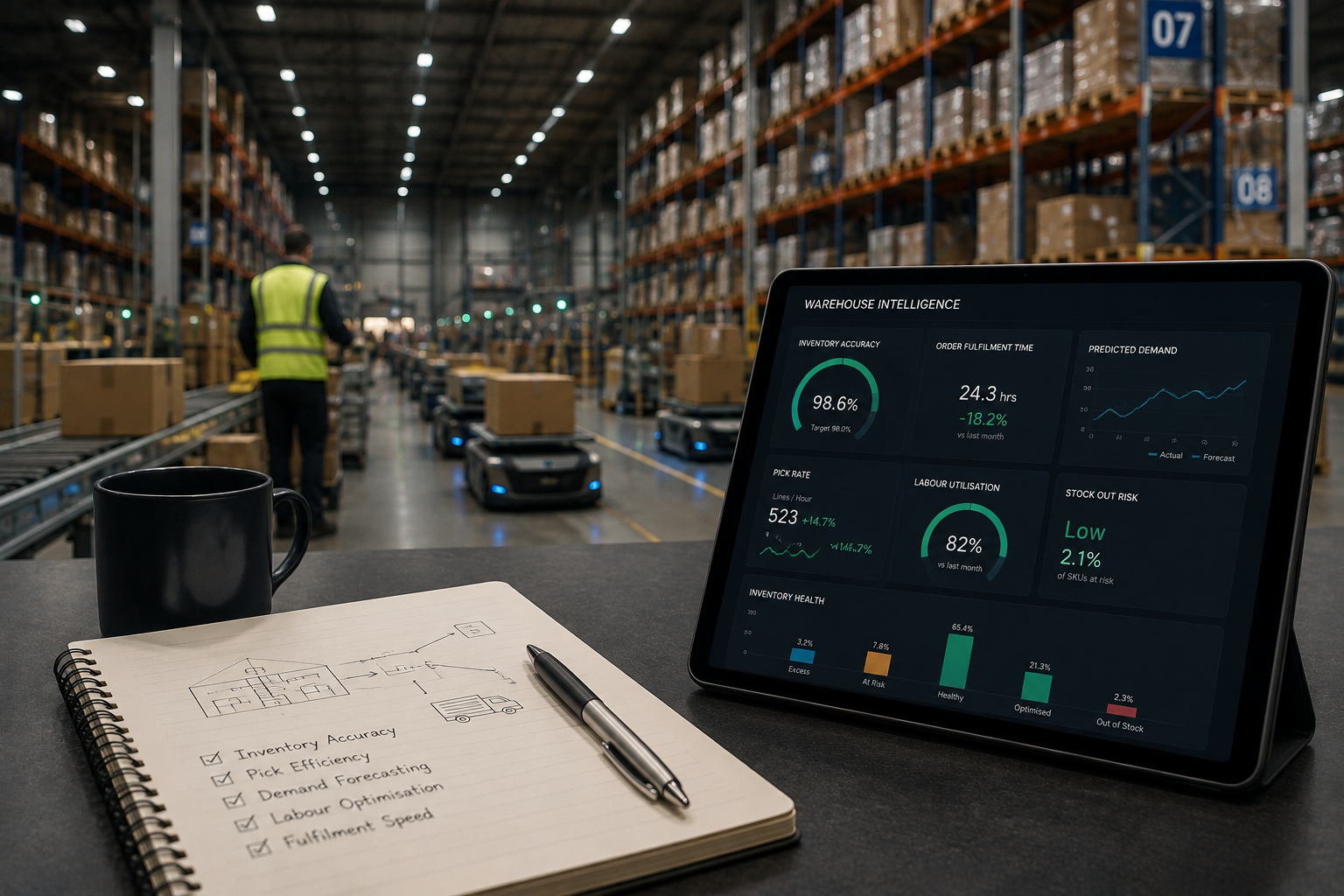
A one percent improvement in inventory accuracy can create significant downstream impact across forecasting, fulfilment, customer satisfaction, markdown reduction, and working capital efficiency.
The challenge is not attracting consumers to buy. The challenge is ensuring operations can support demand profitably.
That distinction is becoming increasingly important.
The Inventory Problem Has Become a Profitability Problem
Retail has always been an inventory business. AI has not changed that reality.
If anything, it has amplified it.
Consumer demand is becoming harder to predict.
Product lifecycles are shortening.
Promotional cycles are accelerating.
Channel complexity continues to grow.
A retailer today may need to manage inventory across:
- Physical stores
- Ecommerce platforms
- Marketplaces
- Click-and-collect operations
- Third-party fulfilment networks
- International markets
Every channel introduces additional uncertainty. Every uncertainty increases forecasting complexity.
Traditional planning approaches struggle to keep pace. The result is familiar.
Excess inventory in some locations. Stock shortages in others.
Capital tied up in products moving too slowly. Lost revenue from unavailable items.
The financial impact is often invisible until margins begin to erode.
As a result, retailers are investing more heavily in AI demand forecasting capabilities. Unlike traditional forecasting models, AI-powered approaches can analyse a broader range of variables simultaneously, helping organisations identify emerging demand patterns earlier and respond before operational issues affect revenue or customer experience.
The greatest value emerges when AI demand forecasting is connected directly to replenishment and inventory management processes. Forecasting becomes more than a planning exercise. It becomes an operational capability that helps retailers align stock levels with real-world demand.
Why Rules-Based Inventory Planning Is Reaching Its Limits
For years, inventory optimisation relied on deterministic models.
Historical sales data produced forecasting assumptions.
Thresholds triggered replenishment actions.
Exceptions were manually reviewed.
The approach worked reasonably well in stable environments.
Modern retail is no longer stable.
Consumer behaviour changes rapidly.
External events influence demand unexpectedly.
Seasonality becomes less predictable.
Social commerce introduces sudden spikes.
Economic uncertainty reshapes purchasing patterns.
Rules-based systems were designed for predictability. Today's retail environment is defined by variability.
This is where many organisations begin to encounter an operational ceiling.
Adding more rules does not necessarily improve outcomes. It often increases complexity.
The model becomes harder to manage while accuracy continues to decline.
The Shift From Forecasting to Continuous Decision-Making
Many retailers still view inventory management as a forecasting exercise.
The most advanced retailers increasingly treat it as a decision-making challenge.
The distinction matters.
Forecasts provide predictions.
Decisions create outcomes.
AI enables organisations to move beyond historical trend analysis and towards continuous optimisation.
Rather than asking: "What demand do we expect next month?"
Leading retailers are asking: "What action should we take right now?"
This simple shift fundamentally changes operational performance.
Inventory becomes dynamic.
Replenishment becomes adaptive.
Risk becomes more visible.
Decisions become faster.
The value comes not from predicting perfectly. The value comes from responding more effectively.
This is where AI inventory optimisation is creating measurable value for retailers. Rather than relying solely on historical forecasts, AI systems continuously evaluate changing demand signals, inventory levels, supplier performance and fulfilment constraints to recommend the most effective operational response. The objective is not simply better prediction. It is better inventory decisions.
For UK retailers, AI inventory optimisation can improve product availability, reduce stockouts and support more efficient inventory allocation across stores, warehouses and fulfilment channels. As retail environments become increasingly volatile, the ability to optimise inventory continuously is becoming a significant competitive advantage.
The Warehouse Is Becoming a Strategic Intelligence Hub
Traditionally, warehouses were execution environments.
Goods arrived.
Goods were stored.
Goods were shipped.
Success was measured through efficiency. Today, the warehouse is becoming something different.
A source of operational intelligence.
Every movement generates data.
Every fulfilment cycle creates signals.
Every inventory adjustment reveals patterns.
When combined with AI, these signals become strategic assets.
Retailers gain deeper visibility into:
- Inventory velocity
- Fulfilment bottlenecks
- Demand fluctuations
- Supplier reliability
- Picking performance
- Operational risk
The warehouse evolves from a cost centre into a decision engine. This represents a significant shift in how retail leaders should think about their operational infrastructure.
This evolution is driving increased interest in AI inventory management across the retail sector. By combining operational data, inventory intelligence and automated decision support, retailers can improve visibility across their supply chains while reducing the manual effort traditionally associated with inventory planning.
Modern AI inventory management systems enable faster stock replenishment decisions, more accurate inventory positioning and improved control of working capital. These benefits are becoming increasingly important as retailers seek new ways to improve profitability without compromising customer experience.
UK Retailers Face a Particularly Complex Environment
The UK retail market presents unique challenges. Labour costs continue to influence operational planning.
Consumer expectations around delivery speed remain high. Economic uncertainty continues to shape purchasing behaviour.
At the same time, retailers must maintain resilience across increasingly complex supply chains. Many organisations are discovering that incremental improvements are no longer sufficient.
They need greater operational adaptability. This is where AI creates a meaningful advantage.
Not because it automates warehouses entirely. Because it improves the quality and speed of decisions throughout the operation.
The impact is cumulative.
Small improvements across forecasting, replenishment, routing, and inventory allocation compound into significant commercial outcomes.
Why Customer Experience Still Depends on Warehouse Excellence
Retail leaders often separate customer experience and operations.
Customers do not.
The customer sees one experience.
A product is either available or unavailable.
A delivery arrives on time or it does not.
A return is processed efficiently or it is not.
Behind every customer interaction sits a chain of operational decisions.
The warehouse influences many of them. This creates an important strategic insight.
The next generation of customer experience improvements may not originate in digital channels.
They may originate in operational infrastructure. The brands winning customer loyalty are increasingly the brands executing consistently behind the scenes.
AI Creates Compounding Advantages Across Retail Operations
Many AI investments focus on isolated use cases.
A chatbot.
A recommendation engine.
A search optimisation tool.
These initiatives can deliver value. Their impact is often localised.
Warehouse intelligence creates broader effects.
Improved forecasting supports inventory optimisation.
Inventory optimisation improves fulfilment.
Fulfilment improves customer satisfaction.
Customer satisfaction improves retention.
Retention improves profitability.
Each improvement strengthens another.
This is why operational AI frequently generates more durable returns than customer-facing experimentation.
The benefits compound across the organisation.
Platform Thinking Separates Leaders From Followers
Many retailers approach AI as a collection of projects. The leaders approach AI as infrastructure.
That distinction increasingly determines outcomes. Project-driven organisations deploy individual solutions.
Platform-driven organisations create reusable capabilities. They establish shared data foundations.
Common governance frameworks. Integrated decision systems. Scalable AI engineering functions.
As new opportunities emerge, deployment becomes faster and less disruptive.
AI shifts from an experiment to an organisational capability.
Why AI Inventory Management Is Becoming a Strategic Priority
For many retailers, inventory represents one of the largest investments on the balance sheet. Small improvements in inventory performance can therefore create disproportionate commercial benefits. This is one reason AI inventory management is becoming a strategic focus for organisations looking to strengthen profitability and operational resilience.
By combining AI-driven demand forecasting, inventory optimisation and adaptive replenishment processes, retailers can improve stock availability, reduce excess inventory and unlock working capital. While customer-facing AI continues to attract attention, inventory management is increasingly emerging as one of the highest-value applications of AI within retail operations.
This is why many retailers are investing in AI Engineering and innovation environments such as Innovify's AI Labs, allowing them to validate use cases while simultaneously building the foundations needed for enterprise-scale adoption.
For organisations seeking to develop intelligent operational capabilities, dedicated AI/ML development expertise is increasingly becoming a strategic requirement rather than a technical luxury.


